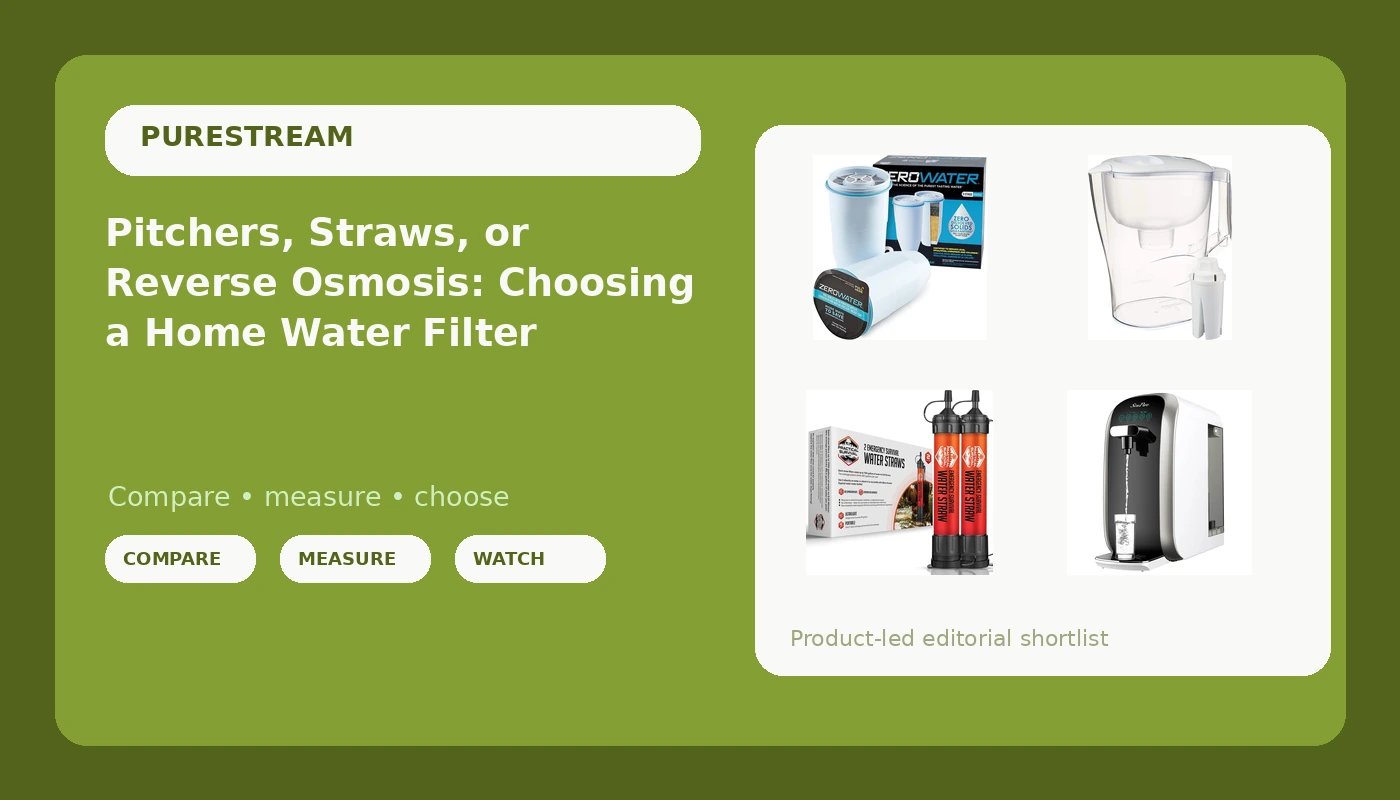
Most people do not set out to buy a water filter. They set out to make a glass of water taste like something their kid will finish, and they end up staring at a shelf of pitchers, cartridges, and countertop machines that all promise roughly the same thing. Sorting through home water filter options honestly means figuring out what problem you actually have first, because a pitcher, a replacement cartridge, an emergency straw, and a countertop reverse osmosis unit are not competing for the same job. They sit at different points on the same spectrum, and the point you pick should depend on what is in your water and where you need the water to come from.
Related: What a Water Filter Really Costs Per Gallon →
Quick answer
Match the device to the contaminant and to the location, not to the marketing. A carbon pitcher like the Amazon Basics 10-cup model is a taste and odor tool that takes widely available Brita-style cartridges. The ZeroWater two-pack is a replacement cartridge for people already running a ZeroWater system who specifically want dissolved solids and PFOA/PFOS addressed, and who accept more frequent cartridge changes as the trade. The Practical Survival straws are emergency gear for a pack, a trunk, or a go bag, not a kitchen appliance. The SimPure Y7P-BW is the only countertop reverse osmosis unit here, and the only one built to push dissolved solids toward near zero without any under-sink plumbing work.
Four useful options
| Model | Best fit | What stands out |
|---|---|---|
| Amazon Basics 10-Cup Water Filter Pitcher Compatible with Brita Filters | Everyday fridge water and basic taste improvement | 10-cup capacity and compatibility with a widely stocked cartridge family |
| ZeroWater Official Replacement Water Filter Removes PFOA/PFOS 2-Pack | Existing ZeroWater owners who want dissolved solids addressed | Two cartridges per pack and a manufacturer-stated PFOA/PFOS reduction claim |
| Practical Survival Reusable Emergency Water Filter Straws, 2-Pack | Emergency kits, hiking packs, and vehicle storage | Two reusable straws in a compact format built for portable use |
| SimPure Y7P-BW UV Countertop Reverse Osmosis Water Filter, 5 Stage RO | Households that want low dissolved solids without plumbing | Five-stage RO treatment plus a UV stage in a countertop footprint |
The everyday pitcher: Amazon Basics 10-Cup Water Filter Pitcher Compatible with Brita Filters
The important thing to understand about any carbon pitcher is what it does not do. Standard carbon filtration is certified under NSF/ANSI 42, which covers aesthetic claims like chlorine taste and odor and particulate reduction. It is not a lead filter, not a PFAS filter, and not a dissolved solids filter unless the specific cartridge carries a separate certification number saying so. That is not a knock on the pitcher. If your complaint is that tap water smells like a swimming pool and your kid will not drink it, a pitcher is a cheap and effective answer. If your complaint is a lead service line or a contaminated well, a pitcher is the wrong tool and no amount of clever marketing changes that. The other thing to price out is the cartridge. Pitcher hardware is inexpensive; the cartridges are where the money goes over a year, and the compatibility here means you have options when one brand goes out of stock.
The replacement cartridge: ZeroWater Official Replacement Water Filter Removes PFOA/PFOS 2-Pack
ZeroWater's whole pitch is dissolved solids. Where a carbon-only pitcher mostly swaps chlorine for nothing, a ZeroWater cartridge is doing more work, and that work is visible in how quickly it wears out. Ion exchange media has a finite capacity, and once it is exhausted, contaminants start passing through. That is what breakthrough means, and it is the reason the cartridge, not the pitcher, is the real product. Two practical consequences follow. First, buy the cartridge the system was certified with, because a certification listing applies to a specific system and its specific replacement, not to the brand name in general. Second, if you own a ZeroWater pitcher, budget by cost per gallon rather than by sticker price. Divide the cartridge cost by the gallons it actually treats in your kitchen and compare that number to every other option on this page. You may be surprised which one is cheapest over three years.
The emergency option: Practical Survival Reusable Emergency Water Filter Straws, 2-Pack
It is worth being blunt about what a straw is and is not. It is not a kitchen filter, it will not fill a pitcher, and it will not give you a glass of cold water to put on the table. What it does is give you a way to drink from a questionable source when the alternative is not drinking. Straws are also limited by their media, which means they have a rated service life and a point where they stop being protection and start being a plastic tube. If you buy a two-pack, keep one in the house and one somewhere you will actually have it, which for most people means the car. Emergency gear that lives in a closet is decoration. Emergency gear that lives in the vehicle is a plan.
The countertop machine: SimPure Y7P-BW UV Countertop Reverse Osmosis Water Filter, 5 Stage RO
Reverse osmosis works by forcing water through a membrane that rejects dissolved material, which is why it drops TDS toward zero in a way no pitcher can match. That is a real benefit if you have a specific dissolved contaminant concern, and it is also the source of the standard complaints. RO strips minerals along with everything else, so some people dislike the flat taste and buy a remineralization stage to put calcium and magnesium back. RO also produces concentrate, meaning it uses more feed water than it delivers as finished water, which matters if you are on a well or watching a water bill. And the treatment train is only as good as its maintenance: a five-stage system has multiple cartridges on different replacement intervals, and a UV lamp has its own service life. This is a machine you maintain, not a pitcher you refill. If you want it, go in knowing the annual consumable cost before the first cartridge ever needs changing.
Prices and availability may change. Confirm the listing details before you buy. Nothing here states a current price, rating, stock status, or measured result as fact.
What the certification numbers actually cover
The single most useful habit you can build is reading the standard number instead of the adjective. NSF/ANSI 42 covers aesthetic effects: chlorine taste and odor, and particulate reduction. NSF/ANSI 53 covers health effects, including lead, cysts, volatile organic compounds, and specific contaminants such as PFOA and PFOS. NSF/ANSI 58 covers reverse osmosis systems. NSF/ANSI 401 covers emerging compounds like certain pharmaceuticals and herbicides. A label that says "tested to NSF standards" without a standard number and a listed model is a sentence, not a certification. A certification is issued to a specific system, and in many cases the replacement cartridge has to carry the same listing. That is why swapping in a cheaper cartridge for a certified system can quietly undo the thing you paid for. If a product claims to remove "everything," that is a sign the claim has not been narrowed to something testable.
How to compare these four before you buy
- Name the problem in one sentence. Taste and odor, dissolved solids, a known contaminant, or emergency access. Each points at a different product on this list.
- Check the certification listing for the exact model, and check whether the replacement cartridge carries it too.
- Price the consumables, not the hardware. Divide cartridge or filter cost by the gallons it treats to get cost per gallon.
- Look at capacity and flow against your actual daily use. A system that makes you wait is a system you will stop using.
- Decide where it lives before you buy it. Fridge door, counter, under sink, or vehicle. Location decides the format more often than performance does.
Practical guidance
- If you have never tested your water, start there. A TDS meter is a cheap first reading, and a certified lab panel is what actually tells you about lead and other health contaminants.
- Buy the cartridge the system was certified with, and write the install date on it with a marker so the schedule is visible instead of remembered.
- Keep one spare cartridge or filter set on hand. Replacement schedules are easier to keep when a backup is already in the cabinet.
- Store emergency straws where you would reach for them under stress, which usually means the car or the go bag rather than a shelf in the basement.
- Rinse and run any new filter through its initial flush before you judge the taste. First-run water is not representative.
Which option should you choose?
Choose the Amazon Basics 10-Cup Water Filter Pitcher Compatible with Brita Filters when your water is safe and your problem is taste, odor, and getting cold water into a kid's hands cheaply, with cartridges you can buy anywhere. Choose the ZeroWater Official Replacement Water Filter Removes PFOA/PFOS 2-Pack when you already run a ZeroWater system and want dissolved solids and PFOA/PFOS addressed, accepting more frequent cartridge changes and a higher cost per gallon as the price of that performance. Choose the Practical Survival Reusable Emergency Water Filter Straws, 2-Pack when the goal is drinking water during an outage, a hike, or a roadside emergency, not filling a glass at dinner. Choose the SimPure Y7P-BW UV Countertop Reverse Osmosis Water Filter, 5 Stage RO when you want membrane-level dissolved solids reduction, a UV stage, and no plumber, and you are ready to maintain a multi-cartridge system on a schedule.
One caveat applies to all four. Manufacturer claims describe what a product was designed and tested to do, and certification listings describe a specific model configuration. Neither tells you what is in your particular water. If you have a known contaminant issue, treat the certification as the floor, not the ceiling, and confirm with your own lab results before you rely on any single device.
The bottom line
These four products are not ranked against each other because they do not do the same job. A Brita-compatible pitcher buys you better-tasting cold water for very little. A ZeroWater cartridge pack buys you dissolved solids reduction and a cartridge bill that reflects it. A pair of filter straws buys you a way to drink when the normal supply is gone. A countertop reverse osmosis unit buys you the lowest dissolved solids of the group and the most maintenance of the group. Pick the problem first, then pick the product, then do the only math that really matters: cost per gallon over the life of the system, not the price of the box.