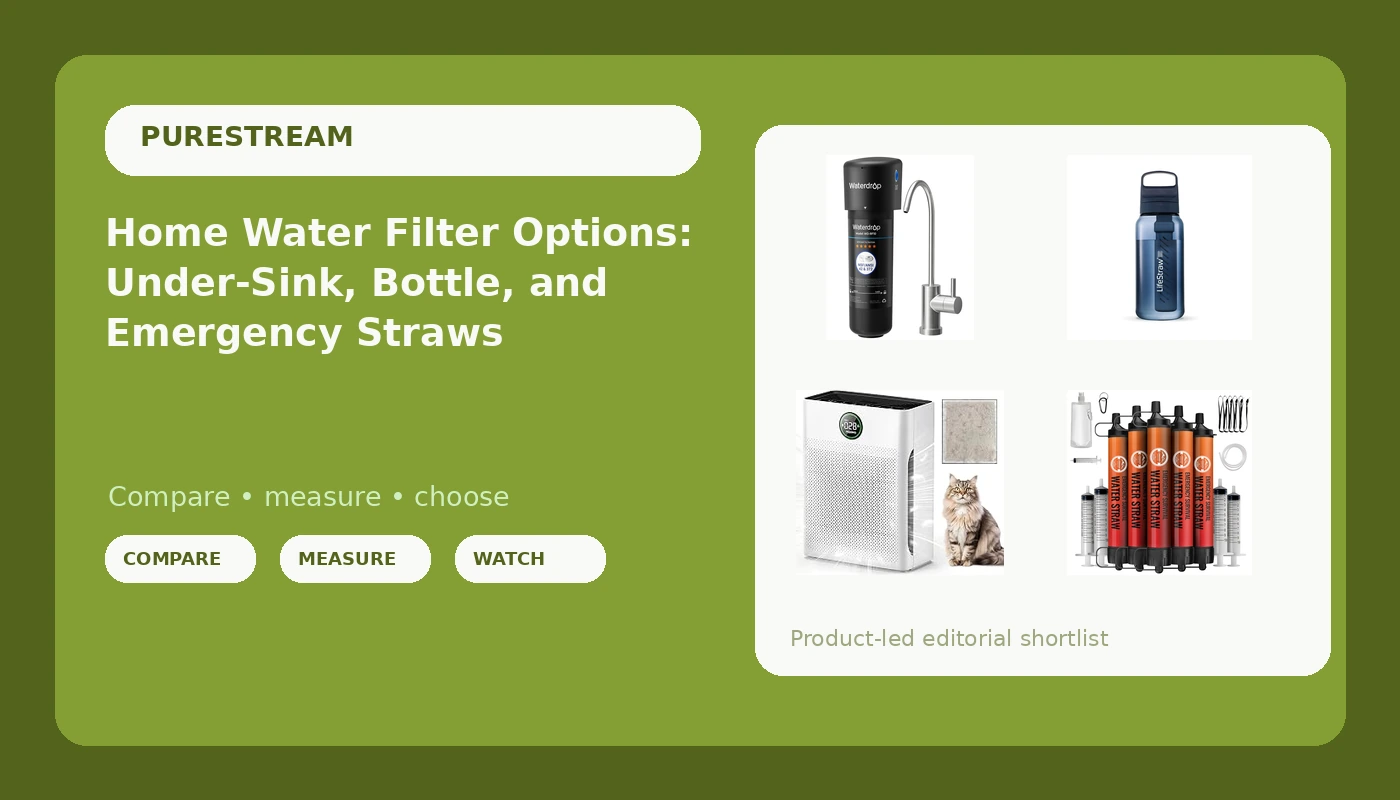
If you have ever stood in your own kitchen with a glass under the tap, waiting for the water to stop smelling like a swimming pool, you already know why people start shopping for home water filter options. The problem is usually not that the water is dangerous. More often the water is unpleasant, or a line in the utility's annual report mentioned a number you did not like, or a kid simply refuses to drink it. The hard part is matching the fix to the problem. An under-sink system with its own faucet solves a different job than a filter bottle you carry to the gym, and both solve a different job than a straw you keep in a hiking pack for the day something goes wrong. What follows is a plain look at four products, what each one is built to do, and which numbers on the box deserve your attention.
Related: How to Read a Water Filter Spec Sheet →
Quick answer
The right pick depends on where you drink the water. An under-sink system with a dedicated faucet is the practical choice for the kitchen you use every day, because it treats water at the point where you fill glasses, kettles, and cooking pots. A filter bottle covers drinking away from home, a pack of straw filters covers camping and emergency kits, and a room air purifier is a separate purchase that addresses air rather than water. None of these is a substitute for a laboratory test if you have a specific contaminant concern. They reduce what their manufacturers list and certify, and they do not do more than that.
4 useful options
| Model | Best fit | What stands out |
|---|---|---|
| Waterdrop 10UB Under Sink Water Filter System with Dedicated Faucet | A kitchen where you want filtered water at the tap | Under-sink design that feeds its own dedicated faucet |
| LifeStraw Go Series 1L Aegean Sea | Daily drinking away from the kitchen | BPA-free bottle with a built-in filter described as removing bacteria, parasites, and microplastics |
| Straw Water Filter 5 Pack | Camping, hiking, and emergency kits | Five individual straw filters in a single pack |
| MOOKA Air purifier PR1 (White) | Rooms where pets, dust, and odors collect | Washable filter with a PM2.5 display and air quality sensor |
The under-sink pick: Waterdrop 10UB Under Sink Water Filter System with Dedicated Faucet
An under-sink system is the category where the purchase price matters least. The filter is the real price, and the honest way to compare two systems is cost per gallon: take the cartridge price, divide it by the rated gallon capacity, and you have a number you can hold next to a competitor's. Two other specs decide whether you will actually like the thing. The first is flow rate, which is often quoted at the beginning of a cartridge's life and drops as the media loads up; a rating taken at gallon one tells you very little about month four. The second is what the cartridge is certified to reduce. A system can be excellent at chlorine taste and odor and still do nothing measurable for lead. Those are different jobs, and the label should tell you which one you are buying.
The everyday bottle: LifeStraw Go Series, 1L Aegean Sea
Bottle filters of this type work on a different principle than a pitcher or an under-sink cartridge. They typically rely on a fine membrane that physically blocks particles and microorganisms rather than on carbon adsorption, which is why they are good at the biological side of the problem and largely indifferent to dissolved metals and minerals. If you fill one with hard water, the water will still be hard. That is not a flaw, it is the design. The trade-off is that a membrane has a rated volume and a care routine, and a bottle that sits in a hot car between trips is not doing you any favors. Used as intended, on the go, it solves a problem no kitchen system can reach.
The emergency pack: Straw Water Filter 5 Pack
Straw filters are the piece of gear people buy after one bad experience and then forget about until they need it. That is fine, as long as you understand what they are for. A straw is a drinking device, not a treatment system: it filters what you pull through it, one mouthful at a time, and it is not going to help you fill a pot for cooking or a bottle for a group. The practical questions are how many people you are packing for and how the straws will be stored. Heat, freezing, and long storage without use are the enemies of any membrane, so a straw that rides around in a hot trunk for three summers is not the same tool as one kept in a cool bin. Buy the five pack, split it across the places you actually go, and replace on the manufacturer's schedule rather than your memory.
The room companion: MOOKA Air purifier PR1 (White)
Keep your expectations calibrated on this one. A washable pre-filter is a durability feature, not a guarantee of particle removal performance, and a PM2.5 display is a sensor reading rather than a certification. If you need documented removal of fine particles, look for the filter media specification and the room size the unit is rated for at a realistic air exchange rate, and treat the square footage claim as a ceiling rather than a target. What a purifier like this genuinely offers is feedback: the sensor gives you a number that moves when you cook, when the dog shakes, and when you open a window. That feedback is useful, because it tells you whether the room actually has a problem worth solving.
Prices and availability may change. Product images, names, and retailer links are matched to verified listings. No current price, rating, stock status, or measured result is stated here without current evidence.
What a filter actually removes, and what the label does not say
Two certification standards do most of the work in this category, and knowing the difference saves money. NSF/ANSI 42 covers aesthetic claims: chlorine taste and odor, and particulate reduction. NSF/ANSI 53 covers health-related claims: lead, cysts, volatile organic compounds, and similar contaminants. A product certified to 42 and marketed as though it were certified to 53 is the single most common piece of misleading packaging in the water aisle. Look for the standard number, not the phrase "tested to NSF standards," which is a sentence anyone can print.
TDS, or total dissolved solids, is the other concept worth holding onto. It measures dissolved minerals and salts in parts per million. It is not a health meter and it is not a purity score. It is a performance meter: if a filter claims to reduce dissolved solids and your TDS reading does not move after it, the claim is not holding up in your kitchen. Reverse osmosis systems drop TDS dramatically because they push water through a membrane that rejects dissolved material. Carbon filters barely move it, because carbon is not designed to remove dissolved salts. Neither result is good or bad on its own. What matters is whether the change matches what the product promised.
Then there is breakthrough, the point at which a filter's media is exhausted and contaminants start passing through instead of being captured. Every cartridge has a rated capacity, usually in gallons or months, and the rating assumes normal use. Heavy use, hot water, and sediment all shorten it. This is why replacement schedules exist, and why running a cartridge well past its rating is a bad trade: you keep the convenience and lose the thing you paid for. Micron rating works the same way. A tighter pore size captures more, and it also clogs faster and costs you flow rate sooner. There is no free lunch in filter media, only a choice about which compromise you prefer.
How to judge flow rate, filter life, and cost per gallon
- Start with your utility's most recent water quality report. It is free, it is published annually, and it tells you which contaminants are actually detected in your supply and at what concentration. Filtering for something that is not there is a donation, not a purchase.
- Match the certification to the contaminant. If lead is the concern, you need a standard that covers lead reduction. If the complaint is taste and odor, an aesthetic standard is sufficient.
- Ask for flow rate at half of the cartridge's rated life, not at gallon one. Any manufacturer can quote a fresh-cartridge number. The figure that predicts your experience is the one measured after the media has done some work.
- Price the replacement before you price the machine. Multiply the cartridge cost by the number of changes per year, divide by the gallons you actually drink, and you have cost per gallon. Compare that number across products and the marketing falls away fast.
- Decide your install tolerance honestly. Under-sink work means drilling, fittings, and a shutoff valve. A bottle or a straw means none of that and also covers none of your cooking water. Pick the format that matches your patience, then pick the product.
Practical guidance for a real kitchen
- Run cold water only through any filter. Hot water shortens cartridge life and can push contaminants through the media faster.
- Flush a new cartridge according to the manufacturer's instructions before you drink from it. The first run of water through fresh carbon is not the water you want.
- Write the install date on the cartridge with a marker. Replacement schedules fail on memory, not on math.
- Keep a spare cartridge on hand if you rely on the filter daily. A backordered cartridge is how a working system becomes a decoration.
- If you use a bottle or straw filter, dry it and store it cool between trips. Heat and long storage are harder on membranes than use is.
- Keep the pitcher or bottle in the fridge if taste is the complaint. Cold water tastes better to almost everyone, and that alone gets people drinking more of it.
Which option should you choose?
Choose the Waterdrop 10UB Under Sink Water Filter System with Dedicated Faucet when the kitchen tap is the center of your household's drinking and cooking water and you want treatment at the point of use with its own faucet. Choose the LifeStraw Go Series bottle when the gap is drinking water away from home, at work, at the gym, or on a trip where you do not trust the tap. Choose the Straw Water Filter 5 Pack when you are stocking camping gear, a car kit, or an emergency bin and you want one filter per bag rather than one filter you keep moving. Choose the MOOKA Air purifier PR1 when the room itself, not the water, is the problem you are trying to solve.
One caveat applies to all four. The removal claims that matter are the ones a manufacturer has certified or tested against a named standard, and the numbers that predict your satisfaction are flow rate after the media has loaded and cost per gallon including replacements. Anything beyond that is packaging. If your utility report shows a contaminant above a health guideline, or if you have a private well, get a laboratory test rather than guessing from a spec sheet, because no consumer filter listing tells you what is in your specific water.
The bottom line
Most households do not need four devices. They need one that matches the actual problem. If the complaint is taste and the kitchen is the source, an under-sink system with a dedicated faucet handles the largest share of the water you drink. If the complaint is portability, a filter bottle covers the hours you are away from the tap. If the concern is preparedness, a five-pack of straw filters puts a tool in every bag for the price of one dinner out. And if the complaint is the air in a room rather than the water in the glass, the MOOKA PR1 addresses that separate problem with a washable filter and a sensor readout you can watch move. Buy the format that fits your routine, check the certification number before the marketing copy, and price the replacement cartridge before you fall in love with the machine.