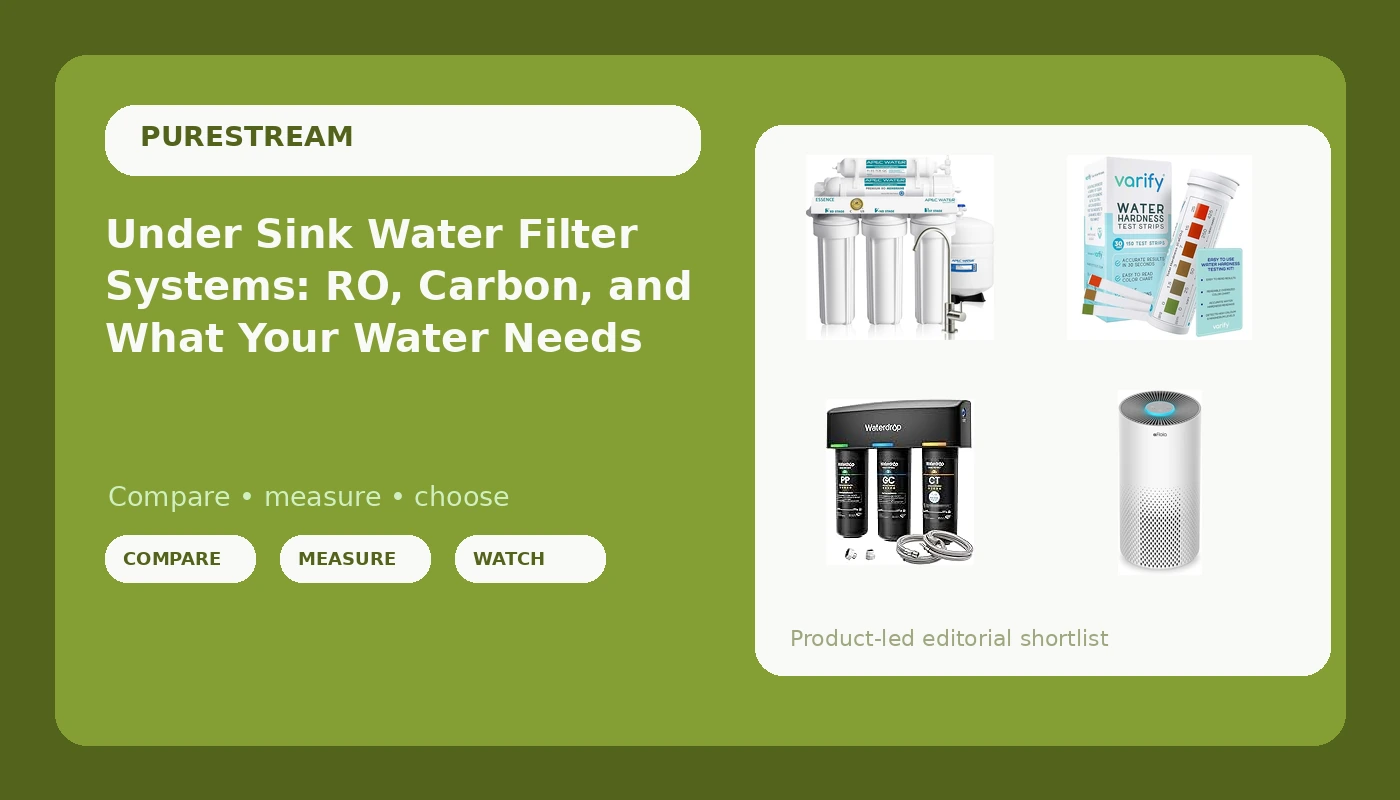
A glass of water that tastes like a swimming pool is the usual trigger. Sometimes it is a municipal water report with a hardness or lead number circled in pen. Either way, the search that follows lands on the same phrase: an under sink water filter system. That label covers a lot of ground. A carbon block cartridge, a five stage reverse osmosis unit, and a two stage sediment filter are all sold as under sink systems, and they do very different things to very different water. Buying before you know what is in your water is how people end up with a filter that removes chlorine beautifully and does nothing about the minerals scaling the kettle.
Related: What a Water Filter Really Costs Per Gallon →
Quick answer
Match the process to the problem. Taste and odor complaints are usually a carbon issue. Confirmed dissolved contaminants or very high TDS call for reverse osmosis, which is the only common residential process that pulls dissolved solids down toward zero. If you do not know what you have, test hardness first, because it tells you in minutes whether you are dealing with a mineral problem or a treatment problem. Three water products below cover those jobs, and a fourth handles the other half of household filtration.
Four useful options
| Model | Best fit | What stands out |
|---|---|---|
| APEC Water ROES-50, 5-Stage Under Sink Reverse Osmosis System, 50 GPD | Confirmed dissolved contaminants, high TDS, or a household that wants near-zero dissolved solids | Five stage reverse osmosis treatment rated at 50 GPD |
| Waterdrop TSA 8 Layer Under Sink Water Filter System, NSF/ANSI 42 Certified | Taste and chlorine complaints where a full RO install is more than you need | Eight layer media with an NSF/ANSI 42 certification listed |
| Varify Water Hardness Test Kit - Hard Water Test Strips for Well & Home | Finding out what you are treating before spending on treatment | Hardness testing built for both well and municipal supplies |
| Afloia Air Purifier for Home Bedroom Large Room up to 1500 Sq Ft | Upgraded HEPA 4-Stage Filtration, Washable Pre-Filter, 22dB Sleep Mode, 7 Color Light, 2/4/8/16H Timer, Kilo White | Households treating water and air as one indoor environment project | Four stage HEPA filtration with a washable pre-filter and a 22dB sleep mode |
The reverse osmosis pick: APEC Water ROES-50
Reverse osmosis works differently from every other filter in this category. Carbon media traps chlorine and organic compounds by adsorption, and sediment media traps particles by size. An RO membrane rejects dissolved ions, which is why it is the process people reach for when TDS is genuinely high or a lab sheet lists something a carbon cartridge was never designed to catch. The trade-off is that RO also strips the minerals that give water its taste, and it produces reject water as part of the process. It is also a system with a filter schedule rather than a single cartridge, so the ongoing cost is the number worth checking before you commit. If your only complaint is that the water tastes like a pool, you may be buying more machine than the problem requires.
The carbon block pick: Waterdrop TSA 8 Layer Under Sink Water Filter System
The certification number matters here, and it is worth being precise about what it means. NSF/ANSI 42 covers aesthetic effects, chiefly chlorine taste and odor and particulate reduction. It is not the same claim as NSF/ANSI 53, which covers health related contaminants like lead. A system certified to 42 is doing real, verifiable work on the thing most people actually notice, and it is honest about the scope of that work. What it will not do is lower your TDS in any meaningful way, because dissolved minerals pass straight through carbon. If your water is hard, a carbon system leaves it hard.
The diagnostic step: Varify Water Hardness Test Kit
Hardness is calcium and magnesium, and it is the single most common reason a household goes shopping for treatment. It is also the one thing none of the filters above will fix, because hardness is dissolved, and softening is a different process from filtration. That distinction is why a test belongs at the front of the buying sequence rather than the back. A strip kit costs a fraction of a filter system and tells you whether your white kettle crust, spotty glasses, and stiff soap lather are a mineral issue, a treatment issue, or both. Testing before you buy is the difference between solving a problem and decorating a cabinet with the wrong solution.
The adjacent pick: Afloia Air Purifier
This is not a water product, and it should not be presented as one. It is here because the people who start reading about water filtration are usually the same people already thinking about what their household is breathing, and because the pre-filter logic is identical: a cheap washable stage in front of an expensive one extends the expensive one. If your water project is settled and the next item on the list is the bedroom, this is the parallel purchase. If your water is the actual problem, skip it and spend the money on the right filter.
Prices and availability may change. Product images, names, and retailer links are matched to verified listings. No current price, rating, stock status, or measured result is stated here without current evidence.
What TDS tells you and what it does not
Total Dissolved Solids is the sum of dissolved minerals and salts in water, reported in parts per million. It is a performance meter, not a health meter. A reading of 400 ppm tells you there is a lot dissolved in the water; it does not tell you whether any of it is harmful, and it says nothing about chlorine, which is a gas in solution and does not show up the way people expect. That is why TDS alone should never drive a purchase decision. What it does do well is show you whether a filter is working. Measure before, measure after, and watch the number hold steady as the cartridge ages. When the post-filter reading starts climbing back toward the pre-filter reading, you are watching breakthrough happen and it is time to change media. That curve is more useful than any marketing claim on the box, and it costs one inexpensive meter to produce.
Matching the process to the problem
The mistake that costs the most money is buying treatment before diagnosis. Work the sequence in order and you will not overspend.
- Pull your municipal water quality report, or if you are on a well, get a basic panel from a certified lab. You are looking for hardness, lead, nitrate, and anything the report flags.
- Test hardness at the tap with strips. This confirms whether the report matches what is actually arriving in your kitchen.
- Decide which category your problem falls into: aesthetic (taste, odor, chlorine) or dissolved (hardness, high TDS, listed contaminants).
- Choose the process that matches the category. Carbon for aesthetic. Reverse osmosis for dissolved. Softening for hardness, which is neither of the above.
- Read the certification line on the listing before you buy, and check the replacement media cost at the same time. A filter with no certification number and no published cartridge price is a question mark, not a bargain.
Practical guidance before you order
- Write down what you actually dislike about your water. Taste, spots, scale, or a lab number. Vague dissatisfaction leads to vague purchases.
- Check the certification number against the NSF listings. A standard named without a number proves nothing.
- Look up the replacement cartridge cost and the recommended change interval together, then estimate a year of ownership.
- Confirm under sink clearance and whether you need an outlet nearby. RO systems and some filtration systems need power.
- Measure your post-filter TDS or hardness a few weeks after installation, then again at the end of the cartridge's rated life, so you learn what normal looks like for your water.
Which option should you choose?
Choose the APEC Water ROES-50 when you have confirmed dissolved contaminants, high TDS, or a household that wants dissolved solids pulled down near zero and will keep up with a multi-cartridge schedule. Choose the Waterdrop TSA 8 Layer Under Sink Water Filter System when your complaint is taste and chlorine and you want a certified carbon system without the wastewater and maintenance of a membrane. Choose the Varify Water Hardness Test Kit when you do not yet know what you are treating, because it is the cheapest way to avoid buying the wrong machine. Choose the Afloia Air Purifier when your water is handled and the next filtration project in the house is the air.
One caveat worth stating plainly: certifications describe what a product was tested to do under specific conditions, not what it will do in your kitchen with your water chemistry, your usage, and your change schedule. The listing tells you the design intent. Your own before and after readings tell you the result.
The bottom line
Filtration is a matching problem, not a ranking problem. Carbon media handles taste and chlorine and is certified to do exactly that. Reverse osmosis handles dissolved solids and costs you minerals, reject water, and a filter schedule in exchange. Hardness testing costs almost nothing and prevents the most expensive mistake in this category, which is buying a filter for a problem it was never built to solve. Test your water, name the problem, then buy the process that addresses it. The product that wins is the one whose job description matches your water.