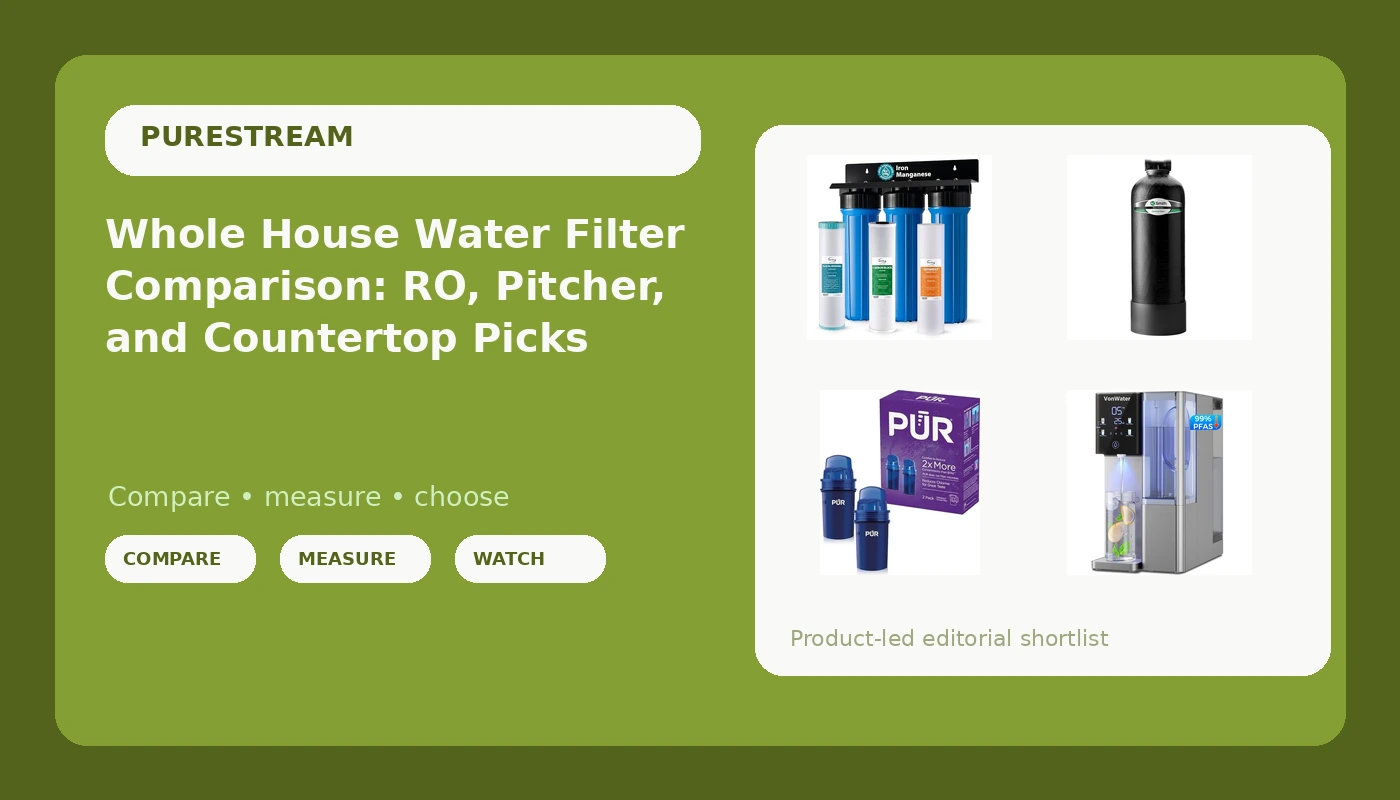
I spent six years running contaminant analyses for a municipal water lab, and the habit that stuck is simple: I trust a spec sheet only after I know what it was tested against. This whole house water filter comparison exists because readers keep asking me to rank four products that solve four different problems. Two of them treat every tap in the house, one is a countertop reverse osmosis machine, and one is a replacement filter for a pitcher you may already own. Putting them in a single ranked list would be dishonest. What I can do is tell you which problem each one actually solves, what it costs you over time, and where it falls short of the marketing.
Related: How to Read NSF Certification Numbers on Water Filters
The short answer: on city water, if you want better tasting, lower-TDS water at one tap, the countertop RO system is the unit that changes your daily glass. On a well with iron and manganese staining your fixtures, the iSpring is the only system here built for that job. The A. O. Smith is the simpler whole house pick for chlorine and taste, and the PUR two-pack is not a system at all, it is maintenance for a pitcher you already own.
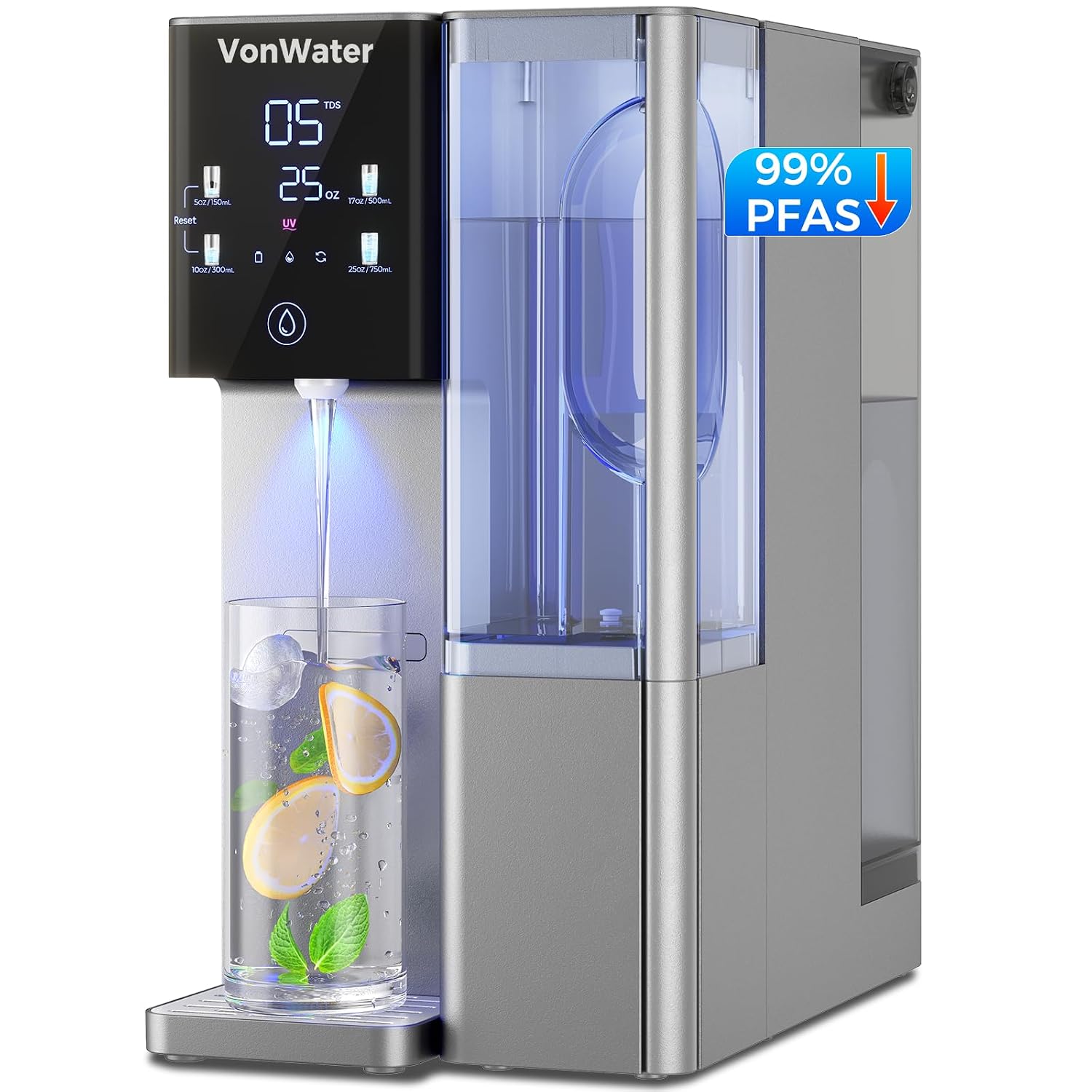
CT910G Countertop Reverse Osmosis Water Filter System
Seven-stage RO with a 528-gallon rating and a 3:1 pure-to-drain ratio, plus NSF 372, 42, and 58 listings and claimed TDS and PFAS reduction. No installation, no plumber, no under-sink work
Countertop footprint is real, RO strips dissolved minerals along with the contaminants, and a seven-stage platform means a cartridge schedule you have to keep
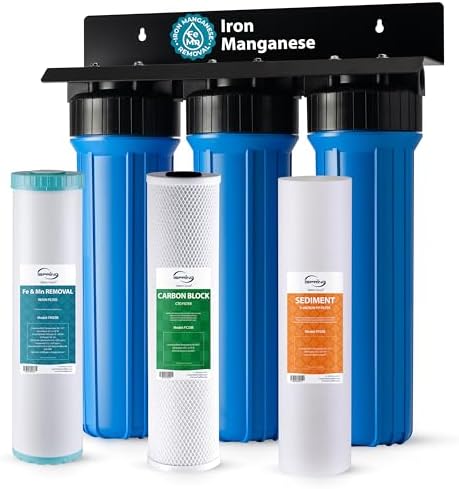
iSpring WGB32BM Iron, Manganese Whole House Water Filter System
The only unit here with media selected for iron and manganese, installed at the main line so every tap, shower, and appliance downstream gets treated water
Whole house install means plumbing work, and iron media has a replacement interval you cannot ignore without losing performance
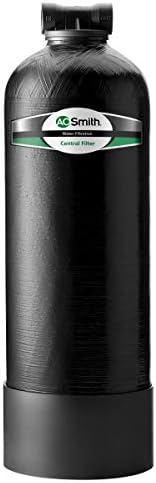
A. O. Smith Whole House Water Filter System, 600K Gal
Rated for 600,000 gallons, which is a long service window, and a simpler single-cartridge platform than the multi-stage competition. Aimed squarely at city water chlorine and taste
It will not fix iron, manganese, or hard water. If your problem is dissolved minerals, this is the wrong tool
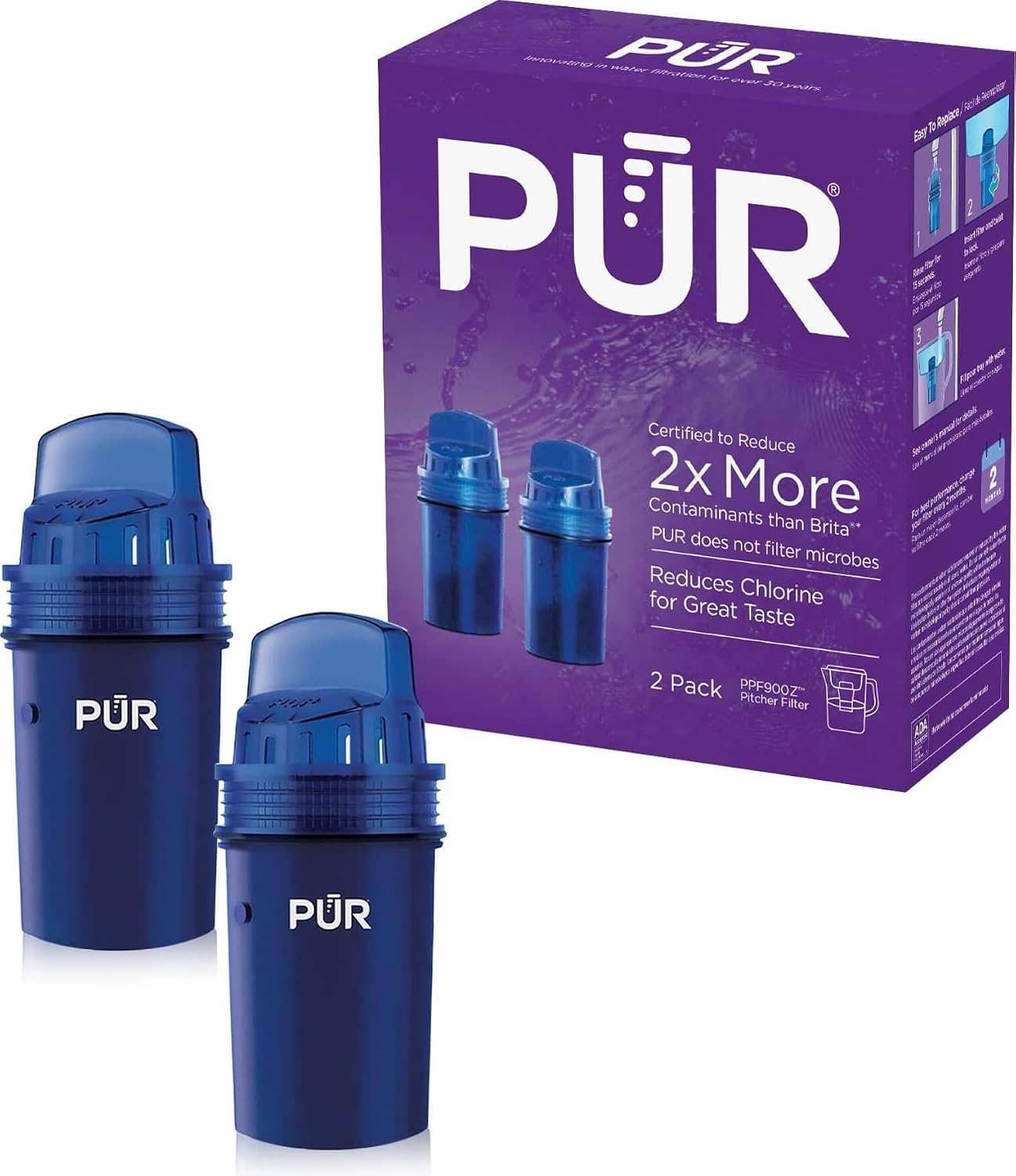
PUR Water Pitcher & Dispenser Filter Replacement 2-Pack, 4-Month Value
The cheapest way to keep an existing pitcher or dispenser running, sold as a two-pack with a four-month rating
It is a consumable, not a system. Pitcher media at this level is a taste and chlorine tool, and it does not lower dissolved solids
Prices and availability were captured from Amazon Creators API and may change.
What each of these four units is actually built to do
The CT910G is a countertop reverse osmosis system. Seven stages, a 528-gallon rated capacity, and a 3:1 pure-to-drain ratio, which means that for every three gallons of clean water it produces, roughly one gallon goes to the drain. It carries NSF 372, 42, and 58 listings, and it claims reduction of TDS and PFAS. It sits on the counter, plugs in, and needs no plumbing modification. That combination is uncommon, and it is the reason this unit shows up in so many of my reader emails.
The iSpring WGB32BM is a whole house system built around iron and manganese media. It installs at the main line, so every tap, shower, and appliance downstream gets treated water. Iron and manganese are the contaminants that turn porcelain orange, stain laundry, and make water taste metallic. No carbon pitcher will ever touch them, and that distinction matters more than any spec on a box.
The A. O. Smith AO-WH-Filter is also a whole house system, but its target is different. It is rated for 600,000 gallons and built for the chlorine, taste, and sediment problems that city water delivers. It is a single-cartridge platform, which matters for maintenance, and it is the simpler install of the two whole house units.
The PUR two-pack is the odd one out. It is not a system at all. It is a replacement filter set for a pitcher or dispenser, sold as a four-month value pack. If you already own a PUR pitcher, this is the consumable that keeps it running, and nothing more.
Whole house filtration: match the media to the problem
A whole house filter is the right answer when the problem exists at every tap. That sounds obvious, but people buy them for the wrong reasons constantly. If your complaint is that the shower smells like a pool and the ice cubes taste flat, a whole house carbon system is exactly right. If your complaint is that your water leaves orange rings in the toilet bowl, you need iron media, and a carbon cartridge will do nothing but clog.
That is the entire difference between these two whole house units. The A. O. Smith is a chlorine, taste, and sediment machine rated for 600,000 gallons. The iSpring is an iron and manganese machine with media chosen for that specific chemistry. Buy the A. O. Smith for a city water house and you will be happy. Buy it for a well with iron and you will be replacing cartridges and still scrubbing stains.
Neither one is a water softener. This is the mistake I see most often in reader mail. Whole house carbon and iron media do not remove calcium and magnesium, which is what hardness actually is. If your glasses come out of the dishwasher spotted and your soap will not lather, you need a softener, and no filter in this comparison will fix that. Softeners and filters do different jobs and often live side by side in the same basement.
Maintenance is the other half of the whole house decision. Both units need cartridge changes on a schedule, and both are installed somewhere inconvenient, which means the change is a project rather than a thirty-second task. That is not a reason to avoid them. It is a reason to write the replacement date on the housing with a marker the day you install it. The iSpring WGB32BM and the A. O. Smith AO-WH-Filter both live or die on that habit.
One more honest note: a whole house system treats water you never drink. Showers, laundry, and toilets consume the majority of what flows through the main line. That is a feature if you care about chlorine exposure in the shower and a waste if you only care about the glass you pour at dinner. Decide which one you are before you spend the money.
The countertop RO case
Reverse osmosis is a membrane process, and it is the only technology in this comparison that removes dissolved solids. Carbon filters, including everything in a pitcher, work by adsorption and leave dissolved minerals exactly where they were. If you want to watch a TDS meter actually move, you need a membrane.
The CT910G takes that membrane and puts it on your counter. Seven stages, a 528-gallon rating, and a 3:1 pure-to-drain ratio. That ratio is worth understanding, because it is the number that decides how much water you waste to get a glass. Three to one is a reasonable figure for a modern home RO unit, and it is far better than the older four and five to one systems that made people feel guilty about every pitcher they filled. It also carries NSF 372, 42, and 58 listings, and it claims reduction of TDS and PFAS. The 58 listing is the one that matters most here, because it is the standard written for reverse osmosis systems specifically.
The trade-off is minerals. RO water is close to mineral free, and that is the point of the process, not a side effect. I have no patience for marketing that calls this dead water and sells you a remineralizer to fix it. If you want minerals in your water, drink it with food, which is where nearly all of your mineral intake comes from anyway.
The second trade-off is the cartridge schedule. Seven stages is not a marketing number, it is seven things that eventually exhaust. A sediment stage, carbon stages, the membrane itself, and usually a polishing stage after the tank. Each has its own interval. A unit like this rewards an owner who keeps a log and punishes one who does not. That said, the installation story is what sells it. No plumber, no under-sink work, no drilling a hole in a countertop for a dedicated faucet. For renters and anyone who does not want to modify a kitchen, the CT910G countertop RO system removes the single biggest barrier to owning an RO unit.
Where a pitcher filter still earns its place
I am hard on pitchers, and I own one anyway. That should tell you something. A pitcher is the lowest friction water improvement you can buy. No install, no plumbing, no countertop footprint beyond the pitcher itself, and a replacement filter costs less than lunch.
What a pitcher does well: chlorine taste and odor, plus sediment, in a format a kid can operate without help. What it does not do: lower dissolved solids, remove iron, or soften anything. Carbon media adsorbs, and adsorption is selective. If your water has a chlorine problem, a pitcher solves it. If your water has a TDS problem, a pitcher will not move the number.
The PUR two-pack is the consumable for an existing pitcher or dispenser, rated as a four-month value pack. Treat that rating as a starting point, not a promise. The honest way to use a pitcher is to watch the flow. When a pitcher takes twice as long to fill as it did on day one, the media is loaded and it is time to change it, regardless of what the calendar says. A pitcher that has slowed to a trickle is not filtering, it is stalling.
One habit I will push on anyone with a pitcher: find the certification number on the pitcher itself, not the filter box. The number tells you which standard that specific model was tested against, and standards differ between taste and health claims. If you cannot find a number, you cannot verify a claim. The PUR replacement filters are the right purchase only if the pitcher they go into is one you already trust.
Cost per gallon is the only honest metric
I do not quote sticker prices, because they move and because the sticker is never the real number. The real number is cost per gallon, and it has three parts: the purchase price, the replacement cartridges over the rated capacity, and your time.
Run that math on all four units and the ranking flips depending on how you use them. A whole house system spreads its cost across every gallon in the house, including showers and laundry, so the per-gallon figure looks excellent. A pitcher concentrates its cost on the small volume you actually drink, so the per-gallon figure looks terrible. The countertop RO sits in the middle, with a membrane that lasts a long time and pre-filters that do not. Check current Amazon price on the unit and on its replacement cartridges before you decide anything. The cartridge price is the one that keeps showing up.
There is a fourth cost nobody prints: the cost of a filter you stop changing. A neglected whole house cartridge is worse than no cartridge, because exhausted media can shed what it captured. If the replacement schedule is one you will not keep, buy the system with fewer stages, not more.
Flow rate, micron rating, and breakthrough
Three specs decide whether you will actually like a filter six months in.
Flow rate is the first. Gallons per minute at gallon one is a marketing figure. What matters is flow at fifty gallons, and again at five hundred. A whole house system that drops your shower pressure is a system you will resent. A countertop RO with a slow tank is a system your family will stop using. Ask what the flow looks like at the end of the cartridge interval, not the beginning.
Micron rating is the second. Smaller pores catch more particles and clog faster. A one-micron absolute cartridge is a wonderful filter and a maintenance burden. There is no free lunch here, only a trade between capture and service life.
Breakthrough is the third, and it is the reason replacement schedules exist. Every filter media has a capacity, and once it is spent, contaminants pass straight through while the water still tastes fine. Taste is not a filter gauge. Time and volume are. That is why I log cartridge dates the way other people log oil changes.
Who should buy which one
If you are on city water and the complaint is taste, smell, or chlorine, start with the A. O. Smith whole house unit and treat every tap at once. It is rated for 600,000 gallons, it is a simple single-cartridge platform, and it is the least fussy way to fix a whole house.
If you are on a well with iron and manganese staining, the iSpring is the only unit here built for that chemistry. Buy it knowing you are signing up for media changes and a plumbing afternoon.
If you rent, or you want one perfect glass of water rather than a whole house solution, the countertop RO system is the pick. It is the only unit in this comparison that lowers TDS, it needs no installation, and it carries the NSF listings I actually look for.
If you already own a pitcher and you like it, buy the filters and keep watching the flow. Just do not ask a pitcher to do a membrane's job.
That is the whole comparison. Four products, four different problems, and one rule that sorts them: decide what you need removed first, then buy the machine that removes it. Everything else is packaging.