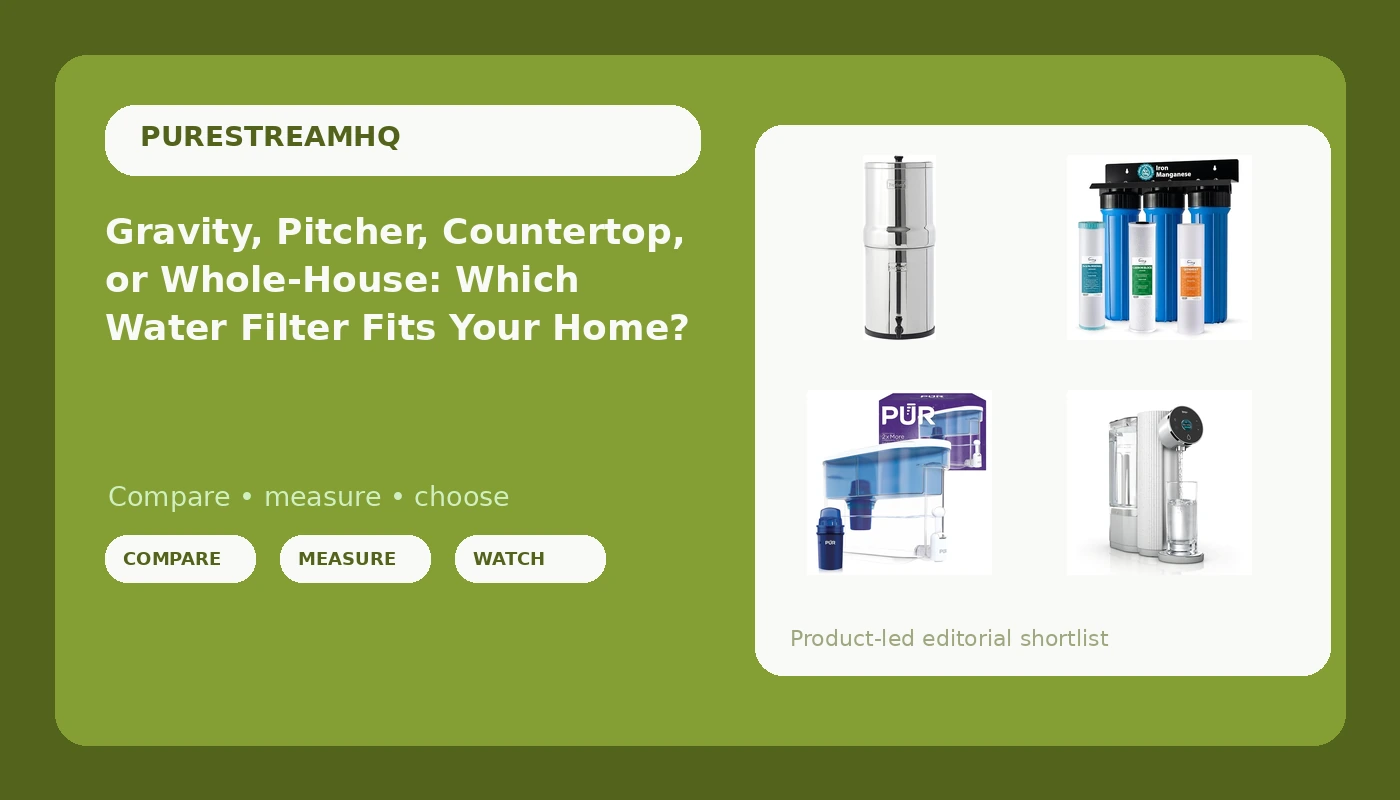
Most people shop for a water filter by reading contaminant lists, which puts the cart before the horse. The format decides almost everything that follows: what the unit can realistically remove, whether you need a plumber, how much counter space it occupies, and how often you will be ordering replacements. Home water filtration systems come in four practical shapes, a powered countertop unit, a bulk countertop dispenser, a gravity tank, and a point-of-entry system on the main line, and each one solves a different problem. Chlorine taste and odor is one problem. Orange staining from iron is a completely different one. No single format handles both well, which is why the honest answer to "which filter should I buy" starts with a question about your water rather than a question about a product.
Related: How to Read an NSF Certification Number →
Quick answer
Match the format to the job before you compare models. If taste and chlorine are the issue and you only need drinking water, a countertop dispenser or a gravity system handles it with no plumbing at all. If iron or manganese is staining fixtures, laundry, and shower glass, you need point-of-entry media filtration on the main line rather than a pitcher. If you want filter-life tracking and a modern interface, a smart countertop system is the category to look at, and it carries a higher up-front cost than a simple dispenser. Two numbers matter more than any badge on the box: the replacement filter cost and the flow rate late in a filter's life, not on day one.
Four useful options
| Model | Best fit | What stands out |
|---|---|---|
| Ninja HydraSense™ Intelligent Water Filtration System, WF1001WH1 | Kitchens that want on-counter filtered water with filter-life tracking | Powered countertop format with an intelligent filter-monitoring design and proprietary cartridges |
| PUR 30-Cup Countertop Water Filter Dispenser, White/Blue, DS1800Z | Households that want a lot of cold filtered water without installation | 30-cup capacity, slim footprint, uses replaceable PUR cartridges |
| Big Berkey 2.25 Gal Gravity Water Filter System with BB9-2 Filters | Renters, cabins, and emergency setups with no plumbing or power | 2.25-gallon gravity body supplied with two BB9-2 filter elements |
| iSpring WGB32BM Iron, Manganese Whole House Water Filter System | Well water or whole-home iron, manganese, and sediment problems | Point-of-entry media filtration on the main line |
The smart countertop option: Ninja HydraSense™ Intelligent Water Filtration System, WF1001WH1
Countertop powered systems split into two families, units that connect to the faucet with a diverter and units that hold their own reservoir, and the difference matters more than the styling. A diverter model gives you unlimited filtered water without refilling; a reservoir model limits you to what fits inside it. Check the listing for the connection style, the stated capacity, and the filter part number, then price that part number. If a year of cartridges costs more than the machine, you have learned the most important fact about the purchase before spending anything.
The bulk dispenser option: PUR 30-Cup Countertop Water Filter Dispenser, White/Blue, DS1800Z
Gravity dispensers of this type address taste, odor, and chlorine through carbon media, and that is a perfectly legitimate job. What they generally do not do is remove dissolved solids or handle a heavy metals problem in well water. They are a convenience and taste solution, not a treatment plant. Measure your counter depth and your fridge shelf clearance before ordering, because a 30-cup dispenser that does not fit where you planned to keep it becomes a chore, and a filter you avoid using is money spent on nothing.
The no-plumbing gravity option: Big Berkey 2.25 Gal Gravity Water Filter System with BB9-2 Filters
Gravity is slow, and that is physics rather than a defect. A tank this size takes a while to refill the lower chamber, so you treat it like a reservoir you keep topped up rather than a faucet you open on demand. The elements also need periodic priming, cleaning, and eventual replacement, and the cost of a replacement set is the number to look up before you commit. For daily drinking water in a plumbed kitchen, this is a lot of counter and a lot of patience. For an emergency supply or a place with no plumbing, it is one of the few formats that keeps working when everything else stops.
The whole-house option: iSpring WGB32BM Iron, Manganese Whole House Water Filter System
Whole-house systems only work when the media matches your water chemistry, so a test comes before the order, not after. Iron and manganese load a filter media bed at a rate that depends on your concentration, your pH, and how much water your household uses, which means replacement intervals vary enormously from one home to the next. Some well supplies also need pretreatment before the media can do its job. If you are on city water with no staining problem, this format is solving something you probably do not have, and the money is better spent on a drinking water unit.
Prices and availability may change. Product images, names, and retailer links must be matched by verified ASIN. Do not state a current price, rating, stock status, or measured result without current evidence.
What the certification numbers actually mean
A filter's claims are only as good as the standard they were verified against, and the standard is identified by a number. NSF/ANSI 42 covers aesthetic claims: chlorine taste and odor, particulates, and clarity. NSF/ANSI 53 covers health-related claims such as lead, cysts, and volatile organic compounds. NSF/ANSI 401 covers a list of emerging compounds, and NSF/ANSI 372 verifies lead-free plumbing materials. The WQA Gold Seal is a comparable third-party program. When a package says "tested to NSF standards" with no standard number and no certification listing, that sentence is marketing rather than evidence. Find the number, then confirm the claim you care about is inside it.
The second thing to understand is that "removes more" is not automatically better. Reverse osmosis, for instance, pushes dissolved solids toward zero, including the calcium and magnesium that give water its taste and that most people have no reason to remove. Media and carbon filters leave those minerals in place while targeting specific contaminants. Neither approach is superior in the abstract; they answer different questions, and the right one depends on what is actually in your water.
TDS, flow rate, and cost per gallon
Total Dissolved Solids is the sum of dissolved minerals and salts in the water, reported in parts per million. It is a poor health metric and an excellent performance metric: if a filter claims to reduce dissolved solids and your TDS reading is unchanged, the filter is not doing what you thought. Carbon pitchers and gravity units do not meaningfully change TDS. Membrane-based systems do. Knowing which category you bought prevents a lot of disappointment.
Flow rate is the spec everyone ignores until they are standing at the sink waiting. Manufacturers quote flow with a fresh cartridge, which is the best case. As media loads up with everything it has captured, flow declines, and a unit that starts at a respectable rate can become a trickle well before the rated replacement date. That is why replacement schedules exist and why running a filter past its interval is a bad trade: you are not saving a cartridge, you are drinking through exhausted media.
Cost per gallon is the only honest way to compare two filters. Take the price of the replacement cartridge and divide it by the gallons the maker rates it for, then check whether that rating assumes ideal water. A cheaper machine with expensive, frequently replaced cartridges loses to a more expensive machine with cheap ones over a few years.
Here is a workable sequence for choosing:
- Get your water tested. Your utility's annual consumer confidence report covers city water; a certified lab test covers a private well, including iron and manganese.
- Write down the two or three things you actually want gone, in priority order, along with anything you want left alone.
- Match each item on that list to a certification number on a product listing, not to a phrase on the box.
- Decide the coverage: drinking water only, or every tap in the house. Whole-house treatment is a plumbing project with a longer payback.
- Compute cost per gallon for each candidate, check that replacement cartridges are in stock and likely to stay that way, then pick the format that fits your counter and your habits.
Practical notes before you buy
- Measure twice for countertop units. Depth and height clearance decide whether a dispenser goes where you will actually use it.
- Look up the replacement cartridge before the machine. If the part number is hard to find, that is a warning sign.
- For well water, test for iron and manganese first. Which media you need depends on the numbers, and so does how long it lasts.
- Keep one spare cartridge on hand. A filter that sits exhausted for a month because of a shipping delay is a filter that is not filtering.
- Renters should favor gravity and countertop formats. Nothing that modifies the plumbing follows you to the next apartment.
- Log your filter change dates somewhere visible. Most premature breakthroughs are just forgotten schedules.
Which option should you choose?
Choose the Ninja HydraSense™ Intelligent Water Filtration System, WF1001WH1 when you want filtered water on the counter and you would rather the machine track cartridge life than remember it yourself, and you have checked what the proprietary cartridges cost. Choose the PUR 30-Cup Countertop Water Filter Dispenser, White/Blue, DS1800Z when taste and chlorine are the whole problem and the house goes through a lot of cold water, with no installation and no plumbing to think about. Choose the Big Berkey 2.25 Gal Gravity Water Filter System with BB9-2 Filters when there is no plumbing to connect to, or when you want drinking water that survives a power outage. Choose the iSpring WGB32BM Iron, Manganese Whole House Water Filter System when iron or manganese is staining fixtures and laundry and you have test results in hand to size the media correctly.
None of these units removes everything, and none of them is a substitute for knowing what is in your water. Certification claims are specific: a filter certified for chlorine taste and odor is not thereby certified for lead. Well water chemistry also shifts over the year, so a test result from three summers ago is not a permanent description of your supply.
The bottom line
Pick the format first, the model second, and the cartridge third, because that is the order in which each decision constrains the next. Drinking water in a plumbed kitchen points to a countertop unit, capacity needs point to a bulk dispenser, no-plumbing situations point to gravity, and whole-home iron and manganese problems point to a point-of-entry system on the main line. Then check the certification numbers against your actual contaminants, and do the cost-per-gallon math on the replacement filters before you buy anything. The machine is the small number. The cartridges are the real one.