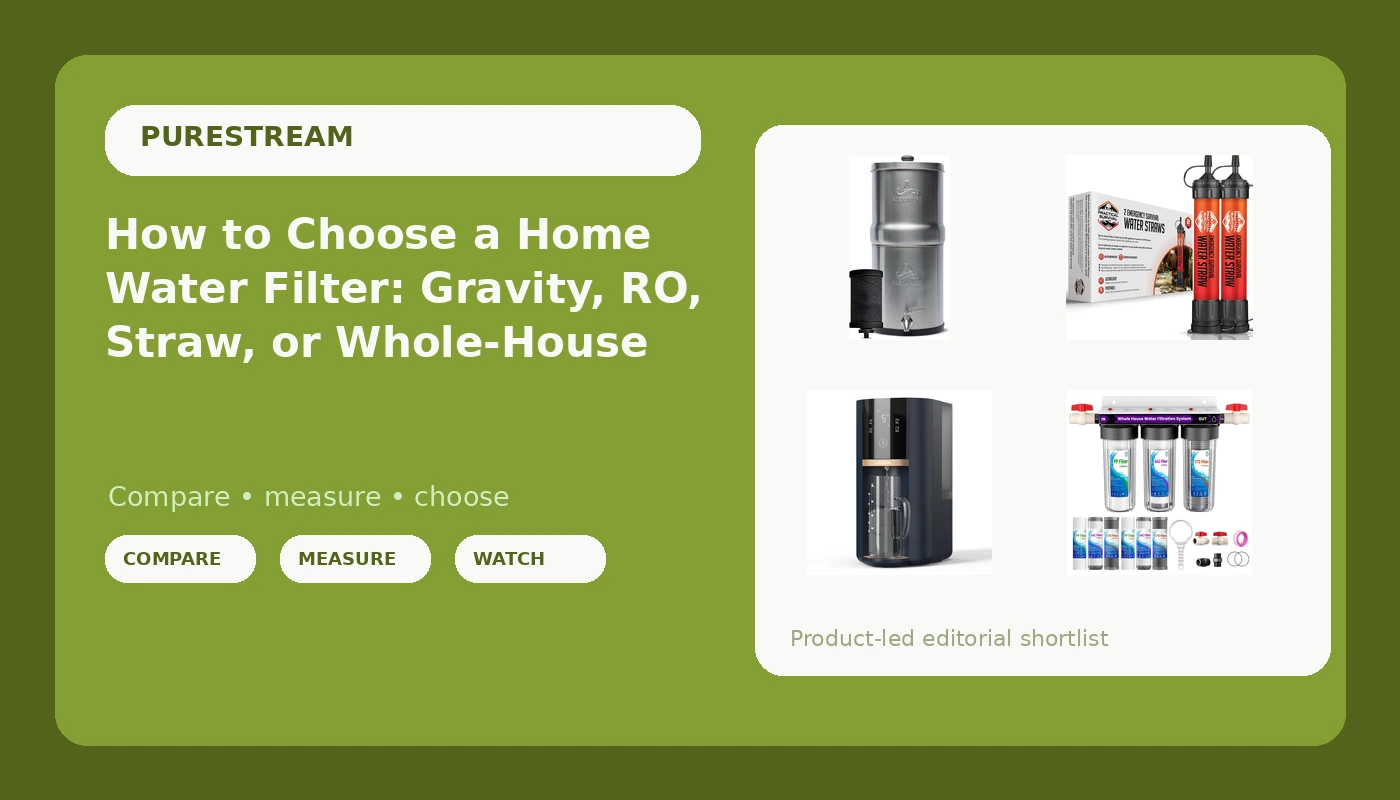
Most people start shopping for home water filter systems because of something small and specific. The water tastes like a swimming pool, the ice smells off, or a kid stops drinking from the tap and starts asking for juice instead. Then they open a shopping page and find a category that runs from a straw you keep in a backpack to a unit that treats every faucet in the building, all listed side by side as if they were interchangeable. They are not. Each of the four options below is built for a different job, and the fastest way to waste money is to buy the one with the longest feature list instead of the one that matches the problem you actually have.
Related: How to Read an NSF Certification Number Before You Buy a Filter →
Quick answer
Match the device to the job, not to the spec sheet. A gravity-fed stainless system covers everyday drinking water when there is no plumbing or power to spare. A personal straw filter belongs in an emergency kit or a hiking pack, not on a kitchen counter. A countertop reverse osmosis unit is the right shape when the goal is stripping dissolved solids without hiring a plumber. A three-stage whole-house system makes sense when the problem shows up at every tap in the building. None of these replaces the others, and none of them is the single correct answer for every home.
Four useful options
| Model | Best fit | What stands out |
|---|---|---|
| Alexapure Pro Stainless Steel Water Filtration System - 200 Gallon Capacity | Households that want filtered water without plumbing or power | Stainless steel body with a 200 gallon rated capacity |
| Practical Survival Reusable Emergency Water Filter Straws, 2-Pack | Emergency kits, travel, and hiking packs | Two reusable straw-style filters in one pack |
| Leysern Countertop Reverse Osmosis Water Filter with UV, No Installation | Renters and small kitchens that want RO without a plumber | Countertop reverse osmosis with a UV stage and no installation |
| Whole House Water Filter System with 9 Filters,0.5Micron Filtration,3-Stage | Homes treating water at every tap | Three-stage whole-house design with nine filters included and a 0.5 micron rating |
The everyday gravity option: Alexapure Pro Stainless Steel Water Filtration System - 200 Gallon Capacity
The trade-off here is time. Gravity systems move water at the pace gravity allows, so you fill the top and come back later rather than holding a glass under a tap. That is a real daily friction point, and it is the reason some people who buy a gravity unit love it and some people leave it in the pantry. The other thing to watch is the capacity rating: 200 gallons refers to the life of the filter media, not to how much water the unit holds at once. When the rated capacity runs out, you are buying replacements, and that cost belongs in your math from day one.
The emergency option: Practical Survival Reusable Emergency Water Filter Straws, 2-Pack
A straw filter treats a mouthful at a time. That is the whole point of the format, and it is also why it cannot serve as a household's daily drinking water solution. The honest way to think about this category is as insurance: it covers the scenario where the tap stops working, the boil-water notice arrives, or you are three miles from a trailhead with a questionable stream. If you buy one, store it where you would actually reach for it, and check the manufacturer's guidance on storage and replacement intervals, because a filter that sat in a hot car for three summers is not the same product you bought.
The countertop RO option: Leysern Countertop Reverse Osmosis Water Filter with UV, No Installation
Reverse osmosis is a membrane process, and a membrane removes dissolved solids at a level carbon filters do not reach. It also removes minerals along with everything else, which some people care about and some do not. Two practical points belong in the decision. First, RO systems produce a stream of concentrate water that goes down the drain, so the unit uses more water than it delivers. Second, RO systems run on a multi-cartridge schedule, and the membrane and pre-filters are the recurring cost, not the machine. A UV stage is a disinfection step, not a filter, so treat it as a separate function rather than as extra removal capacity.
The whole-house option: Whole House Water Filter System with 9 Filters,0.5Micron Filtration,3-Stage
Whole-house treatment is a different purchase decision from a drinking water filter, and mixing them up causes most of the disappointment in this category. A micron rating describes pore size, not a contaminant list. A 0.5 micron filter is a mechanical barrier; whether the system also reduces chlorine, lead, or other dissolved contaminants depends on the media inside the stages, which is a separate question from the number on the box. Also plan for pressure. A fine mechanical filter placed on the main line can cost you flow at the showerhead, and a plumber's opinion on your specific supply line is worth more than any spec table.
Prices and availability may change. Product images, names, and retailer links are matched to verified listings. No current price, rating, stock status, or measured result is stated here without current evidence.
What micron ratings and TDS actually tell you
A micron rating and a TDS reading are the two numbers shoppers lean on hardest, and both are routinely misread. Micron rating is pore size. Smaller pores catch smaller particles, but they also clog faster, which means a tighter filter usually has a shorter service life and a bigger pressure penalty. There is no prize for the smallest number on the shelf.
TDS stands for total dissolved solids, measured in parts per million. It counts dissolved minerals and salts, and it says nothing about bacteria, and very little about lead. What it does well is measure filter performance over time: if a filter is removing dissolved solids, TDS drops, and if the media is exhausted, TDS climbs back toward the source water. That makes a TDS meter a useful trend tool and a poor health meter.
The claim that actually matters is certification. NSF/ANSI 42 covers taste and chlorine reduction. NSF/ANSI 53 covers health-related contaminants such as lead. A listing that says "tested to NSF standards" without a standard number attached is a marketing sentence, not a certification, and it should not be the reason you buy anything.
How to compare these four on cost per gallon
- Find the rated capacity or the replacement interval for every filter in the system, not just the one you can see.
- Add up a year of replacement filters at your household's actual usage, not at the manufacturer's suggested pace.
- Divide that yearly number by the gallons you really drink and cook with, and write the result next to the purchase price.
- Check the flow rate at the point where you would actually use the unit, and ask whether you are willing to wait that long every day.
- Confirm the certification numbers for the specific claims you care about, and skip any claim that has no number behind it.
Practical guidance before you buy
- Test your water first. A $30 TDS meter and a municipal water quality report tell you whether you have a dissolved solids problem, a chlorine problem, or no problem at all.
- Decide which taps you are solving for. One kitchen tap and every tap in the house are different budgets and different installations.
- Treat the replacement filter as the real price. The unit is the entry fee; the cartridges are the subscription.
- Put the replacement date on your calendar the day you install the system, and buy the next set of filters before you need them.
- Keep an emergency option separate from your daily system. A straw filter in a go-bag does not compete with a countertop unit, and owning both is not redundant.
Which option should you choose?
Choose the Alexapure Pro Stainless Steel Water Filtration System - 200 Gallon Capacity when you want everyday filtered drinking water and you have no plumbing or power to work with. Choose the Practical Survival Reusable Emergency Water Filter Straws, 2-Pack when the goal is portable, personal coverage for emergencies, travel, or the outdoors. Choose the Leysern Countertop Reverse Osmosis Water Filter with UV, No Installation when you want dissolved solids reduced and you cannot or will not install an under-sink system. Choose the Whole House Water Filter System with 9 Filters,0.5Micron Filtration,3-Stage when the water quality issue shows up at every fixture and you are prepared for a point-of-entry installation.
One caveat applies to all four: none of these listings tells you what your specific water contains. Certification numbers tell you what a product was tested to remove under test conditions, and your supply is its own case. If you have a real contamination concern, such as lead from older service lines, get a lab test on your own water before you spend anything, because a filter aimed at the wrong contaminant is an expensive way to feel better without changing anything.
The bottom line
These four products are not four versions of the same decision. They are four answers to four different questions: how do I get filtered water without plumbing, how do I cover an emergency, how do I get reverse osmosis in a rental, and how do I treat the whole house. Answer your question first, then compare prices and replacement costs inside that answer. The filter that fits your kitchen, your budget, and your patience is the one you will actually keep using, and a system you stop using is worth nothing regardless of what it claims on the box.