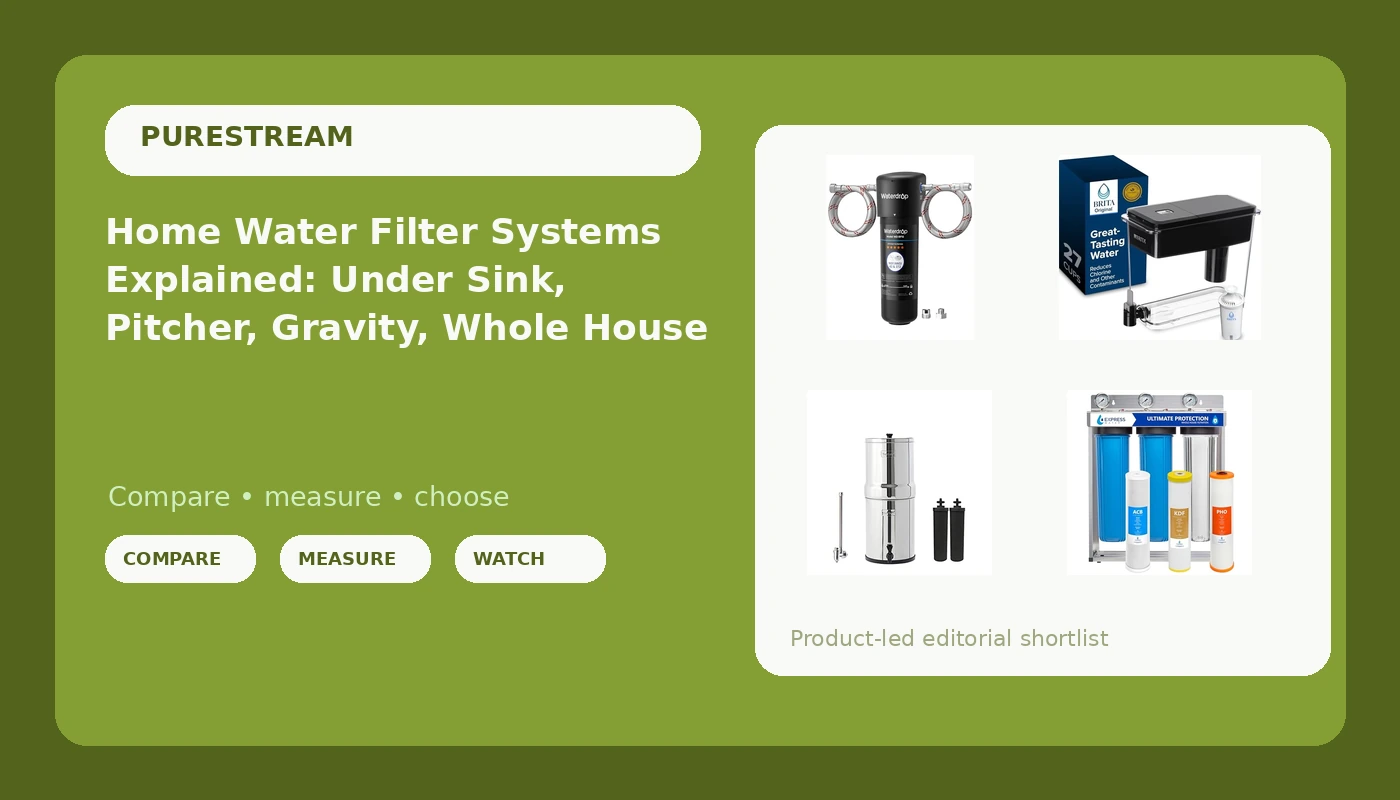
Most people shopping for home water filter systems are not trying to solve a water chemistry problem. They are trying to solve a glass-of-water problem. The tap water smells like a swimming pool, or it tastes flat, or the kid refuses to drink it, or the plumbing is old and nobody has looked inside it since the house was built. Those are four different problems wearing one label, and the four units below are built for four different jobs: point-of-use under the sink, a countertop dispenser for volume, a gravity system that needs no plumbing, and a whole-house unit that treats everything entering the building.
Related: How to Read an NSF Certification Number →
Quick answer
Match the filter to the problem before you match it to the price. For better tasting drinking water at a single faucet, an under sink system certified to NSF/ANSI 42 is the most direct fix. For cold water in the fridge at family volume, a large-capacity dispenser covers the demand. For water when the power or the plumbing is out, a gravity system needs neither. For chlorine smell at every tap, including the shower, a point-of-entry system is the only category that reaches that far. Certification numbers, flow rate at the end of a filter's life, and cost per gallon decide whether the unit is worth owning.
4 useful options
| Model | Best fit | What stands out |
|---|---|---|
| Waterdrop 10UA Under Sink Water Filter System, NSF/ANSI 42 Certified 1 Year | Dedicated drinking water at one faucet | Under sink installation with an NSF/ANSI 42 certification listed in the product name |
| Brita X-Large 27 Cup Water Dispenser, Includes 1 Filter, Black | Fridge and countertop volume for a household | 27 cup capacity with one filter included |
| Royal Berkey 3.25 Gal Gravity Water Filter System with Water View Spigot | Off-grid, emergency, and no-plumbing setups | 3.25 gallon gravity body with a water view spigot |
| Express Water Whole House Water Filter System, Ultimate Protection, 3-Stage | Treating all water entering the home | Three-stage point-of-entry configuration |
Under sink: Waterdrop 10UA Under Sink Water Filter System, NSF/ANSI 42 Certified 1 Year
NSF/ANSI 42 covers aesthetic claims: chlorine taste and odor, and particulate reduction. It does not cover lead, and that distinction matters more than any star rating on the page. If your concern is a lead service line or lead solder in older plumbing, you need a unit whose certification listing includes NSF/ANSI 53 for that contaminant, or a reverse osmosis stage. Buying an under sink filter is mostly a commitment to a filter schedule, so the honest question is not what the housing costs, it is what the replacement cartridge costs divided by the gallons it is rated to treat. A one year rating on a single-cartridge system is a reasonable place to start that math.
Countertop volume: Brita X-Large 27 Cup Water Dispenser, Includes 1 Filter, Black
Pitcher and dispenser filters are the most misunderstood category on the shelf. Standard carbon media in this format is aimed at taste and chlorine, and it typically does not meaningfully reduce dissolved solids, so a TDS meter will barely move before and after. That is not a defect, it is a design target. The failure mode to watch is capacity versus time: a dispenser this size gets emptied fast in a busy kitchen, and a filter that is rated for a set number of gallons will hit that limit sooner than a calendar suggests. If the flow slows to a trickle, the media is loaded and the replacement is overdue. Buy this category for taste, volume, and cold water that a kid will actually drink, not for contaminant removal it was never certified to do.
No plumbing: Royal Berkey 3.25 Gal Gravity Water Filter System with Water View Spigot
Gravity is the trade that buys independence from plumbing and power, and the price is time. There is no line pressure pushing water through the media, so the flow rate is whatever gravity provides, and that is slow by design. For daily life that means filling a carafe and walking away rather than standing at the tap. For an outage, a cabin, a well, or a rental where you are not drilling into a cabinet, it is the only category on this list that works at all. The other thing gravity systems change is maintenance rhythm: the elements are cleaned and replaced on their own schedule, and the housing itself is the durable part, so the long-run cost story is about elements rather than the unit.
Whole house: Express Water Whole House Water Filter System, Ultimate Protection, 3-Stage
Whole-house filtration is the category people reach for when the chlorine smell follows them into the shower, and it is genuinely the only way to fix that, because a point-of-use filter at the kitchen sink cannot reach the bathroom. What it does not do is solve every drinking water concern. Sediment and carbon stages at the entry point address particulates, chlorine, and taste across the building, but dissolved contaminants such as lead that enter the water inside your own plumbing are still downstream of the filter, and dissolved solids are largely untouched by carbon media. That is why a whole-house system and a point-of-use drinking water filter are complements, not competitors. It also has the highest installation demand of the four, since it goes on the main line and needs space and access.
Prices and availability may change. Product images, names, and retailer links must be matched by verified ASIN. Do not state a current price, rating, stock status, or measured result without current evidence.
What NSF/ANSI 42 and 53 actually certify
These two standards get quoted constantly and explained rarely. NSF/ANSI 42 is the aesthetic standard. It covers things you notice with your senses: chlorine taste and odor, and particulate reduction. A filter certified to 42 makes water taste and look better, and that is the whole claim. NSF/ANSI 53 is the health effects standard, and it covers specific contaminants named in the listing, which can include lead, cysts, volatile organic compounds, and others depending on what the manufacturer paid to test.
The practical rule is that the number matters, and the phrase does not. "Tested to NSF standards" without a certification number and a listing you can look up means nothing, because anyone can run water through a lab and print a sentence about it. When you see a certification claim, find the standard number and the specific contaminant it applies to. A filter certified to 42 for chlorine taste is not a lead filter, no matter how the packaging reads.
TDS, flow rate, and cost per gallon: the three numbers that matter
Total dissolved solids, measured in parts per million, is the concentration of dissolved minerals and salts in water. It is not a health meter, and a high number is not automatically bad, but it is an excellent filter-performance meter. Carbon media barely moves TDS, while reverse osmosis drops it toward zero. If a product claims to remove dissolved contaminants and your TDS reading does not budge, that is information.
Flow rate is the spec people ignore until they are standing at the tap wondering why a glass takes ninety seconds. A rating at gallon one is not the number you live with; the number you live with is the flow at gallon fifty, after the media has loaded up. Cost per gallon is the last one: divide the replacement filter price by the gallons it is rated to treat, and compare that figure across categories. The purchase price is the bait. The filter is the real price.
- Find your water report, usually published annually by your utility, and note chlorine, hardness, and any lead or copper detections.
- Decide what you are actually fixing: taste, a specific contaminant, whole-home odor, or emergency supply.
- Look for a certification number on the unit or its listing, and confirm which standard and which contaminant it covers.
- Compare flow rate and rated filter life, then calculate cost per gallon using the replacement cartridge price.
- Check the replacement schedule and whether the cartridges are proprietary, because that is what you will be buying every year.
Practical guidance before you buy
- Read the replacement filter price before the unit price, since the cartridge is the recurring cost.
- Confirm the certification standard number, not just the phrase "NSF tested."
- Match the category to the problem: point of use for drinking water, point of entry for whole-home odor.
- Measure your own water with an inexpensive TDS meter before and after, and keep the readings in a log.
- Check that replacement cartridges are actually available and not discontinued a year after purchase.
Which option should you choose?
Choose the Waterdrop 10UA Under Sink Water Filter System, NSF/ANSI 42 Certified 1 Year when you want better tasting drinking water at one faucet and you have space under the sink. Choose the Brita X-Large 27 Cup Water Dispenser, Includes 1 Filter, Black when the household goes through pitchers fast and the goal is cold, better tasting water with minimal setup. Choose the Royal Berkey 3.25 Gal Gravity Water Filter System with Water View Spigot when there is no plumbing to tap, or when you want water that keeps working during an outage. Choose the Express Water Whole House Water Filter System, Ultimate Protection, 3-Stage when the chlorine smell is everywhere in the house and you are ready for a main line installation.
One caveat applies across all four: the certifications and ratings quoted here come from the product names and manufacturer claims, not from independent testing. Verify the certification listing and the current replacement schedule for your specific model before you commit, and treat any contaminant claim without a standard number as marketing.
The bottom line
The right home water filter system is the one matched to the problem you can actually name. If the issue is taste at the kitchen tap, an under sink unit handles it and stays out of the way. If the issue is volume for a family, a large dispenser is the simplest fix. If the issue is resilience, gravity is the only category that works without infrastructure. If the issue is the whole house, point of entry is the only place to solve it, and it still may not replace a drinking water filter downstream. Buy the certification, the flow rate, and the cost per gallon. Everything else on the box is decoration.