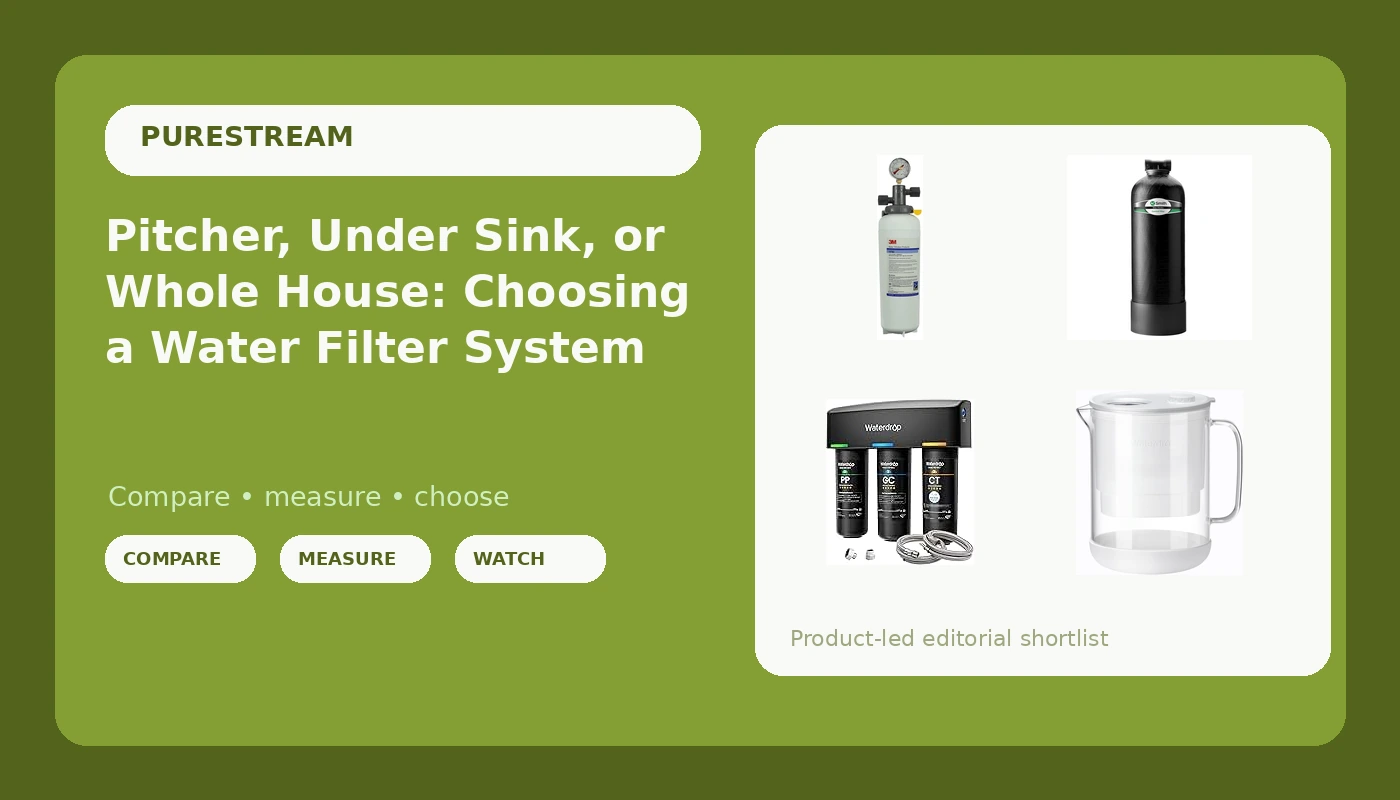
A water filter system is not one product category. It is at least four, and they solve different problems at different points in your plumbing. A pitcher sits in the refrigerator and makes cold water taste better. An under sink unit handles the water you actually drink and cook with. A whole house filter treats every tap, shower, and washing machine in the building. A high-capacity commercial unit keeps a break room or a coffee bar supplied at flow rates a home never needs.
The problem is that all four get sold with the same language: "removes 99.9% of contaminants," "clean, healthy water," and a photograph of a mountain stream. None of that tells you whether the thing removes the contaminant you actually have. This guide walks through four filters at four different scales, what each one is built to do, and how to match the hardware to your water instead of to the label.
Related: How to Read an NSF Certification Number on a Water Filter →
Quick answer
Match the filter to the problem and to the point of use. If your only complaint is taste and you want cold water with zero installation, a pitcher is the right tool. If you want certified chlorine and taste reduction at a dedicated kitchen tap, an under sink system is the next step up. If sediment or chlorine is affecting every fixture in the house, you need a whole house unit installed at the main line. If you are running a coffee shop, a break room, or any setting that pulls dozens of gallons a day, you need a high-capacity unit with a published flow rate and a real capacity rating. The four filters below cover those four jobs. None of them is universally better than the others, and a claim that one is best for everyone is marketing, not engineering.
4 useful options
| Model | Best fit | What stands out |
|---|---|---|
| Waterdrop PT-72W Glass Water Filter Pitcher, 7-Cup, Eco-Friendly, White | Renters and small households that want cold, better-tasting water without installation | 7-cup glass pitcher, no plumbing required |
| Waterdrop TSA 8 Layer Under Sink Water Filter System, NSF/ANSI 42 Certified | Kitchens that want certified filtration at a dedicated tap | NSF/ANSI 42 certification and 8-layer media |
| A. O. Smith Whole House Water Filter System | 600K Gal | AO-WH-Filter | Homes treating water at the main line | 600,000 gallon rated capacity |
| 3M Water Filtration Products Filter System, Model BEV160, 35000 Gallon Capacity, 3.34 gpm Flow Rate, 0.2 Micron | High-volume residential and light commercial use | Published 3.34 gpm flow rate and 0.2 micron rating |
The entry point: Waterdrop PT-72W Glass Water Filter Pitcher, 7-Cup, Eco-Friendly, White
Pitchers are the cheapest way into filtration and the most expensive way to stay in it. The unit is inexpensive and the cartridges are not, and a 7-cup reservoir is about three large glasses, so a family of four refills it constantly. Gravity does the work, which means the flow rate is whatever gravity gives you and no specification sheet will promise you more. What a pitcher does well is remove the taste and odor problems that make people stop drinking tap water in the first place, and it does it with no plumber, no landlord conversation, and no cabinet space. The glass body is the detail worth noting here: if you are replacing a pitcher specifically to get away from plastic in contact with your drinking water, this is one of the fewer options that gives you that. Check the certification statement on the cartridge before you assume it addresses anything beyond taste and chlorine, because most pitcher cartridges do not.
The kitchen upgrade: Waterdrop TSA 8 Layer Under Sink Water Filter System, NSF/ANSI 42 Certified
Under sink filtration is where most households should land if they care about the water they drink and cook with but do not want to treat the whole house. You get better media, higher flow, and longer cartridge life than any pitcher, and the water comes out of a tap you can fill a pot from. The certification matters more than the layer count. NSF/ANSI 42 is the aesthetic standard: it covers chlorine taste and odor and particulate reduction. It is not the health contaminant standard. If lead, cysts, or volatile organic compounds are your concern, you want a unit that also carries NSF/ANSI 53 for those specific contaminants, and the certification listing will name them one by one. Eight layers sounds impressive, and layer counts are a marketing metric rather than a performance one. Read the certification number and the contaminant list, then decide.
The whole home option: A. O. Smith Whole House Water Filter System | 600K Gal | AO-WH-Filter
A whole house filter is a different purchase decision than anything else on this list, because it is plumbing work, not an appliance. It goes in on the main line, usually ahead of the water heater, and everything downstream benefits: showers, laundry, the dishwasher, and every faucet. That is also its limitation. Point of entry filtration has to handle the whole house flow rate without choking your shower, so it generally targets the broad problems, sediment and chlorine, rather than the narrow ones. It is not a water softener. If your problem is hardness, that is an ion exchange process and this is not that device. The 600,000 gallon capacity rating is the number to think about: it is a rated volume, and real life depends on how much sediment your incoming water carries. Heavily loaded municipal or well water shortens that interval, and a cheap sediment prefilter upstream will protect the cartridge that costs real money.
The high capacity option: 3M Water Filtration Products Filter System, Model BEV160, 35000 Gallon Capacity, 3.34 gpm Flow Rate, 0.2 Micron
This one belongs in a different conversation than the first three, and that is the point. A 0.2 micron rating is a tight pore size, tight enough that it is doing work a standard carbon block is not, and it comes with the trade-off that tight media loads up faster and costs more to replace. The 3.34 gpm flow rate is the number that makes it usable in a commercial setting: a coffee brewer, a steamer, or a busy break room needs water at a rate a pitcher cannot approach and many residential cartridges cannot sustain. The 35,000 gallon capacity is lower than the whole house unit above, which sounds backwards until you remember that this is filtering to a much finer degree at much higher flow, and those two things fight each other. If you are specifying this for a business, the decision is straightforward: does your peak demand fit inside 3.34 gpm, and does your annual volume fit inside 35,000 gallons before the cartridge change? If yes, this class of unit is the correct answer. If you are a homeowner with a normal kitchen, it is more filter than your plumbing needs.
Prices and availability may change. Product images, names, and retailer links must be matched by verified ASIN. Do not state a current price, rating, stock status, or measured result without current evidence.
What the certification numbers actually mean
The single most useful thing you can do before buying any filter is look up its certification. NSF/ANSI 42 covers aesthetic effects: chlorine taste and odor, and particulate reduction. NSF/ANSI 53 covers health effects, and it is contaminant by contaminant, so a filter can be certified for lead and not for cysts, or the reverse. NSF/ANSI 401 covers emerging contaminants like some pharmaceuticals. A manufacturer that says "tested to NSF standards" without listing a standard and a certification number has told you nothing you can verify, and you can check any real claim against the public certification listings.
Two more label terms deserve translation. Micron rating is the nominal pore size of the media. A 0.2 micron rating is tighter than the 5 micron and 1 micron ratings common on sediment cartridges, and tighter means more captured and faster clogging. Smaller is not automatically better; it is a trade against capacity and replacement cost. "Removes 99.9% of contaminants" without a contaminant list is a sentence with no content. The only version of that claim worth reading names the contaminant and the standard it was tested under.
Flow rate, capacity, and the cost per gallon
Flow rate is the specification people ignore until they are standing at the sink waiting. It is measured in gallons per minute, and it determines whether a filter is a pleasure or an obstacle. The 3M unit publishes 3.34 gpm, which is generous for a point of use application. A gravity pitcher publishes nothing because gravity sets the pace, and it is slow. An under sink cartridge sits in the middle. When you compare units, compare the flow rate at the end of the cartridge's life rather than at the beginning, because media loads up and flow drops as it does.
Capacity ratings work the same way. The whole house unit is rated for 600,000 gallons and the 3M for 35,000. Those are rated volumes under specified test conditions, not promises about your water. High sediment, high chlorine, or high hardness all shorten the interval. Cost per gallon is the honest metric: take the purchase price plus the cost of every replacement cartridge you expect to buy, and divide by the gallons the system is rated to deliver. Do that math before you buy, not after. The replacement filter is the real price, and the pitcher is the bait.
- Find your water report or test your water, and write down the actual contaminants, not the general worry.
- Match each contaminant to a certification standard: 42 for taste and chlorine, 53 for specific health contaminants.
- Confirm the certification number exists in the public listings before you trust the box.
- Check the flow rate against your real demand, and check capacity against your annual volume.
- Calculate cost per gallon including every replacement cartridge over the life of the unit.
Matching a filter to your household
- Count your daily drinking and cooking water first. A 7-cup pitcher is about three glasses, and that refill frequency is the real user experience.
- If you rent, weight the installation requirement heavily. A pitcher asks nothing of your landlord; an under sink or whole house unit does.
- If you have one bad tap and the rest are fine, you want point of use filtration, not point of entry.
- If the problem shows up in the shower, the laundry, or the water heater, you want the main line, because no kitchen filter fixes a whole-house issue.
- Buy the replacement cartridges before you need them, and put the change date on the calendar. A filter past its rated volume is not filtering, it is passing water.
Which option should you choose?
Choose the Waterdrop PT-72W Glass Water Filter Pitcher when your complaint is taste and temperature, you want zero installation, and you like the idea of a glass vessel instead of plastic. Choose the Waterdrop TSA 8 Layer Under Sink Water Filter System when you want certified chlorine and taste reduction at a kitchen tap and you are willing to work under the sink once. Choose the A. O. Smith Whole House Water Filter System when sediment or chlorine is a whole-house problem and you are ready to treat the water at the main line. Choose the 3M Water Filtration Products Filter System when you need a published flow rate and a tight micron rating for a high-volume or commercial setting.
A caveat worth stating plainly: none of these four addresses hardness, and none of them is a substitute for knowing what is actually in your water. Certification covers what a product was tested to remove, not what your specific supply contains.
The bottom line
The right water filter system is the one that matches the contaminant, the point of use, and the volume you actually consume. Pitchers win on convenience and lose on cost per gallon and speed. Under sink units are the sensible middle for most kitchens, provided you read the certification rather than the layer count. Whole house filtration is plumbing, and it belongs in the conversation only when the problem is house-wide. High-capacity commercial units exist because flow rate and micron rating are engineering constraints, not marketing adjectives. Decide what you need removed, verify the certification number, run the cost per gallon, and the choice usually makes itself.