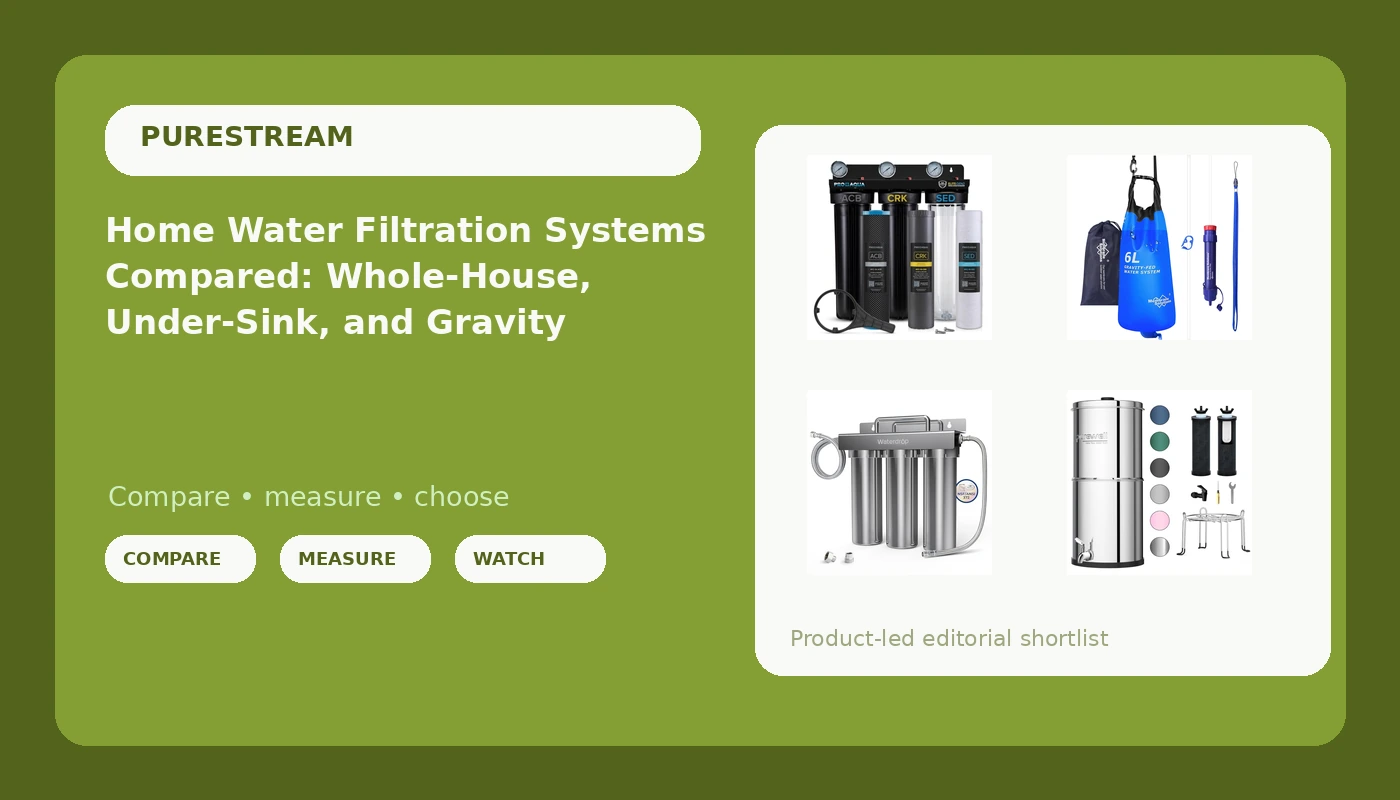
Home water filtration systems are usually sold on fear, which makes them genuinely hard to shop for. The labels shout about contaminants, the prices span two orders of magnitude, and almost nothing on the box tells you where the unit installs or what it costs to keep running. The four systems below are not four versions of the same product. One mounts at the main line and treats every drop entering the house. One tucks under a kitchen sink and treats a single tap. Two are gravity-fed units that need no plumbing at all, one sized for a countertop and one sized for a group. Choosing among them is a plumbing and lifestyle question before it is a chemistry question, and the filter you will actually maintain beats the one with the longer spec sheet.
Related: How to Read an NSF Certification Number on a Water Filter →
Quick answer
There is no single best home water filtration system in this group, because each unit treats different water at a different point in the house. If you want every tap, shower, and appliance covered, a whole-house point-of-entry system is the right category. If you want filtered drinking water at one sink without cutting into the main line, an under-sink ultra-filtration system is the right category. If you have no plumbing to work with, rent, or need water away from a faucet, a gravity filter is the right category. Match the category to your water and your kitchen first, then compare replacement filter costs before you commit.
Four useful options
| Model | Best fit | What stands out |
|---|---|---|
| PRO+AQUA Elite Series GEN2 PRO-100-E 3-Stage Whole House Water Filtration System | Treating all water entering the home | Three stages, pressure gauges, 1 inch ports, city and well water |
| Waterdrop TST-UF 0.01μm Ultra-Filtration Under Sink Water Filter System | Filtered drinking water at one tap | 0.01 micron ultra-filtration, no storage tank, under-sink footprint |
| Purewell 3-Stage 0.01μm Ultra-Filtration Gravity Water Filter System | Countertop filtration without plumbing | Listed NSF/ANSI 42 and 372, 304 stainless steel body, 2.25 gallon capacity, two filters and a stand included |
| Membrane Solutions 6L Gravity Water Filter Pro for Group Camping | Portable and group use | 6 liter gravity capacity, no plumbing or power required |
Point-of-entry: PRO+AQUA Elite Series GEN2 PRO-100-E 3-Stage Whole House Water Filtration System
This is the only category here that changes the water going to your shower, your washing machine, and your water heater, which is also why it is the only one that requires a plumber or a confident DIY afternoon. The pressure gauges matter more than they look: a gauge before and after the media lets you watch pressure drop as the cartridges load up, which is the honest signal that a change is due rather than a calendar. Two things to hold in mind. First, a three-stage system like this is filtration, not reverse osmosis, so it is not designed to strip dissolved solids down to near-zero TDS. Second, sediment capacity is the limiting factor on well water, so budget for the prefilters, not just the machine.
Point-of-use: Waterdrop TST-UF 0.01μm Ultra-Filtration Under Sink Water Filter System
Ultra-filtration sits in a useful middle ground. It is fine enough to hold back particles and microorganisms far smaller than a sediment filter can catch, and unlike reverse osmosis it does not reject dissolved minerals, so it does not need a drain connection or a tank. The trade-off is exactly that: because it is not rejecting dissolved solids, a TDS meter reading before and after will barely move, and a low TDS number is not the point of this unit. The other trade-off is flow. A tighter membrane restricts flow more, and the flow you get depends heavily on your existing line pressure. If your kitchen already runs at low pressure, check that before buying any restrictive under-sink filter.
Countertop gravity: Purewell 3-Stage 0.01μm Ultra-Filtration Gravity Water Filter System
The certifications are the interesting part here, and they are worth reading correctly. NSF/ANSI 42 covers aesthetic claims, taste and odor and chlorine reduction, which lines up with the chlorine figure in the listing. NSF/ANSI 372 is not a contaminant standard at all; it certifies that the wetted materials meet the lead content requirements of the Safe Drinking Water Act. So this unit carries a real taste-and-chlorine certification and a real materials certification, and it does not carry an NSF/ANSI 53 health-contaminant certification, because none is listed. That is not a flaw, it is just the honest reading of the label. The real cost of gravity is time: with no line pressure pushing water through the media, refills take minutes, not seconds, and a 2.25 gallon reservoir is a household supply rather than an unlimited tap.
Portable gravity: Membrane Solutions 6L Gravity Water Filter Pro for Group Camping
This is the one in the group whose job is portability rather than household supply. Nothing in the listing claims a certification number, so treat it as a field filter and not as a substitute for a certified countertop unit at home. The 6 liter capacity is what separates it from a personal bottle filter: it is enough to fill several people's bottles from one batch. Gravity flow is slow by design, and the rate falls as the media loads, which is the same breakthrough logic that applies to any filter. For a cabin, a campsite, or an emergency kit, slow is acceptable. For daily kitchen use, slow is the reason people stop using a filter.
Prices and availability may change. Product images, names, and retailer links are matched to verified listings. No current price, rating, stock status, or measured result is stated here without current evidence.
What the NSF numbers on the label actually mean
Three standards come up constantly in this category, and mixing them up is how shoppers end up disappointed.
NSF/ANSI 42 is the aesthetic standard. It covers taste, odor, and the reduction of chlorine and particulates. A filter certified to 42 is a taste and clarity filter, and that is a legitimate thing to buy.
NSF/ANSI 53 is the health-effects standard. It covers specific contaminants such as lead, volatile organic compounds, and certain cysts, and it is always certified contaminant by contaminant, not as a blanket statement. A listing that says "NSF/ANSI 53" without saying which contaminants has told you very little.
NSF/ANSI 372 certifies lead-free wetted materials. It says nothing about what the filter removes. It is a plumbing safety standard, not a performance standard.
The phrase to watch for is "tested to NSF standards." That is not the same as certified by NSF, and without a certification number and a standard number, it is a marketing sentence. A real certification has a number you can look up.
Micron rating, flow rate, and the trade-off nobody mentions
Micron rating describes pore size, and the instinct is that smaller must be better. Smaller pores do catch finer material, but they also clog faster and restrict flow more, which is why ultra-filtration membranes sit at the restrictive end of the range and sediment prefilters sit at the open end. A 0.01 micron membrane is doing real work, and it is also the reason a gravity unit takes minutes per batch and an under-sink unit needs decent line pressure behind it.
TDS, or total dissolved solids, is the other number people fixate on. It measures dissolved minerals and salts in parts per million. It is not a health meter and it does not detect lead or chlorine, but it is a genuinely useful filter-performance meter for anything that rejects dissolved solids, like reverse osmosis. For ultra-filtration and carbon-based systems, a flat TDS reading before and after is expected, not a failure.
- Test your water first, or pull the utility's annual water quality report, so you know whether the problem is taste, sediment, hardness, or a specific contaminant.
- Decide the point of treatment: whole house, one tap, or no plumbing at all.
- Check the certification number and the standard it belongs to, and write down which contaminants it actually covers.
- Compare replacement filter cost per gallon, not the purchase price, because the cartridges are the recurring expense.
- Confirm the flow rate you can live with, then confirm the unit fits your cabinet, counter, or main line.
Practical guidance before you buy
- Buy the replacement filters at the same time as the system. A filter with no spare cartridges on hand is a filter that gets run past breakthrough.
- Keep a log of install date, filter change date, and any pressure or flow observations. Patterns show up in writing that you will not notice day to day.
- If a unit installs on the main line, check your line size and available space before ordering, and account for the pressure drop the media will add.
- For gravity units, plan storage. A filled countertop reservoir is heavy, and it needs a spot where refilling is not a chore.
- Treat any claim of removing "everything" as incomplete until you see the contaminant list and the certification behind it.
Which option should you choose?
Choose the PRO+AQUA Elite Series GEN2 PRO-100-E 3-Stage Whole House Water Filtration System when you want every fixture in the house on filtered water and you have main-line access for a 1 inch connection. Choose the Waterdrop TST-UF 0.01μm Ultra-Filtration Under Sink Water Filter System when drinking water at one kitchen tap is the goal and you would rather not run a drain line or give up cabinet space to a tank. Choose the Purewell 3-Stage 0.01μm Ultra-Filtration Gravity Water Filter System when you want a countertop unit with listed certifications and no plumbing work at all. Choose the Membrane Solutions 6L Gravity Water Filter Pro for Group Camping when the water you need to filter is not in your kitchen.
The caveat that applies to all four: certification listings, contaminant coverage, and replacement schedules are set by the manufacturer, and they change. Verify the current certification and the current filter part numbers for your specific water before you install anything, and if you are on a private well, test the water rather than assuming.
The bottom line
The category decision comes first, and it is not close. Whole-house filtration solves a whole-house problem. Under-sink ultra-filtration solves a drinking-water problem at one tap without a tank or a drain. Gravity filtration solves a plumbing problem, at the cost of speed. Once you have picked the category, the honest comparison is not the sticker price but the cost per gallon across the life of the unit, plus the flow rate you will still tolerate in month six. Buy for the water you actually have, plan for the cartridges before you need them, and read the certification number instead of the headline. That is the whole method.