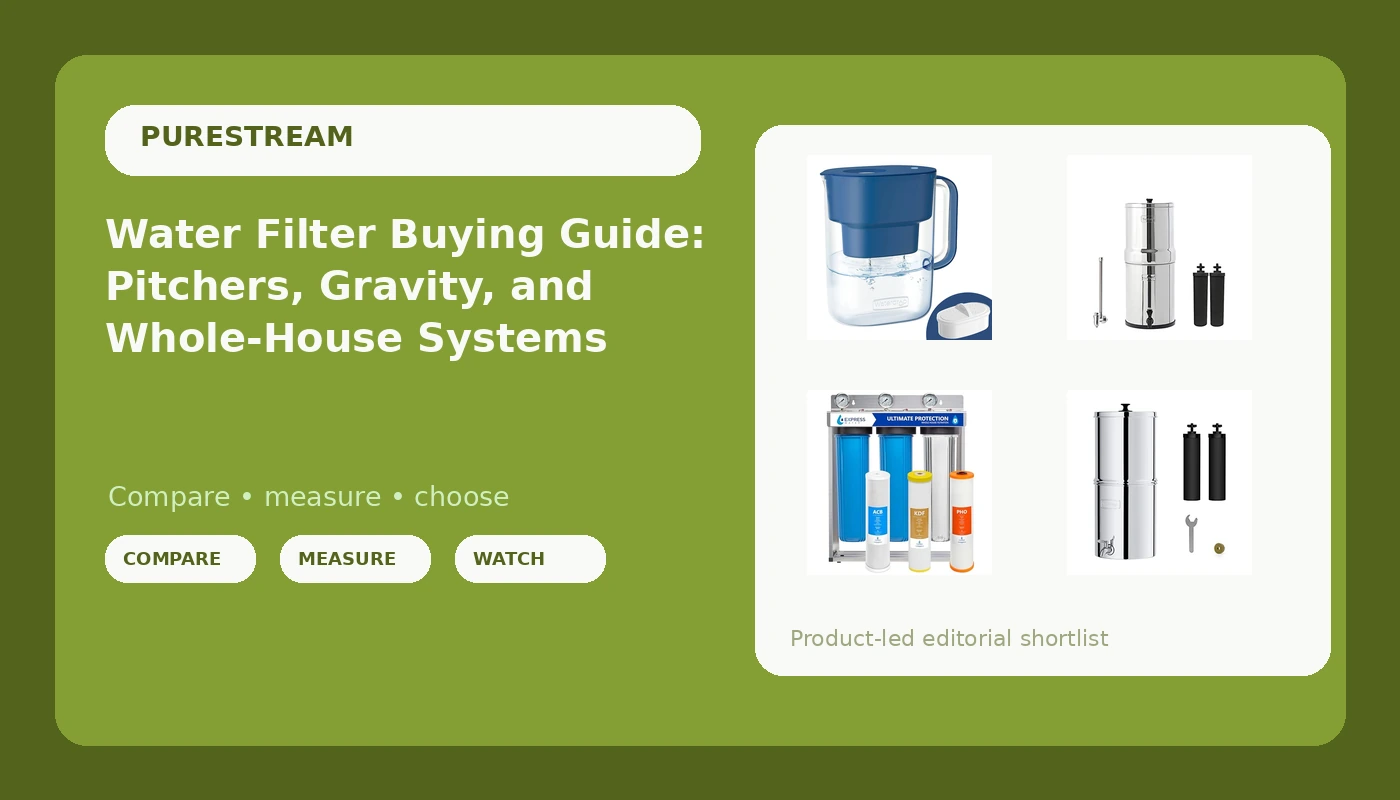
Related: How to Read an NSF Certification Number Before You Buy a Filter
Most people start this search the same way. They buy a pitcher, they drink better water for three weeks, and then they wonder why the water tastes like a swimming pool again. I started there too, with Madison tap water that smelled like a public pool and a kid who refused to drink it.
Here is what years on a lab bench and a logbook full of readings taught me about the water filter buying guide question. It is not "which filter is best." It is "what am I trying to remove, and how much water do I need to move in a day." Answer those two and the category picks itself.
There are three honest categories in this roundup: a countertop pitcher you keep in the fridge, a gravity system you fill by hand, and a whole house unit that treats everything entering the building. I also included a second gravity option, because its certification label says something different than most shoppers assume, and that difference is worth understanding before you spend a dollar.
Two rules before you scroll. First, the replacement filter is the real price. The pitcher is the bait. Second, a certification number means something. "Tested to NSF standards" without a number means nothing at all.
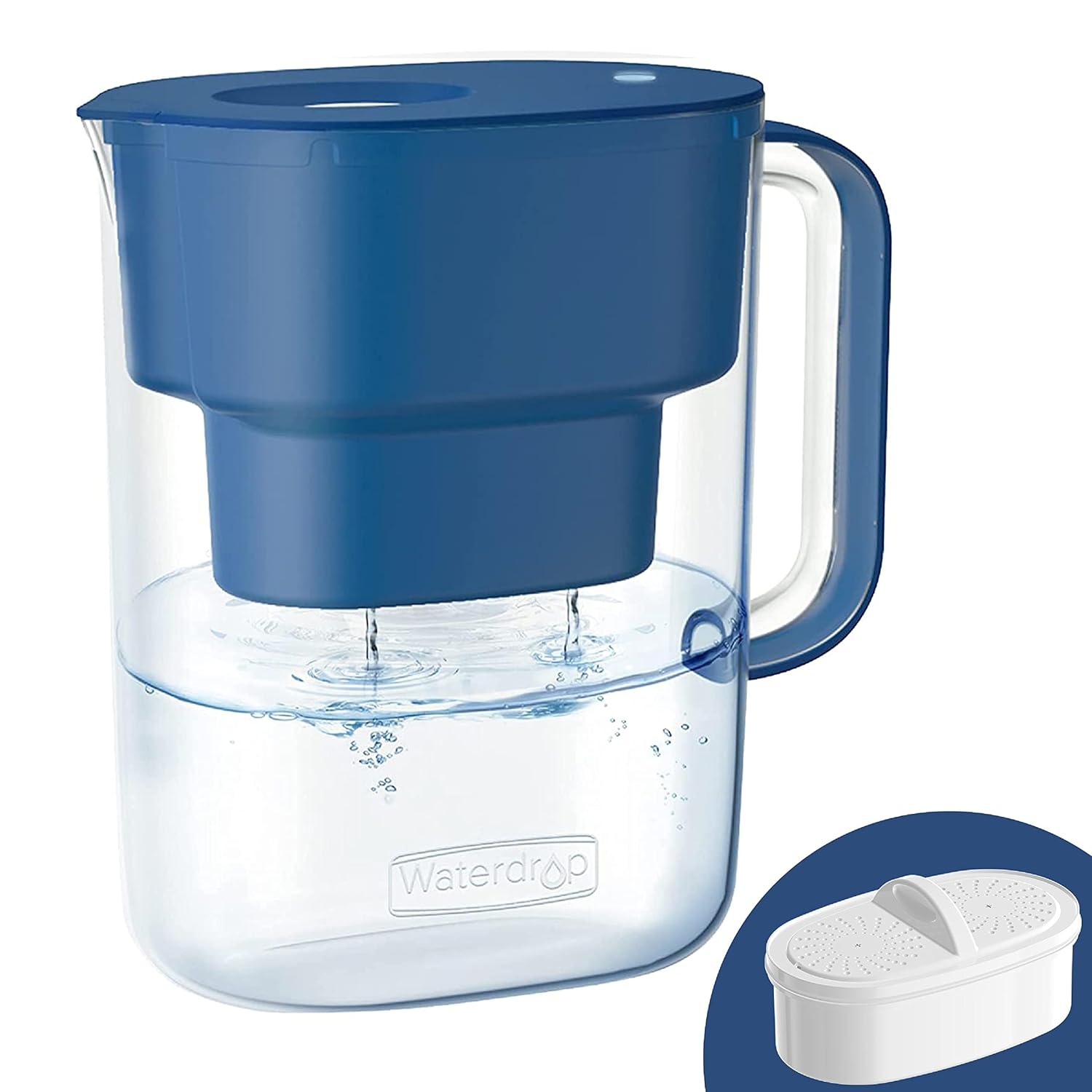
Best for the Fridge: Waterdrop PT-07C Water Filter Pitcher
This is the category most households should start with, and the 10-cup PT-07C is a clean example of it. A reservoir you fill from the tap, a cartridge that works while you walk away, and a body that lives in the fridge instead of on the counter. The unit is NSF certified, which matters more than any adjective on the box.
A pitcher is not a plumbing project. That is the whole pitch, and it is a good pitch. You fill it, you wait, you pour. The trade is volume. You are not waiting on a glass, you are waiting on a reservoir, and a full reservoir is what gets a family through dinner.
The real cost lives in the cartridge, not the pitcher. Do the math before you buy: cartridge price divided by the gallons it is rated for. That is your cost per gallon, and it is the only honest way to compare two pitchers. If the number embarrasses you, the pitcher is a decoration.
Two pitcher rules. If a cartridge is rated for months of life but the flow chokes to a drip after a few weeks, the rating is fiction and the media is exhausted. And skip anything that advertises added minerals. That is rocks in a cartridge making your water harder, not healthier.
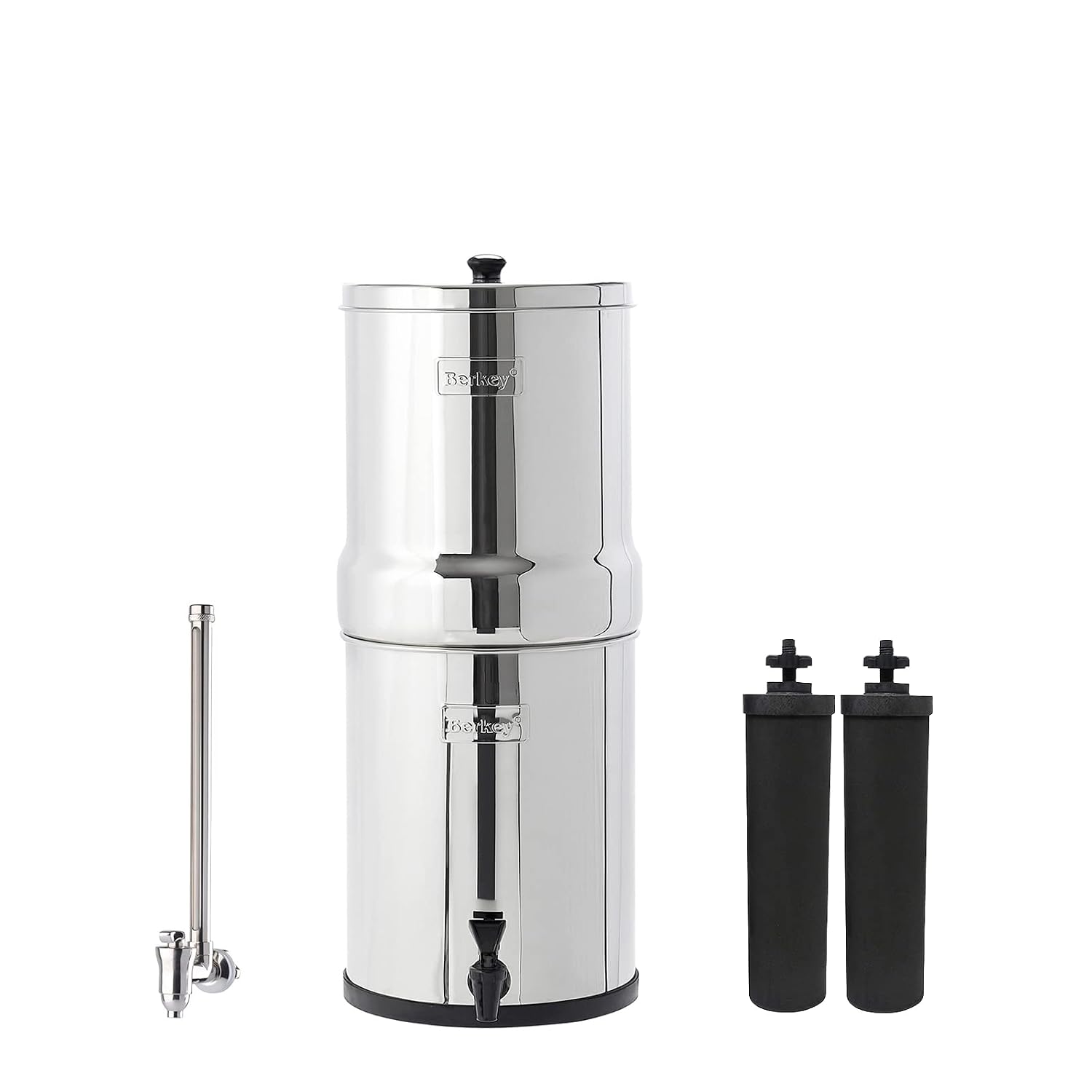
Best for Outages and Off-Grid: Royal Berkey 3.25 Gal Gravity System
Gravity systems are the category I recommend for emergencies and awkward for daily life, and I say that with affection. Nobody wants to wait on a liter of water when they are thirsty. What nobody argues with is 3.25 gallons of reserve sitting on the counter with no electricity, no plumbing, and no pump.
The Royal Berkey is stainless steel with a water view spigot, so you can see the level without lifting the lid. You fill the top chamber, gravity pulls the water through the media, and the lower chamber holds the finished water until you draw it off. For a cabin, a well, a storm week, or a household that simply wants a deep bench of drinking water, that design earns its counter space.
Two honest caveats. First, the footprint is real. This is a 3.25 gallon unit, so measure your counter before you order it. Second, read the certification language on the listing carefully. Gravity filters in this class do not all carry the same point of use certification numbers as the countertop units below, and a manufacturer claim is not the same thing as a certification. Ask for the number, then check it.
Best for the Whole House: Express Water 3-Stage System
This is a different job entirely. A whole house system installs at the point of entry, on the main line, and treats every drop that enters the building. Three stages of sediment and carbon protection mean your showers, your laundry, your dishwasher, and your water heater all see cleaner water than they would otherwise.
That is worth real money in a house with hard, chlorinated municipal water. Chlorine is hard on rubber seals, on appliance finishes, and on skin. Sediment is hard on everything downstream of it. A point of entry system is a building maintenance decision as much as a drinking water decision.
Be clear about what it is not. A three stage sediment and carbon system is not a drinking water filter for dissolved contaminants. If you want lead or dissolved solids addressed at the glass, that is a point of use job, and you want a certification number that speaks to health contaminants rather than taste. Pair the two and you have a complete answer. Buy only this and assume the kitchen tap is solved, and you have a very expensive shower filter.
Installation is a plumbing job with a cartridge schedule attached to it. Three housings, three replacement intervals, and a pressure drop you should understand before you cut into the main line.
Best Certified Gravity Option: Waterdrop TK-A Gravity System
This is the one I want you to read the label on, because the label is doing two separate jobs and most shoppers collapse them into one.
NSF/ANSI 42 is the aesthetic effects standard. It covers things like chlorine taste and odor and particulate reduction. NSF/ANSI 372 is the lead free materials standard. It certifies that the wetted components of the system meet lead free requirements. That second number is a materials safety statement about the hardware, not a promise that the filter pulls lead out of your water.
I am not splitting hairs here. If you have a lead concern, you need a certification that speaks to lead reduction in the water, and you should look for a system certified to the health contaminants standard or an RO membrane system. A gravity unit with a 42 and 372 label is a genuinely useful countertop filter with no electricity and no installation. It is just not a lead removal device, and no marketing copy changes that.
As a daily countertop gravity filter, the design is sensible. You pour in the top, gravity does the work, and you draw finished water from the bottom. It is slower than a pitcher you pre fill, and it is faster than standing at the sink waiting for a glass.
How I evaluate a filter
Every unit gets the same four questions before it earns a recommendation.
What does the certification number say it removes, and what did the manufacturer test against? A number on a listing beats a paragraph on a box every time.
What is the flow rate at the end of a cartridge's life, not at gallon one? A filter that starts strong and finishes as a trickle is a faucet decoration.
What does it cost per gallon including replacements? Sticker price divided by rated gallons tells you almost nothing. Cartridge price divided by rated gallons tells you everything.
Would I serve it to my kid every day? That is the final gate, and it filters out a lot of clever products.
Analysis: what the numbers actually tell you
TDS is not the whole story, but it is a damn good start. A total dissolved solids reading tells you how much is dissolved in the water, and it tells you almost nothing about whether any of it is harmful. What it does beautifully is show you whether a filter is still working. When the number starts climbing back toward your tap baseline, the media is exhausting and the replacement schedule is not optional.
Flow rate is the spec people ignore until they are standing at the sink waiting. Gravity systems are patient by design, pitchers trade speed for a reservoir, and whole house systems trade pressure for protection. None of those are flaws. They are just things you should know before the box arrives.
Breakthrough is the reason replacement schedules exist. When the media is exhausted, contaminants start passing through, and the filter does not announce it. That is why I put cost per gallon next to every purchase price. A cheap system with a costly cartridge is not cheap, and an expensive system with a long interval can be the better buy.
Certification numbers are the closest thing this category has to a shared language. Aesthetic effects standards cover taste and chlorine. Health contaminant standards cover things like lead. Materials standards cover the hardware itself. If a filter claims to remove everything, it is either lying or stripping minerals you might actually want. Read the number, not the adjective.
The comparison table
| Product | Type | Certification | Where it fits | Price |
|---|---|---|---|---|
 Visit on Amazon → Waterdrop PT-07C Pitcher |
Countertop pitcher | NSF certified per listing | Fridge water, renters, small kitchens | $16.99 |
 Visit on Amazon → Royal Berkey 3.25 Gal |
Gravity countertop | Verify current certification on listing | Outages, cabins, wells, large reserve | $458.00 |
 Visit on Amazon → Express Water 3-Stage |
Whole house, point of entry | Check listing for current standard | Plumbing, appliances, showers, laundry | $443.14 |
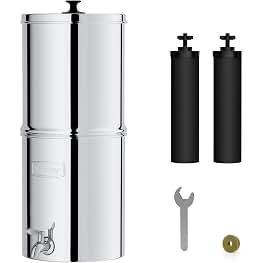 Visit on Amazon → Waterdrop TK-A |
Gravity countertop | NSF/ANSI 42 and 372 | Certified taste and chlorine reduction, lead free materials | $159.99 |
Should you buy the Waterdrop PT-07C pitcher?
Yes, if the goal is better tasting fridge water with zero installation and a small footprint. It is a 10 cup NSF certified pitcher, and it does the one job pitchers are genuinely good at: it makes a reservoir of cold water that a kid will actually pour and drink.
The catch is the cartridge, and it is always the cartridge. Run the cost per gallon math before you buy, keep a spare on the shelf, and replace it on schedule rather than waiting for the flow to die. Skip the mineral adding versions entirely. Harder water is not healthier water.
Should you buy the Royal Berkey 3.25 Gal?
Yes, if you want a serious reserve of drinking water that works when the power does not. No electricity, no plumbing, no pump, and a water view spigot that shows you exactly how much you have left. For a cabin, a well, or a household that has watched a storm take out the water plant, that is a real kind of insurance.
Go in knowing that gravity is slow and that 3.25 gallons takes up counter space. And verify the certification language on the current listing before you buy. A manufacturer claim is not a certification number, and the number is what you want.
Should you buy the Express Water 3-stage system?
Yes, if your problem is the whole building rather than the glass. Sediment and carbon protection at the point of entry is money well spent on plumbing, appliances, and the water hitting your skin in the shower. Chlorine is not kind to rubber seals or to people.
Just do not expect it to solve the kitchen tap. A three stage sediment and carbon system is a building system. If you want dissolved contaminants addressed at the glass, add a certified point of use filter and read the certification number before you trust the claim.
Should you buy the Waterdrop TK-A gravity system?
Yes, if you want a countertop gravity filter with certification numbers you can actually look up. NSF/ANSI 42 for taste and chlorine reduction, NSF/ANSI 372 for lead free materials. That is a meaningful pair of labels on a no electricity, no installation design.
Do not read the 372 as lead removal. It is a materials standard, not a contaminant removal claim. If lead is your concern, look for a system certified to the health contaminants standard or an RO membrane, and pair it with the gravity unit rather than replacing it. Read the number, not the adjective, and you will end up with the right filter for the water you actually have.