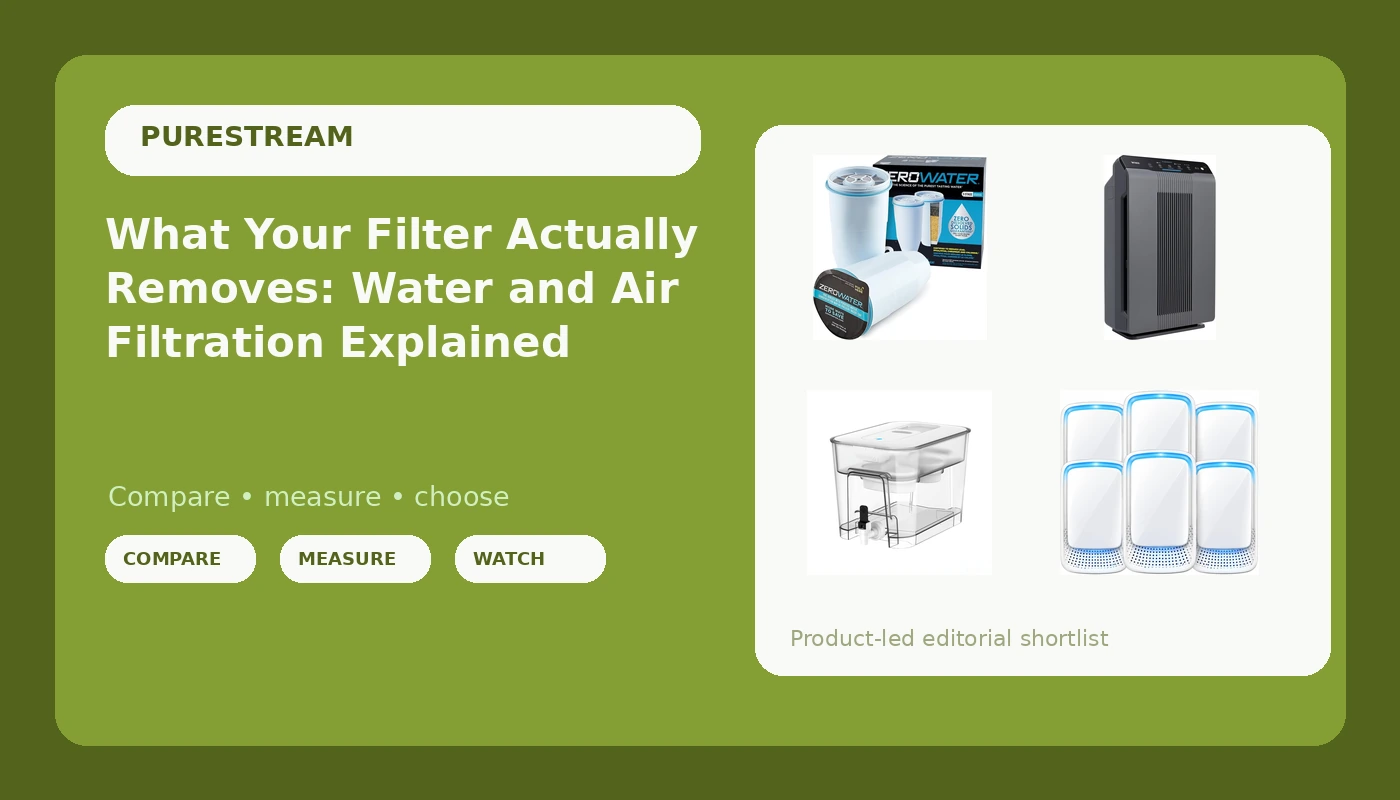
Most households do not have a filtration problem. They have a specific problem, and it usually has a name: chlorine taste, a TDS reading that keeps climbing, pet odor in a bedroom, or smoke that lingers after the windows close. A water filter dispenser will not help with any of the air problems, and an air purifier will not pull dissolved solids out of your tap. The buying logic, though, is identical for both. What does the device actually remove, what does it cost to keep running, and will you still be changing the cartridge six months from now? That is the framework I use on my own bench, and it holds whether the media is filtering water or air.
Related: How to Read an NSF Certification Number on a Water Filter →
Quick answer
If your concern is the water itself, a large-capacity dispenser paired with a standing supply of the cartridge it uses covers a kitchen without any plumbing work. If your concern is the air, a room-scale HEPA purifier and a plug-in ionizer do genuinely different jobs: the HEPA unit traps particles in media you replace, while the ionizer changes how particles behave in the room without trapping them at all. Match the device to the contaminant first, then compare the ongoing cost of consumables, because that is where the money actually goes.
Four useful options
| Model | Best fit | What stands out |
|---|---|---|
| Waterdrop WFD-22L-DF Water Filter Dispenser, 40-Cup Water Purifier, White | Households that want a large reservoir sitting on the counter | 40-cup capacity and a dispenser format that skips the lift-and-pour pitcher routine |
| ZeroWater Official Replacement Water Filter Removes PFOA/PFOS 2-Pack | Anyone already running a ZeroWater system | Two replacement cartridges, labeled by the manufacturer for PFOA and PFOS reduction |
| Winix 5300-2 Air Purifier with True HEPA, PlasmaWave and Odor Reducing Carbon Filter | Bedrooms and living rooms with particle and odor problems | Combines a True HEPA stage with a carbon odor stage and PlasmaWave |
| 2026 Upgraded Air Purifiers Plug In Negative Ion Air Ionizers, 6 Pack | Small rooms, pet areas, and spots where a full purifier will not fit | Six plug-in units with no filter media to replace, marketed for odor, smoke, dust, and pets |
The countertop reservoir: Waterdrop WFD-22L-DF Water Filter Dispenser
Here is the trade-off nobody puts on the box. A 40-cup reservoir takes up real counter space, and it holds water that has already been filtered, sitting there waiting to be drunk. Gravity-fed dispensers also pour at their own pace. That is fine when you are filling a glass; it is annoying when you are filling a pasta pot. The upside is that a dispenser removes the friction that kills pitcher ownership, which is the refilling. A pitcher you have to top off four times a day gets abandoned. A reservoir you fill once does not.
The other thing to check before buying any dispenser is which cartridge it takes and what that cartridge is certified to reduce. The reservoir is the bait; the cartridge is the price.
The consumable: ZeroWater Official Replacement Water Filter Removes PFOA/PFOS 2-Pack
ZeroWater's whole pitch is dissolved solids, and the media behind it is aggressive enough that the cartridges exhaust faster than a plain carbon pitcher cartridge would. That is not a defect. It is the cost of actually removing things rather than just polishing taste. But it means the math matters: if a cartridge is rated for a certain number of gallons, and your tap water starts at a high TDS, you will replace it sooner than the label suggests, because the media is spending itself on everything in the water, not just the contaminants you were worried about.
Two packs are a supply, not a subscription. Buying them in pairs is the cheapest way to keep from running a cartridge past the point where it stops doing its job. When media is exhausted, contaminants start passing through, and you usually notice it as a change in taste before you notice anything else.
The room-scale air option: Winix 5300-2 Air Purifier
True HEPA is a classification, not a brand name. It refers to filter media rated to capture a defined percentage of particles at a defined size, and it is the reason a HEPA unit is the right tool for smoke particles, pollen, and pet dander. Carbon is the stage that handles odor and many volatile organic compounds, and it is the stage that exhausts first in a smoky house. Check the room size rating and the replacement filter cost before you buy, because a purifier that is undersized for the room runs at high speed forever and burns through filters.
This is the device class where you are buying coverage for a whole room. Placement matters as much as the spec sheet: a purifier tucked behind a couch is a purifier working against a wall.
The plug-in spot option: 2026 Upgraded Air Purifiers Plug In Negative Ion Air Ionizers, 6 Pack
An ionizer is not a HEPA filter and should never be compared to one on removal. It works by charging particles so they clump and settle out of the air or attach to surfaces. That can visibly reduce haze and odor in a small space, and it costs nothing to maintain beyond the electricity. What it does not do is trap anything in a sealed media cartridge you can throw away, which means the particles are still in the room, just no longer floating.
One more consideration that belongs in any honest ionizer conversation: some ionizer designs produce ozone as a byproduct, and others are designed not to. If that concerns you, look for the manufacturer's own ozone statement rather than a marketing adjective. For a closet, a bathroom, or a pet corner, a plug-in unit is a reasonable spot tool. It is not a substitute for a HEPA purifier in a bedroom where someone is sleeping.
Prices and availability may change. Product images, names, and retailer links must be matched by verified ASIN. Do not state a current price, rating, stock status, or measured result without current evidence.
Why the certification number matters more than the word "filter"
A water filter label is a claim, and claims are cheap. Certification is not. The numbers you want to look for are NSF/ANSI 42, which covers aesthetic issues like taste, chlorine, and particulates; NSF/ANSI 53, which covers health-related contaminants including lead, cysts, and volatile organic compounds; NSF/ANSI 401, which covers a list of emerging compounds; and the PFOA/PFOS protocol, which is where a cartridge earns the right to put those four letters on the package.
The phrase "tested to NSF standards" without a certification number is meaningless. It means someone ran a test, not that an independent body verified the result and monitors the factory. The same logic applies on the air side: HEPA has a definition, and "HEPA-type" does not. If a product name says True HEPA, that is a claim you can check against the manufacturer's documentation.
What cost per gallon actually hides
A pitcher costs twenty dollars and the cartridges cost more than the pitcher every year. That is the whole trick of this category. The honest metric is cost per gallon: cartridge price divided by the gallons it is rated to treat. For air, the equivalent is annual filter cost per room.
The catch is that rated gallons assume a certain influent water quality. High TDS, high hardness, and heavy chlorine all spend filter media faster, so a cartridge rated for a number of gallons may not last that long on your water. Track the trend rather than trusting a single reading: measure your tap once, then measure the filtered water periodically, and watch for the point where the gap narrows. That narrowing is breakthrough, and it is your signal to change the cartridge, not the calendar.
A filter that slows to a trickle in a month is a faucet decoration. Flow rate and capacity are the specs people ignore until they are standing at the counter waiting.
Here is the method I would use, in order:
- Identify the problem before the product. Get your municipal water quality report, or a lab test if you are on a well, and write down what is actually in the water.
- Write down the air problem separately. Particles and odors are different problems with different hardware, and one device rarely solves both well.
- Check the certification number for the specific claim you care about, on the current listing, not on a review site.
- Do the consumable math: cost per gallon for water, cost per year for air.
- Check capacity against your household's actual daily use, then confirm the flow rate is something you can live with.
Practical guidance for a real kitchen and a real bedroom
- Put the cartridge change on a recurring calendar reminder the day you set the system up, and note the date you installed it on the cartridge itself.
- Store filtered water cold and covered. A dispenser reservoir that sits in sunlight grows things you did not filter out.
- Measure your tap water once with a TDS meter so you have a baseline, then treat the trend as the useful signal rather than the absolute number.
- For air, size the purifier to the room and put it where you breathe, not behind furniture.
- Treat a plug-in ionizer as a spot tool for small spaces, and keep it out of the room where the most vulnerable person sleeps unless the manufacturer's documentation addresses ozone.
Which option should you choose?
Choose the Waterdrop WFD-22L-DF Water Filter Dispenser when you want a large countertop reservoir and you are tired of refilling a pitcher several times a day. Choose the ZeroWater Official Replacement Water Filter 2-Pack when you already run a ZeroWater system and want a spare supply of the cartridge that keeps it working. Choose the Winix 5300-2 Air Purifier when the problem is airborne particles or odor in a room-sized space and you want media that traps what it captures. Choose the 6 Pack Plug In Negative Ion Air Ionizers when you want inexpensive, maintenance-free spot coverage in small spaces like closets, bathrooms, or pet corners.
One caveat worth stating plainly: this article describes what each product is and what it is designed to do based on the manufacturer's own labeling. It does not report measured removal results, because those depend on your water, your room, and your replacement habits. Verify the certification number on the current listing before you buy, and treat any removal claim without a number as marketing until proven otherwise.
The bottom line
Water filtration and air filtration are the same purchase in different clothing: you are buying media, a schedule, and a habit. The unit is the cheap part. The Waterdrop dispenser solves capacity, the ZeroWater two-pack solves supply, the Winix unit solves room-scale particles and odor, and the plug-in ionizers solve small-space spot duty with no cartridges at all. Pick the one that matches the contaminant you actually have, then commit to the replacement schedule. A filter you stop maintaining is just a container.