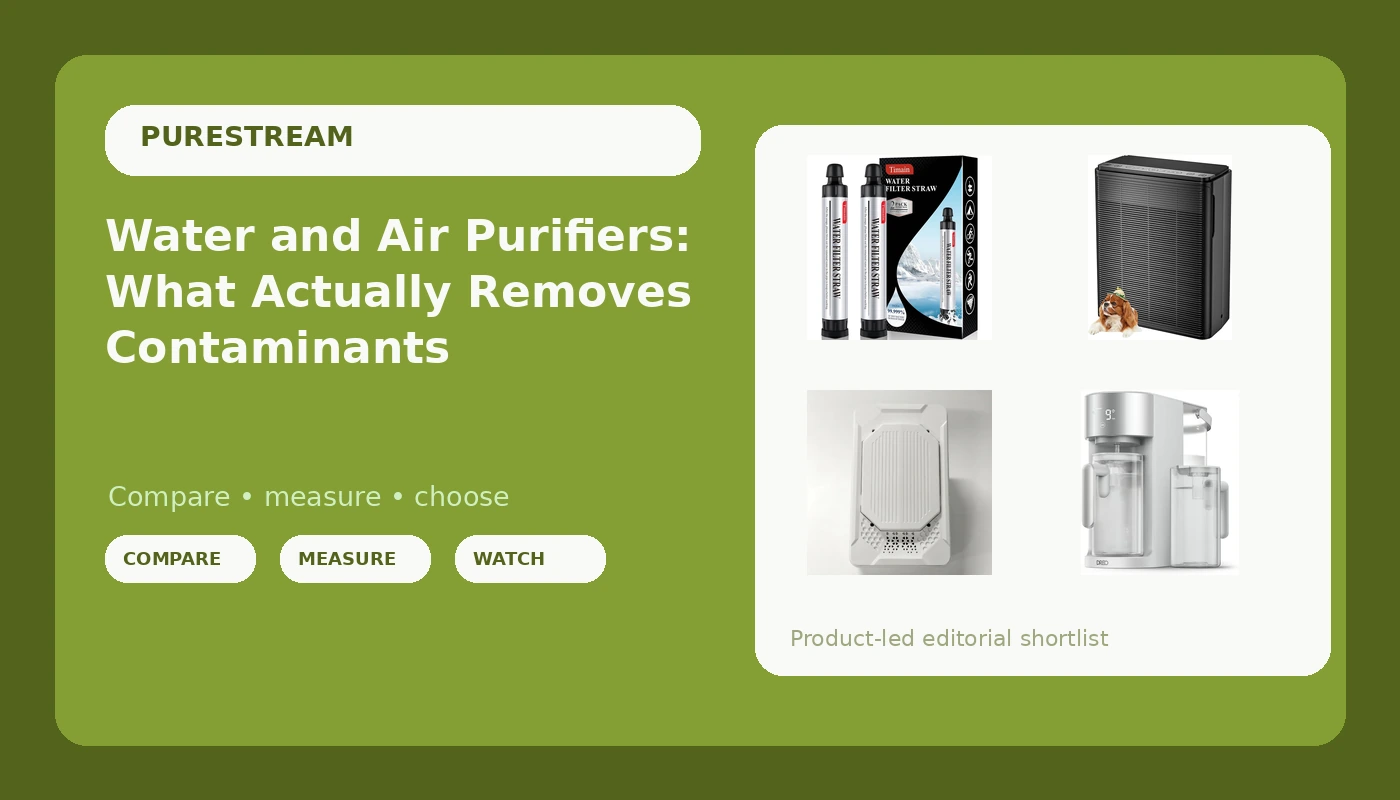
Most households shopping for water and air purifiers are trying to fix two unrelated problems: something in the glass tastes wrong or reads wrong on a meter, and something in the room smells or lingers. Those problems have different causes, different test methods, and different hardware, which is why a single "best purifier" list tends to be useless. This explainer covers four devices that handle four distinct jobs: a countertop reverse osmosis system for drinking water, a straw filter for emergency and travel water, a HEPA room air purifier for particles and pet dander, and plug-in negative ion generators for standing odors in small rooms. It also covers what to check on a label before you spend anything.
Related: How to Read an NSF Certification Number on a Filter Label →
Quick answer
No single device does all four jobs. If your concern is dissolved solids, taste, or mineral content in drinking water, the countertop RO unit is built for that. If your concern is drinking water while hiking, traveling, or during a boil-water notice, the straw filter covers that. If your concern is airborne particles such as pet dander, dust, or smoke in a large room, the H13 HEPA purifier addresses particles. If your concern is a bathroom, kitchen, or pet room that smells even when it is clean, the plug-in ionizers are aimed at odor. Match the device to the contaminant class first, then compare the specs.
4 useful options
| Model | Best fit | What stands out |
|---|---|---|
| DREO Reverse Osmosis Water Filter Countertop, RO Filtration System, 3:1 Pure to Drain, TDS & Filter Life & 2 Autofill Pitchers, Install-Free, Self-Cleaning Water Purifier, RO Water Filter | Drinking water at the kitchen counter | Listing states 3:1 pure to drain, an onboard TDS and filter life display, two autofill pitchers, and no installation |
| Timain 2 Pack 4-Stage Filtration, High Flow Rate Water Filter Straw, Water Purifier Survival for Emergency Kits, Travel, Camping, Hiking, Fishing, Hunting | Emergency kits, travel, hiking, camping | Two straws per pack, four-stage filtration described for direct-drink use |
| Air Purifiers for Home Large Room Up to 2000 Ft² with Washable Filters, AIUZLK H13 HEPA Filter,Bedroom Air Purifier for Pet,Air Cleaner for Smoke Pet Hair Dander Odor,P260 | Large rooms with pets, smoke, or dander | H13 HEPA media, a washable filter component, and a listing coverage rating up to 2000 square feet |
| 6 Pack Air Ionizerr for Home,Plug in Air Purifier with Negative Ion Generator,99% Odor Eliminator for Pet Odors,Quiet Negative Ion Air Purifiers for Bathroom,Living Room,Office,Kitchen,Pet Room | Bathrooms, kitchens, pet rooms, offices | Six units per pack, a negative ion generator, no fan, and a listing claim of 99% odor reduction |
The countertop unit: DREO Reverse Osmosis Water Filter Countertop
The trade-off with any RO system is that it is a maintenance commitment, not a one-time purchase. The membrane and the other cartridges have finite lives, and the filter life display exists because those lives are not identical. RO also strips minerals along with contaminants, which is why the water can taste flat to people used to tap water. That is a property of the process, not a defect. The 3:1 pure to drain figure means roughly a quarter of the water entering the unit goes to drain, which matters on a metered supply or a septic system. And a countertop unit occupies counter space permanently, usually next to the sink it draws from.
The travel filter: Timain 2 Pack 4-Stage Filtration Water Filter Straw
A straw filter is a specific tool for a specific problem: biologically questionable water when you are away from a treated supply. It is not a household purifier, and it is not a fix for chemically contaminated water, salt water, or a municipal system with a lead problem. The four-stage description refers to stacked media inside the straw, the usual way these devices handle sediment first, then finer filtration, then carbon for taste. The practical limit is your own suction, so real-world flow depends on the drinker, and capacity is measured in total liters rather than months. Two per pack means one can stay in a hiking bag and one in a car kit, which is the sensible way to store them.
The room air purifier: AIUZLK H13 HEPA Air Purifier P260
Coverage ratings like 2000 square feet are best read as geometry under ideal conditions. They typically assume a standard ceiling height and a set number of air changes per hour, and they describe the largest space the unit can serve rather than the space where you will notice a difference. HEPA media is the right tool for particles: pet dander, dust, pollen, smoke particles. It does nothing for gases, which is why cooking odor, paint, and some pet smells need carbon, not HEPA. The washable filter mentioned in the listing is a genuine cost factor, since a reusable stage reduces how often you buy replacements, but washable does not mean permanent. Check what is washable and what still has to be replaced.
The plug-in ionizers: 6 Pack Air Ionizerr for Home
Ionizers work differently from filters, and that difference matters. They release charged ions into the air, which causes particles to clump and drop out of suspension. The particles still exist; they land on surfaces, so you vacuum and dust more. That makes ionizers a reasonable supplement for a bathroom or pet room where odor is the complaint, and a weak substitute for a HEPA unit where the complaint is dander or smoke you want captured and removed. Some ionizer designs produce ozone as a byproduct, which is a real reason to read the listing and any safety documentation before placing six of them in a home with children or respiratory conditions. The 99% odor reduction figure is stated without a named test standard, so treat it as a claim rather than a measurement.
Prices and availability may change. Product images, names, and retailer links are matched to verified listings. No current price, rating, stock status, or measured result is stated here without current evidence.
What each purifier actually removes
The most common buying mistake is treating every purifier as interchangeable. They are not, because they target different contaminant classes.
Reverse osmosis targets dissolved solids. Water is forced through a membrane that rejects most dissolved minerals and salts, which is why RO systems drop TDS readings sharply and why they also strip out calcium and magnesium you might have wanted. Carbon stages before and after the membrane handle chlorine and many taste and odor compounds. RO is the appropriate tool for someone worried about dissolved contaminants, high TDS, or the flat taste of very hard water.
Straw filters target biological contamination. The media inside a straw is built to catch sediment and microorganisms in untreated surface water, and carbon improves taste. It is not a desalination device and not a defense against industrial chemicals or heavy metals at municipal levels.
HEPA purifiers target particles. HEPA media captures particles mechanically, including the dander, dust, and smoke particles that drive most indoor air complaints. It does not remove gases, so it will not fix a smell that comes from volatile compounds unless the unit also includes carbon.
Ionizers target suspended particles indirectly. They charge particles so the particles clump and settle, which can reduce what you smell in the air but does not destroy the source. Surfaces need cleaning, and ventilation still matters.
How to judge a purifier before you buy
Ignore the adjectives and read the four numbers that decide whether a device will still be working for you in six months.
- Identify the contaminant class before you shop: dissolved solids, microorganisms, particles, or gases. A device built for one class will underperform on another.
- Look for an NSF/ANSI certification number. "Tested to NSF standards" without a number tells you nothing about which contaminants were tested.
- Read the flow rate and rated capacity, and ask what happens near the end of the rated life, not on day one. A filter that slows to a trickle gets bypassed.
- Calculate cost per gallon including replacement media. The purchase price is the entry fee, not the cost.
- Check the physical requirements: counter space, outlet placement, drain access, ceiling height, and how loud the unit is in the room where you will actually sit.
Practical guidance for a two-part setup
- Test your water before buying anything. Your utility's annual water quality report is free and covers regulated contaminants; a certified lab test covers what the report does not.
- Let the countertop RO handle drinking and cooking water, and keep a simple pitcher in the fridge if cold water is what gets your household to drink more.
- Size the air purifier to the room it sits in, not the whole house. One unit rated for a large space, placed in a bedroom, will move more air through the media than the same unit spread thin across an open floor plan.
- Replace media on the schedule the manufacturer states, and note the date on the filter itself. Breakthrough happens quietly.
- Keep the straw filter in a kit, inspect it once a year, and remember that it is an emergency and travel tool, not a daily household solution.
Which option should you choose?
Choose the DREO Reverse Osmosis Water Filter Countertop when dissolved solids, taste, or hard water minerals are your actual complaint and you want treated drinking water without cutting into a cabinet or hiring a plumber. Choose the Timain 2 Pack 4-Stage Filtration Water Filter Straw when you need water treatment that fits in a pack for hiking, travel, or an emergency kit. Choose the AIUZLK H13 HEPA Air Purifier P260 when the problem is airborne particles: pet dander, dust, or smoke in a large room. Choose the 6 Pack Air Ionizerr for Home when the problem is lingering odor in small spaces like bathrooms, kitchens, and pet rooms, and you want something that plugs in and runs quietly.
The caveat is that none of these listings comes with independently verified performance data in front of you. The flow rates, coverage ratings, and odor percentages described here are manufacturer statements, and the only reliable way to judge a water filter is to measure your own water before and after. For air, the honest test is whether the room smells and feels different after a week of running the unit, not what the box promises.
The bottom line
Water and air treatment are separate purchases that solve separate problems, and the four devices here split cleanly along those lines. A countertop RO system addresses dissolved solids in drinking water and accepts the maintenance and drain water that come with the process. A straw filter is emergency and travel gear, not a kitchen appliance. A H13 HEPA purifier is the right answer for particles and dander in a large room. Plug-in ionizers are a low-effort supplement for odor in small rooms, with a claim you should read skeptically. Buy for the contaminant class you actually have, budget for replacement media from the start, and check the certification number before you check the price.