If you are shopping for water filters and air purifiers at the same time, you have probably noticed that both categories get sold with the same vocabulary: clean, pure, fresh, protected. That shared language hides the fact that the two devices are doing completely different jobs. A water filter sits in a stream of liquid and pulls dissolved or suspended material out of it. An air purifier moves room air through a media stack and traps particles or gases. Different media, different standards, different failure modes, and almost no overlap in what they can fix.
I write about water treatment because I spent years running contaminant analyses in a municipal lab, and the most common mistake I see in reader email is buying the wrong category. Someone with a smoky house buys a pitcher. Someone with a lead service line buys a HEPA unit. Both end up disappointed, and both blame the product instead of the mismatch.
This is a plain explanation of what each category does, followed by four specific options that cover the most common situations: two for drinking water and two for indoor air.
Related: How to Read an NSF Certification Number on a Filter Label →
Quick answer
Water filtration and air filtration are separate problems, and no single device handles both. If your complaint is about the water you drink, you want a water filter whose certification number matches your specific concern. If your complaint is about smoke, dust, pollen, or pet dander in a room, you want a HEPA air purifier sized to that room. The four options below split along those lines: a 10-cup pitcher and a personal straw filter for water, and two HEPA purifiers at different room sizes and budgets for air.
Four useful options
| Model | Best fit | What stands out |
|---|---|---|
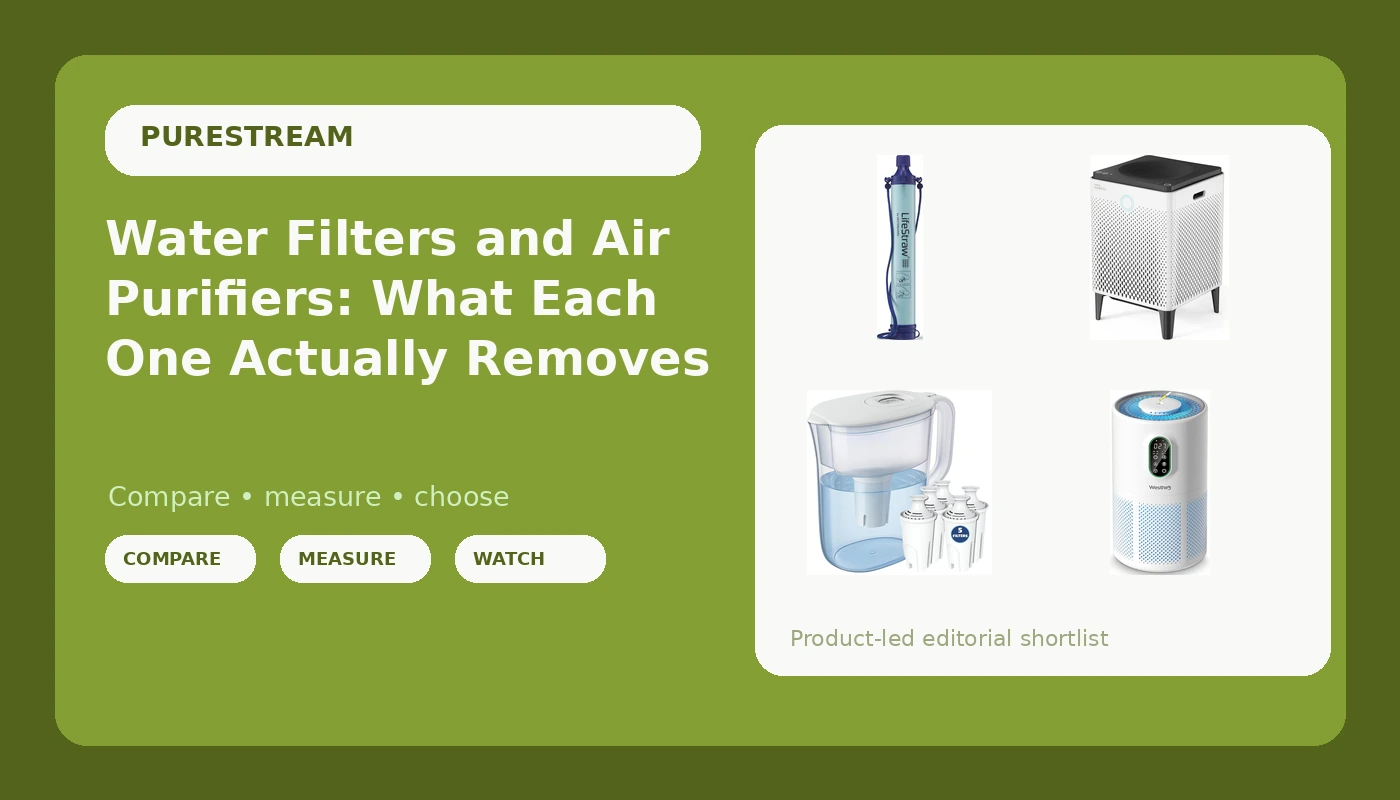
| 10-Cup Water Filter Pitcher with 5 Replacements, Electronic Change Reminder | Everyday drinking water at the kitchen table | 10-cup capacity, five replacement filters included, electronic reminder when a change is due |
| LifeStraw Personal Water Filter for Hiking, Travel and Emergency, Blue, 1PK | Hiking, travel, and emergency kits | Personal straw format, no power or plumbing needed, single pack |
| WESTHEY H13 HEPA Air Purifier for Home up to 1650 Sq Ft | Bedrooms and mid-size rooms | H13 HEPA with washable pre-filter, PM2.5 display, auto and sleep modes, night light |
| COWAY Air Purifier for Home Up to 3,120ft², Airmega 400 White, AP-2015F | Large open living spaces | Manufacturer coverage rating up to 3,120 sq ft, washable pre-filter plus HEPA, 5-year warranty |
The everyday kitchen pitcher: 10-Cup Water Filter Pitcher with 5 Replacements, Electronic Change Reminder
Pitchers are the lowest-friction entry point into water filtration, and they are also where the marketing gets thickest. What a pitcher realistically does well is improve taste by reducing chlorine and the compounds that ride along with it, which is exactly the problem most people are trying to solve when their tap water smells like a swimming pool. What a pitcher does not automatically do is remove dissolved metals or other health-related contaminants. That depends on the specific media inside the cartridge and on whether the unit carries a certification for that contaminant. The certification number on the label, not the word "pure" on the box, is what tells you which is which.
The replacement math also matters more here than anywhere else. Five filters in the box spreads out the first year of media cost, and the electronic change reminder is genuinely useful because pitcher filters are usually changed late rather than early. Late changes are how a filter that worked in month one stops working in month four.
The go-anywhere filter: LifeStraw Personal Water Filter for Hiking, Travel and Emergency, Blue, 1PK
This is a different tool for a different job. A personal straw filter is built for the case where you are drinking directly from a source you do not control: a trailside stream, an unfamiliar tap while traveling, a storm kit after the water main fails. It needs no power, no pump, no plumbing, and no counter space, which is why it earns a permanent spot in an emergency bag even if it never leaves that bag.
What it is not is a household water solution. It is a personal device, it filters as you drink, and it does not chill, store, or treat a whole pitcher at once. If you want better-tasting water for a family at the kitchen table, this is the wrong category. If you want something in a pack that works when the usual infrastructure does not, this is the right one.
The mid-size room purifier: WESTHEY H13 HEPA Air Purifier for Home up to 1650 Sq Ft
HEPA filtration is a particle technology. An H13 filter is rated to capture a very high percentage of particles at the most penetrating particle size, and that is the mechanism that matters for smoke particles, dust, pollen, and the dander that rides on dust. What HEPA does not do is remove gases and odors. That is why purifiers pair the HEPA layer with a pre-filter or a carbon layer, and why the fragrance sponge on this unit is a scent feature rather than a filtration claim.
Pay attention to the coverage number. Manufacturer coverage ratings are calculated at a specific air-change rate, so a room at the very top of the advertised range is getting a fairly modest number of air exchanges per hour. In a large open floor plan, treat the rating as a ceiling and size down. The PM2.5 display is a useful reality check: it gives you a number to watch when you cook, burn a candle, or button up the house during a smoke event.
The large-room purifier: COWAY Air Purifier for Home Up to 3,120ft², Airmega 400 White, AP-2015F
The trade-off between this unit and the smaller purifier is room size against cost. A larger purifier moves more air, which means it can hold a useful air-change rate in a bigger space, and it usually means a bigger filter stack and a bigger replacement bill down the road. The washable pre-filter is the part that softens that bill: it catches visible dust and hair before they reach the HEPA layer, and rinsing it on the manufacturer's schedule is the cheapest maintenance you can do.
The AQI readout, auto mode, sleep mode, and timer are conveniences that matter more than they sound. A purifier that runs at full speed all night is a purifier that eventually gets switched off. Auto mode and a sleep setting are what keep a unit running in the background, and the five-year warranty is a manufacturer term worth noting for a device you expect to run continuously.
Prices and availability may change. Product images, names, and retailer links must be matched by verified ASIN. Do not state a current price, rating, stock status, or measured result without current evidence.
What water filters actually remove, and what they do not
Certification is the whole conversation here. In the United States, the numbers you want to see on a filter label are the NSF/ANSI standards. NSF/ANSI 42 covers aesthetic claims: chlorine taste and odor, and particulate reduction. NSF/ANSI 53 covers health-related contaminants such as lead, cysts, and certain volatile organic compounds. NSF/ANSI 401 covers a list of emerging compounds. NSF/ANSI 58 covers reverse osmosis systems. A product certified to 42 is telling you it makes water taste better. It is not telling you it removes lead. Those are different claims, tested differently, and listed separately on the certification sheet.
The phrase "tested to NSF standards" with no number attached means nothing, because almost anything can be tested to a standard and fail it. Look for the certification mark and the standard number. Then look at the contaminant list on the manufacturer's performance data sheet, which is the document that names what the unit actually reduced and by how much in a lab.
TDS is the other number people fixate on, and it deserves a caveat. Total Dissolved Solids measures how much dissolved material is in the water, in parts per million. It is a great filter-performance meter, because a filter that removes dissolved solids will show a falling TDS number, and a filter that only removes chlorine will not. It is a terrible health meter, because it cannot tell the difference between calcium and lead.
Why HEPA is a separate conversation
Air purifiers work on a completely different principle, and the spec sheet reads differently. HEPA is a physical particle barrier. Air is pulled through a dense fiber mat, and particles are trapped by interception, impaction, and diffusion. That mechanism is excellent for smoke particles, fine dust, pollen, mold spores, and pet dander. It does nothing for gases, which is why odor and volatile organic compound claims depend on the carbon media in the unit rather than the HEPA layer.
Two specs decide whether an air purifier is useful in your room. The first is the filter grade: a true HEPA or H13 rating tells you the media meets a defined particle capture threshold, while "HEPA-type" and "HEPA-like" are marketing terms without a defined threshold. The second is how much air the unit actually moves, which is what the coverage rating is derived from. Manufacturer coverage numbers assume a specific number of air changes per hour, so the honest way to read them is as a maximum, not a promise. A unit rated for a very large space will clean a bedroom quickly and a great room slowly.
How to choose in five steps
- Write down the actual complaint in one sentence. "The water tastes like a pool" and "my throat hurts when the windows are shut" point to two different devices, and no amount of shopping will fix the wrong one.
- If the complaint is about water, get data before you get a product. Municipal utilities publish an annual consumer confidence report that lists what is in your finished water. Private wells need their own test, because nobody else is testing them.
- Match the certification number to the contaminant you are chasing. NSF/ANSI 42 for taste and chlorine, 53 for health contaminants like lead and cysts, 401 for emerging compounds, 58 for reverse osmosis systems. If the label has no number, treat the claim as unproven.
- Size the device to the space it has to serve. Room square footage and air-change rate for a purifier, daily drinking volume for a water filter. Undersizing is the most common reason people conclude that a working product does not work.
- Do the replacement math before you buy. Filters, not hardware, are the recurring cost, and a cheap device with expensive proprietary cartridges can cost more over two years than a better device with cheaper ones.
What to check before you buy
- Buy the first set of replacement filters at the same time as the device so the first change is not a surprise purchase.
- Read the performance data sheet, not the front of the box. The data sheet lists contaminants, reduction percentages, and the standard the unit was tested against.
- For purifiers, confirm the filter grade is stated as HEPA or H13 rather than "HEPA-type," and check what the coverage rating assumes.
- For pitchers, check whether the certification covers taste and chlorine only or extends to the contaminant you actually care about.
- Follow the manufacturer's maintenance schedule for washable pre-filters, and replace media on schedule rather than on smell. Breakthrough happens before you notice it.
Which option should you choose?
Choose the 10-Cup Water Filter Pitcher with 5 Replacements, Electronic Change Reminder when your complaint is taste and chlorine and you want filtered water on the counter or in the fridge without installing anything. Choose the LifeStraw Personal Water Filter for Hiking, Travel and Emergency, Blue, 1PK when you need drinking water away from a treated tap, or when you are building an emergency kit that has to work without power. Choose the WESTHEY H13 HEPA Air Purifier for Home up to 1650 Sq Ft when you want particle filtration in a bedroom or mid-size room and you want a PM2.5 reading to watch. Choose the COWAY Air Purifier for Home Up to 3,120ft², Airmega 400 White, AP-2015F when you are treating a large open space and you want the broader coverage rating, the AQI display, and the longer warranty term.
None of these four replaces the others, and none of them substitutes for fixing the source. A purifier cannot clean a water line, and a pitcher cannot clean air. Coverage ratings, filter life, and contaminant reduction all depend on your specific water, your specific room, and how consistently you maintain the unit. If you have a known contaminant problem in your water, start with a lab test and a certification lookup before you buy anything at all.
The bottom line
Water and air are two separate systems, and the fastest way to waste money is to buy a device from the wrong category. Match the tool to the complaint: a pitcher for taste and chlorine at the table, a personal straw filter for water you cannot otherwise trust, and a HEPA purifier sized to the room for smoke, dust, and dander. Then read the certification number on the water side and the filter grade on the air side, because those two lines of small print decide whether the product can do what you are buying it to do. Do the replacement math before checkout, and check the current Amazon price and availability for each option once you have decided which category you actually need.