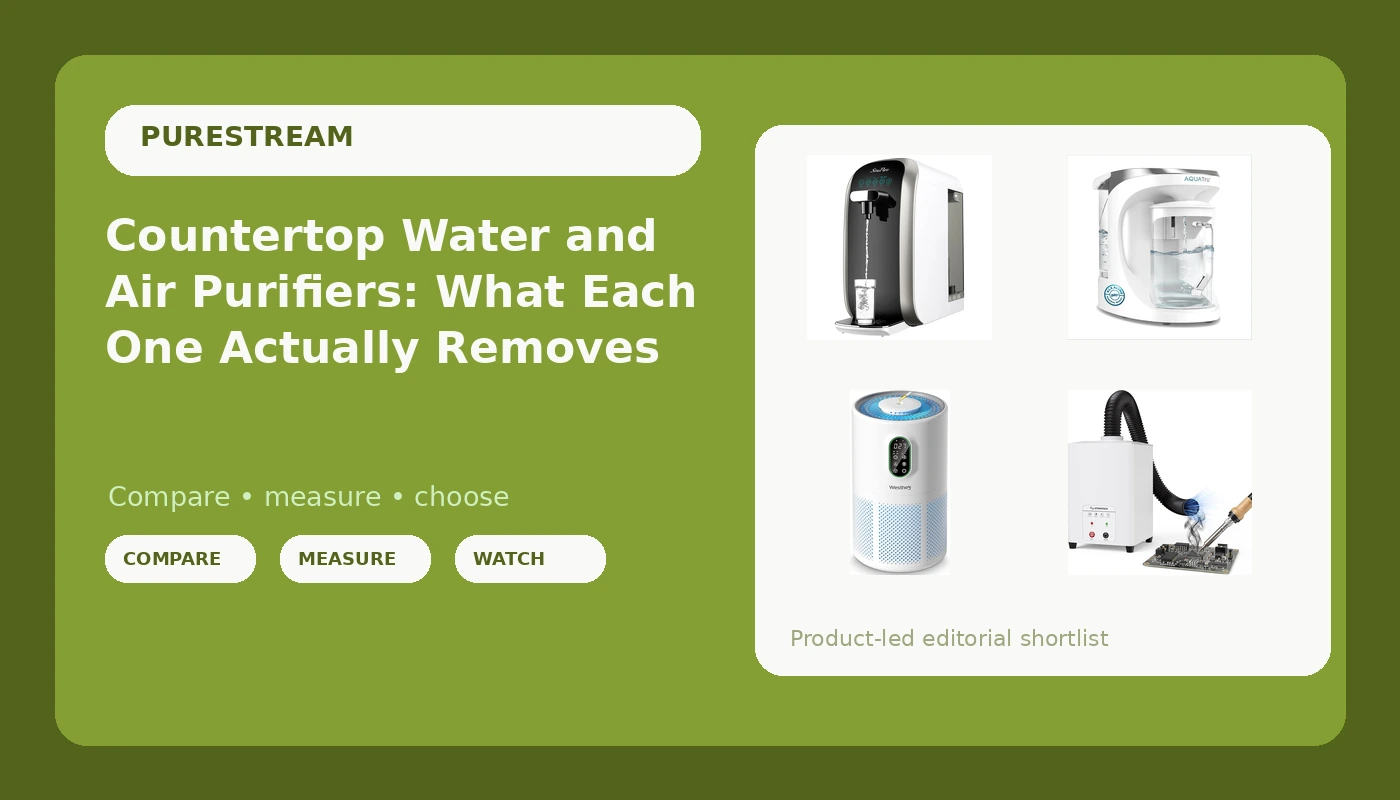
Two problems in a house can make the water and the air in it feel wrong, and they have almost nothing to do with each other. In the water, dissolved solids, lead, PFAS, and the chlorine a municipal plant uses to keep pipes clean show up as taste, odor, and things you would rather not drink. In the air, fine particles, dust, pet dander, and the fumes off a laser engraver or a soldering iron hang around long enough to be breathed in. Countertop water and air purifiers solve those problems with completely different mechanisms, and the labels on both categories tend to blur what a unit is certified to remove with what a listing simply says it removes. This is a walk through four units that cover four different jobs: two countertop reverse osmosis purifiers for drinking water, one room air purifier, and one source-capture smoke purifier.
Related: How to Read an NSF Certification Number on a Water Filter →
Quick answer
Match the unit to the contaminant, not to the category. For dissolved solids, lead, PFAS, and the taste of treated municipal water, a countertop reverse osmosis system is the tool that addresses the problem, and both RO units here run multi-stage trains with different finishing steps. For airborne particles, dust, pollen, pet dander, and smoke that has already spread through a room, an H13 HEPA room purifier is the right shape of product. For fumes generated at one specific spot, such as a laser engraver or a soldering station, a source-capture smoke purifier that pulls air off the work area does a job a room purifier cannot. None of these four covers all of those jobs, and the certification numbers and filter specs matter more than the box copy.
Four useful options
| Model | Best fit | What stands out |
|---|---|---|
| AquaTru Glass Carafe Alkaline Countertop Reverse Osmosis Water Purifier | Drinkers who want RO water with a mineral-forward finish | 4-stage RO listing that names 84 contaminants including PFOA and PFOS, lead, and microplastics, with a glass carafe and an alkaline stage |
| SimPure Y7P-BW UV Countertop Reverse Osmosis Water Filter | Smaller kitchens that want RO plus a disinfection step | 5-stage RO with a UV stage, countertop format, no under-sink plumbing |
| WESTHEY H13 HEPA Air Purifier for Home | Whole-room particle and odor control | H13 HEPA with a washable pre-filter, listed for rooms up to 1650 sq ft, PM2.5 display, auto and sleep modes |
| ATOMSTACK D5 Smoke Purifier | Fume capture at a laser, soldering iron, or bench | 1400Pa suction, 3-layer HEPA and carbon filtration, 3-speed control |
Countertop RO with a mineral finish: AquaTru Glass Carafe Alkaline Countertop Reverse Osmosis Water Purifier | 4 Stage RO System | Removes 84 Contaminants Including PFOA & PFOS (PFAS), Lead and Microplastics | Adds Alkaline Minerals
The trade-off with any RO unit is the membrane itself. Reverse osmosis is very good at pushing dissolved solids, lead, and PFAS out of the water, and it is equally good at removing the calcium and magnesium that give water its body. The alkaline stage here is a finishing cartridge that adds minerals back after the membrane, which changes pH and mouthfeel. Read that as a taste preference, not a health feature: the minerals in a glass of water are trivial next to what comes from food. The other thing to look at is the cartridge schedule, because a four-stage unit with proprietary cartridges is a subscription in disguise. Work out the cost per gallon including replacements before you decide, not after.
Five stages with UV at the end: SimPure Y7P-BW UV Countertop Reverse Osmosis Water Filter, 5 Stage RO
UV is a disinfection step, not a filtration step. It does not remove dissolved solids, lead, or PFAS; the RO membrane does that work, and the UV chamber at the end of the train targets microorganisms. If your water comes from a private well or a source you do not fully trust, that extra stage is a meaningful addition. If your concern is TDS and the taste of city water, the membrane is doing the heavy lifting and the UV stage is a bonus. More stages also means more cartridges to track, each on its own replacement interval, so ask for the filter schedule in writing before you buy.
Room-scale particles and odors: WESTHEY H13 HEPA Air Purifier for Home up to 1650 Sq Ft Washable Pre-Filter | Air Cleaner with PM2.5 Display, Auto & Sleep Modes, Night Light and Fragrance Sponge for Wildfire Smoke, Dust and Pet Dander
Square footage ratings on air purifiers are written under specific assumptions, usually a set number of air changes per hour at a given fan speed, and often the lowest one. A unit rated for a large room will clean a smaller room more times per hour, and that is the number that actually matters when you are trying to clear smoke or dander. The washable pre-filter is the practical feature here: it catches the hair and coarse dust that would otherwise load the HEPA layer, and rinsing it extends the life of the filter that costs real money. The fragrance sponge is a scent accessory and does nothing for air quality, which is fine as long as you know that going in.
Fume capture at the bench: ATOMSTACK D5 Smoke Purifier, 1400Pa High Suction Air Filter with 3-Layer HEPA & Carbon Filtration, 99.5% Purification Rate for Laser Engraving, Soldering, and Desktop DIY Projects, 3-Speed Control
Source capture is a different geometry from room circulation. A laser engraver or a soldering iron produces fine particles and volatile organic compounds at a single point, and a room purifier has to wait for those fumes to reach its intake and then dilute them across the whole room. A unit that pulls 1400Pa of suction through a hose attached to the enclosure or the fume source catches the smoke before it spreads. The 99.5% purification rate in the listing is worth reading closely: the useful questions are what particle size it was tested against and what the carbon layer is rated for, because HEPA captures particles while carbon handles gases and odors. Three speeds let you run it low for soldering and high for a long engraving job.
Prices and availability may change. Product images, names, and retailer links are matched to verified listings. No current price, rating, stock status, or measured result is stated here without current evidence.
What countertop reverse osmosis removes, and what it does not
Reverse osmosis works by forcing water through a semipermeable membrane under pressure. The membrane rejects most dissolved solids, which is why RO is the standard answer for lead, PFAS, and the general dissolved content that a TDS meter reads. Total Dissolved Solids is not a health meter, but it is an excellent performance meter: if the number coming out of an RO unit is not dramatically lower than the number going in, the membrane is exhausted or the unit is not doing what it claims.
The numbers on the label are what matter. NSF/ANSI 58 covers reverse osmosis systems, NSF/ANSI 53 covers health-related contaminants such as lead, and NSF/ANSI 42 covers taste and chlorine reduction. A phrase like "tested to NSF standards" without a certification number behind it means nothing, because any lab can test to any protocol. When a listing names specific contaminants, such as the PFOA and PFOS, lead, and microplastics named for the AquaTru unit here, that specificity is a better sign than a percentage with no list attached.
One honest caveat about RO: it strips minerals along with everything else. That is why an alkaline stage exists on one of these units and not the other. Adding minerals back changes pH and taste, and if you prefer the mouthfeel of mineral water, that is a legitimate reason to choose it. It is not a health intervention, and any marketing that frames mineral-free water as "dead water" is selling you a cartridge, not a benefit.
Air purifiers: particles, gases, and where the smoke is
HEPA filtration is a particle technology. H13 is a classification with a defined efficiency at the most penetrating particle size, and it captures dust, pollen, pet dander, and the fine particulate in wildfire smoke. Carbon is a separate job: it adsorbs volatile organic compounds and odors, which is why almost every serious air unit pairs a particle filter with a carbon layer. A washable pre-filter sits in front of both and catches the coarse debris that would otherwise clog the expensive layers.
Room purifiers recirculate. They clean the air that passes through them, so the honest way to compare them is by how much air they move and how many times per hour they can turn over your actual room, not by the largest square footage on the box. Source-capture units skip the recirculation problem entirely by pulling fumes at the point of generation. Laser engraving and soldering are exactly the cases where that matters, because the smoke is produced at a nozzle or a tip and would otherwise spread through the room before any purifier could respond.
- Identify the contaminant first: dissolved solids, lead, and PFAS point to RO; particles and dander point to HEPA; bench fumes point to source capture.
- Look for a certification number, not a standard name, on any water filter making a health claim.
- Read the filter replacement schedule and price out a year of cartridges before you compare purchase prices.
- Match capacity to your real space: reservoir size and counter footprint for water, room volume and air changes per hour for air.
- Decide whether you need to clean a whole room or catch fumes at one point, because no single unit here does both well.
Practical guidance
- Track performance, not marketing: a cheap TDS meter tells you when an RO membrane is losing its edge, and a visible drop in flow tells you a pre-filter is loaded.
- Replace cartridges on schedule. Breakthrough happens quietly, and a filter running past its interval can pass what it used to remove.
- Confirm filter availability and pricing before buying any unit with proprietary cartridges, since the replacement is the real cost.
- Keep a room purifier's pre-filter clean; rinsing it is the cheapest maintenance you will ever do on an air cleaner.
- Do not expect a room purifier to handle bench fumes, and do not expect a source-capture unit to clean the air in a whole room.
Which option should you choose?
Choose the AquaTru Glass Carafe Alkaline Countertop Reverse Osmosis Water Purifier when you want RO water with a mineral-forward finish and prefer a glass carafe to a plastic reservoir. Choose the SimPure Y7P-BW UV Countertop Reverse Osmosis Water Filter when you want a five-stage RO train with a UV disinfection step in a compact countertop footprint. Choose the WESTHEY H13 HEPA Air Purifier for Home when the problem is particles and odors circulating through a room. Choose the ATOMSTACK D5 Smoke Purifier when the problem is fumes generated at one point, such as a laser engraver or a soldering station.
Specifications, contaminant lists, and purification rates quoted here come from the manufacturer listings, and certification details should be confirmed against the current listing or the certifying body's product database before purchase.
The bottom line
These four units are not competing for the same spot on your counter. Two of them treat drinking water with reverse osmosis, one adds a UV stage and one adds minerals back after the membrane, and the choice between them comes down to whether you want disinfection or a different mouthfeel. The other two treat air, and they split along the same kind of line: a room purifier recirculates and slowly reduces particles and odors, while a source-capture unit pulls fumes directly off a work area where they are generated. Decide what you are trying to remove, check the certification numbers and filter schedule, price out a year of replacements, and the right pick usually becomes obvious.