I keep two logbooks on my basement bench: one for water, one for air. They look identical from across the room and they answer completely different questions. Water filtration and air filtration get sold with the same playbook, a scary problem, a spec sheet full of percentages, and a replacement cartridge that shows up every few months, but the failure modes are not the same. A pitcher that slows to a trickle is annoying. An air purifier that never moves enough air through its media is worse, because you cannot see the difference from the couch.
This home water and air filtration comparison puts four units side by side: a 10-cup water filter pitcher with five spare cartridges, two large-room HEPA air purifiers, and a six-pack of plug-in ionizers. They do not compete for the same job, and that is the point. Most households have both problems at once, a tap that tastes off and a room that smells like a dog, and a budget that covers one purchase at a time. So the useful question is not which one is best. It is which one fixes the thing that actually bothers you, and what it costs to keep running after month three.
The short answer: if the problem comes out of your faucet, start with the 10-cup pitcher, because five cartridges in the box pushes the first real replacement cost out by months. If the problem is in the air, the FreAire HAP605 is where I would look first for a big room with pets or smoke, and the HAP603 is the pick if you want a True HEPA filter, smart mode, and the aromatherapy tray. The six-pack of plug-in ionizers is a supplement for small, closed spaces, not a substitute for either.
Here is how the four units line up on the specs that decide whether you will still be using them a year from now.
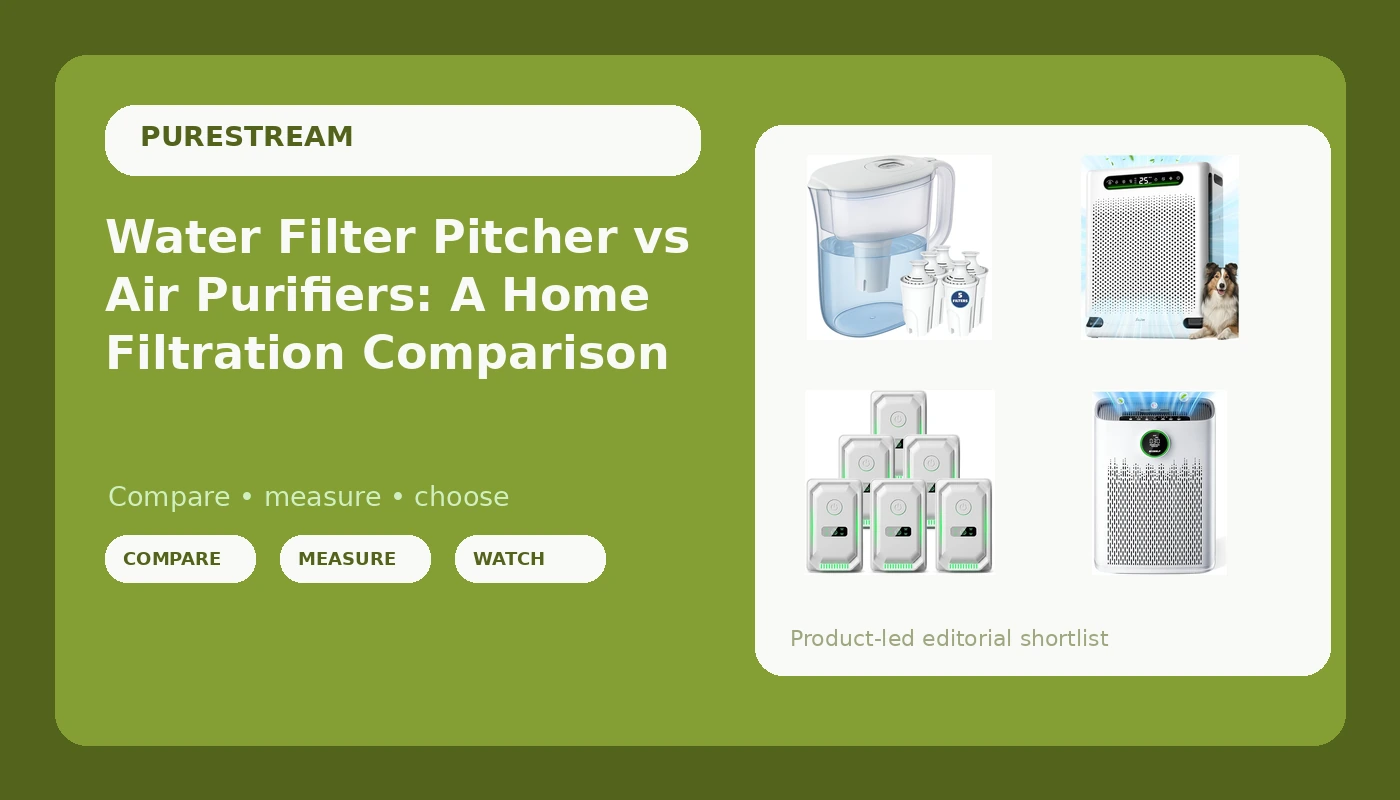
10-Cup Water Filter Pitcher with 5 Replacements, Electronic Change Reminder
10-cup capacity, five spare cartridges in the box, and an electronic change reminder that targets the real failure mode of pitchers
Drinking and cooking water only, one jug at a time, and any contaminant claim needs an NSF/ANSI 42 or 53 listing to be worth anything
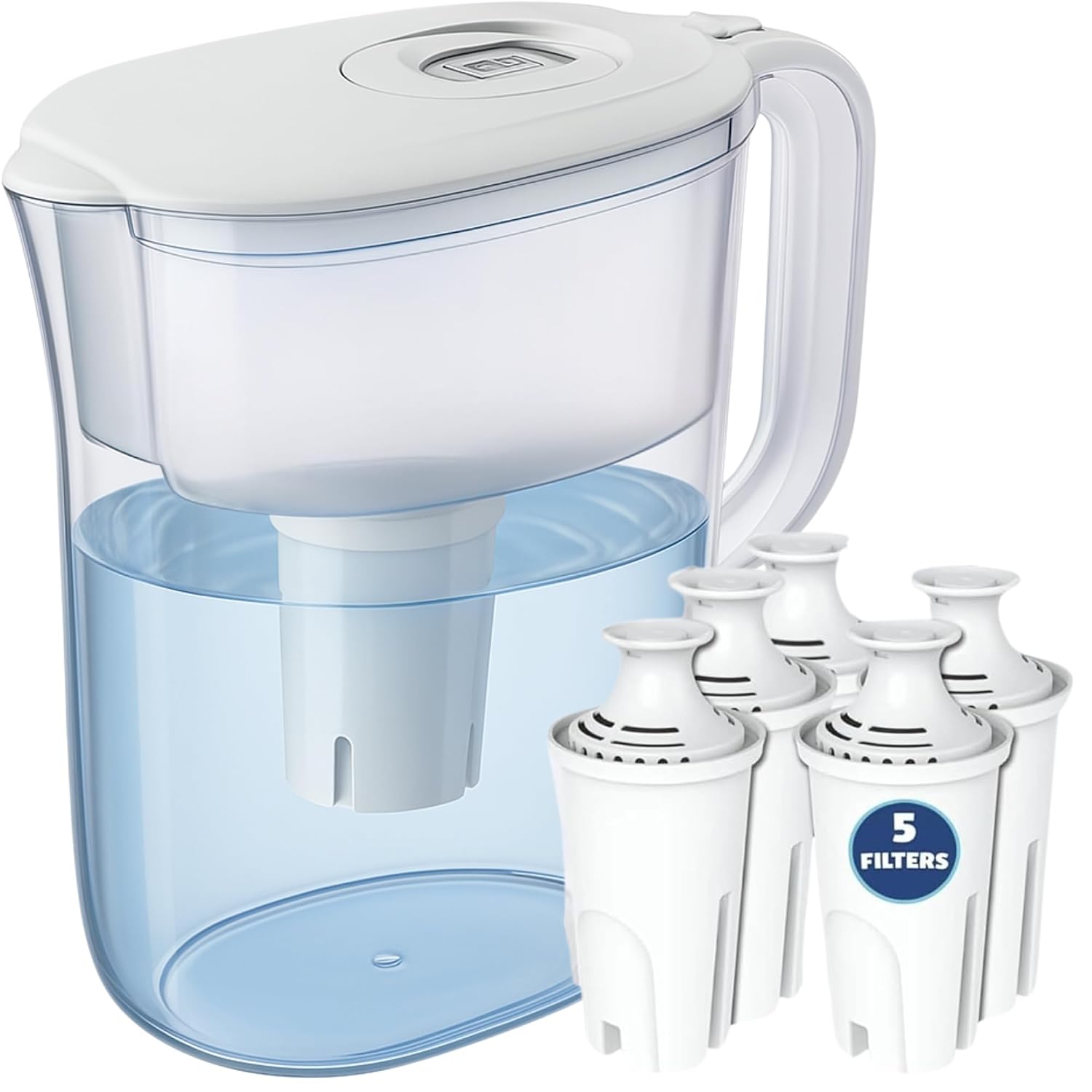
FreAire Air Purifiers for Home Large Room Up to 2600 Ft², HAP605, White
Largest coverage claim in this group at up to 2,600 Ft², turbo mode aimed at pet hair, dust and smoke, washable filter, real-time PM2.5 display, 20 dB sleep mode
Washable media is your maintenance job, turbo is the loud end of the range, and the coverage number assumes top fan speed
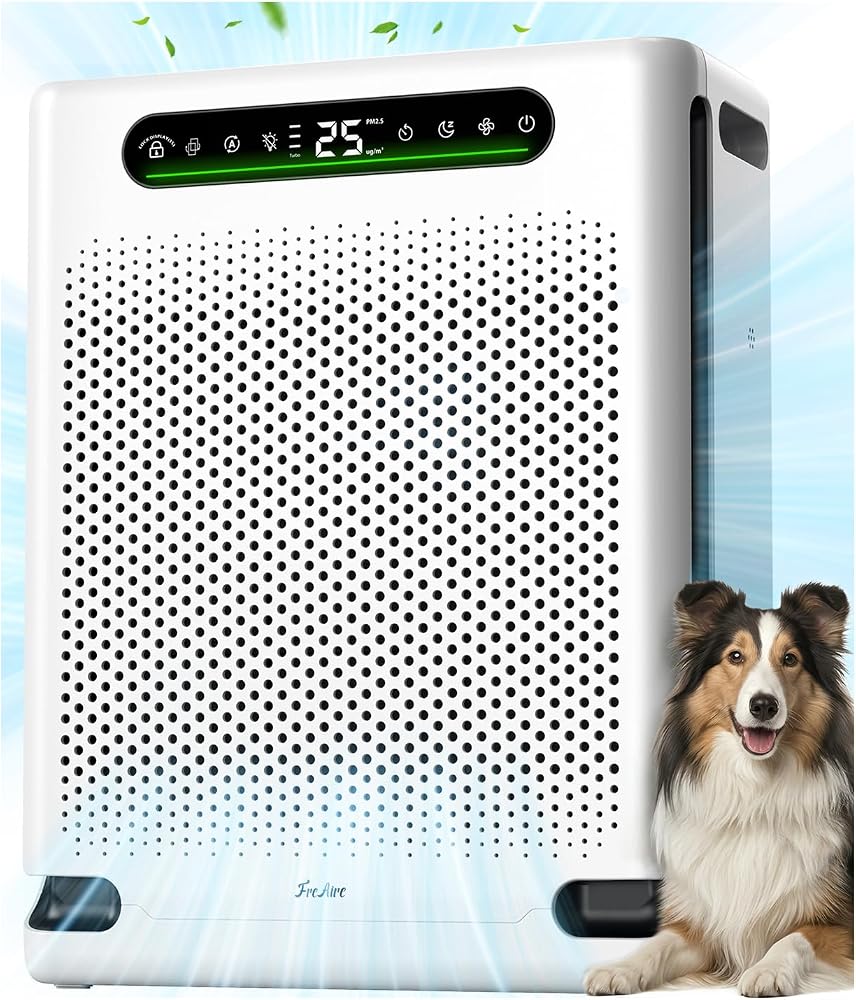
2026 New 6 Pack Plug In Air Purifier for Home, Negative Ion Air Purifier
Lowest cost per room, filterless so there is nothing to buy ever, six units cover a bedroom, office, kitchen, bathroom and living room at once
No filter means no measurable clean air delivery, no PM2.5 feedback, and ionizers settle particles rather than capture them in a cartridge
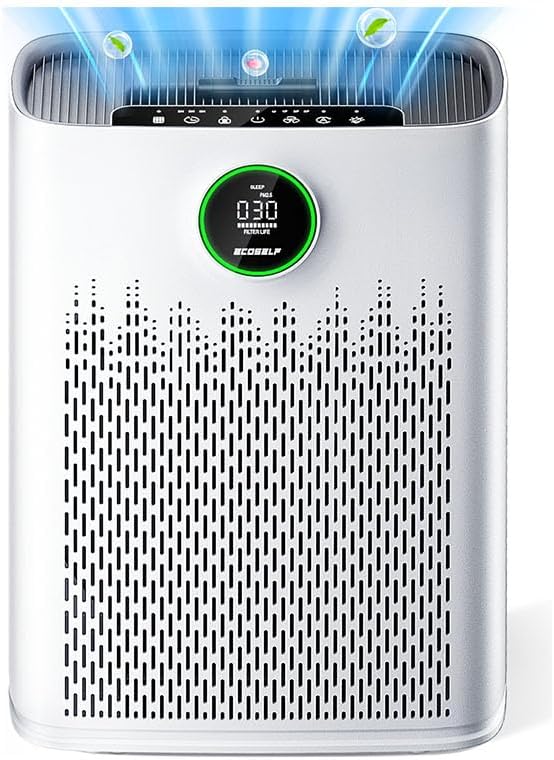
Air Purifiers for Home Large Room, Up to 2400 Ft² with True HEPA Filter, HAP603, White
True HEPA filter, smart mode, PM2.5 air quality display, 360° air outlet, 22 dB sleep mode, aromatherapy tray
The True HEPA cartridge is a recurring cost, aromatherapy is not for everyone, and the coverage claim is slightly lower than the HAP605
Prices and availability were captured from Amazon Creators API and may change.
Why a water pitcher is in the same article as three air purifiers
Fair question. I split my own work by medium, because the two categories get verified in completely different ways, and mixing up the methods is how people end up disappointed.
Water has a paper trail. A filter that claims lead reduction should carry an NSF/ANSI 53 listing. One that claims chlorine and taste improvement should carry NSF/ANSI 42. Those numbers are searchable, and if a listing does not exist, the claim is marketing copy. Air has a different kind of number: filter class, fan speed, and the particle reading a display shows you in real time. One is auditable, the other is observable, and both beat the adjectives on the box.
What the two categories share is the thing that decides whether you keep using the product: consumables. A pitcher is a cartridge schedule. A HEPA purifier is a filter schedule. An ionizer has no schedule at all, which sounds like a win until you ask how you would know it is working. Keep that lens on while you read the table, because it explains almost every trade-off below.
What the pitcher spec sheet actually tells you
Ten cups is roughly 80 ounces, enough for drinking and cooking for a couple of people across part of a day, and not enough to fill a stockpot without a second trip. That is a real constraint, and it is why I tell people to think of a pitcher as a drinking-water appliance rather than a whole-house solution. This pitcher will not touch your living room air, and the purifiers below will not touch your faucet.
The more interesting line in the listing is "5 Replacements." Cartridges are where pitcher money actually goes, and a box that includes five of them changes the ownership math in a way that a lower sticker price with one cartridge does not. My rule on this bench: never compare two pitchers by purchase price, because the pitcher is the bait and the filter is the price. Five spares in the box is the closest thing to an honest cost structure you will find in this category.
The electronic change reminder is the feature I care about most, and not for convenience. Filters have a working life, and when the media is exhausted, contaminants start passing through instead of being held. A reminder light removes the single biggest source of user error in pitcher ownership, which is running a cartridge two months past the point where it stopped doing its job. My one caution: confirm the reminder is tracking something real. If it is a simple timer rather than a volume counter, change on schedule anyway and do not let the light talk you into an extra month.
Before you buy, find the certification numbers. Taste and chlorine reduction live under NSF/ANSI 42. Lead, VOCs, and the health contaminants live under NSF/ANSI 53. "Tested to NSF standards" without a number is a sentence, not a certification. Visit on Amazon → and read the certification section of the listing closely, because that is where the honest information lives.
HEPA versus ionizer: the real fork in the road
The FreAire HAP605 and the HAP603 are both HEPA machines. Air gets pulled through a pleated media by a fan, particles get trapped in the fibers, and the machine reports what it is seeing through a PM2.5 display. You get feedback, you get a filter to maintain, and you get air that has physically passed through something.
The 6-pack of plug-in negative ion purifiers works on a different principle. There is no fan and no filter. The units release charged ions that make particles clump together and settle out of the air, and because they plug into a wall outlet and have no media, there is nothing to replace and nothing to wash. That is genuinely convenient, and it is also why they belong in a different tier of this comparison.
Here is how I would use each one. For a bathroom with a damp towel smell, a closet, a laundry room, or a small home office, six plug-in units for the price of one cartridge-based purifier is a sensible way to cover a lot of small square footage. For wildfire smoke, a shedding dog, or a bedroom where someone wakes up congested, an ionizer is not the tool. It has no rated clean air delivery to compare, no particle readout to confirm it is doing anything, and no cartridge holding what it captured. If you go the ionizer route, read the listing's documentation carefully, because filterless devices vary widely in how they are built and how they are described.
FreAire HAP605 and HAP603: two large-room units, two maintenance styles
Both of these are built for the same buyer: someone with an open living space, a pet, or a smoker nearby who wants a display that shows a particle number instead of a colored mood light. Both list real-time PM2.5 readouts, both list sleep modes in the low 20s of decibels, and both are white towers that will disappear against a wall.
The HAP605 claims coverage up to 2,600 Ft² and adds a turbo mode aimed at pet hair, dust, and smoke, along with a washable filter. Turbo matters more than the coverage number, honestly, because it is the setting you reach for when something just happened: the dog shook off on the couch, someone burned toast, a candle got snuffed. Washable media means no cartridge to buy for that element, and it means you own the maintenance. Wash it on a schedule you will actually keep, and let it dry completely before it goes back in, because a damp filter is a microbial problem you built yourself.
The HAP603 claims up to 2,400 Ft², uses a True HEPA filter, and adds smart mode, a 360° air outlet, and an aromatherapy tray. Smart mode is the feature that earns its keep, since it lets the machine ramp up and down based on the particle reading instead of you babysitting a dial. The aromatherapy tray is a genuine love-it-or-hate-it addition: if you want the room to smell like eucalyptus, it is a nice bonus, and if you are sensitive to fragrance, or you bought a purifier specifically to remove odors rather than add them, leave the pad out.
Two hundred square feet of difference in the coverage claims is not the deciding factor. Twenty versus 22 decibels in sleep mode is not the deciding factor either, since both are quieter than a refrigerator and neither will wake you. The deciding factor is the filter: washable media you maintain yourself, or a True HEPA cartridge you replace. Pick the maintenance style you will actually keep up with, then Visit on Amazon → on the HAP605 or Visit on Amazon → on the HAP603 and price the replacement media in the same visit.
The coverage number is a ceiling, not a promise
Every square-foot rating in this comparison assumes a normal ceiling height and a specific number of air changes per hour, and the manufacturer usually measures at the highest fan speed. That means a 2,600 Ft² claim and a 20 dB sleep mode are describing two different operating points. At sleep speed, you are moving far less air than the box implies.
The practical translation: size the purifier for the room you actually occupy, not the square footage of your whole floor plan. An open-plan kitchen and living room is one big room for filtration purposes, and a hallway, closet, or closed bedroom door blocks air movement. If you have a 400 square foot living space, either HEPA unit here will cycle it comfortably. If you have 2,000 square feet of open plan, one unit in a corner is doing less than the number suggests, and two units in the right places usually beat one big one in the wrong place.
The cost question nobody prints on the box
There are three cost structures in this comparison, and they behave differently over time.
The pitcher is the lowest entry point and the most predictable schedule: a cartridge every so often, with five spares included, which is why I keep saying the box contents matter more than the sticker.
The HEPA units are the opposite. The HAP605 asks you to wash the filter, so its ongoing cost is your time plus whatever a replacement eventually costs. The HAP603 asks you to buy a True HEPA cartridge on a schedule, and you should price that cartridge before you buy the machine, because the replacement is the real cost of ownership.
The ionizer six-pack has no consumables at all. That is genuinely appealing, and it is also the reason to be careful: a product with no filter has no maintenance signal, no replacement reminder, and no way for you to tell from the outside whether it is doing anything. You are buying on faith, which is exactly what I tell people not to do in the water aisle.
Who should buy which
- If your tap water tastes like a swimming pool, or a kid in the house refuses to drink it, buy the pitcher. Ten cups, five spare cartridges, and a change reminder is a complete starter kit for drinking water.
- If you have pets, smoke, or dust in a large open room, buy the HAP605 for the turbo mode and the biggest coverage claim here, and accept that you will be washing a filter.
- If you want a True HEPA cartridge, a real-time particle display, and smart mode handling the fan for you, buy the HAP603, and use the aromatherapy tray only if you actually want the scent.
- If you have a musty bathroom, a closet that smells like gym clothes, a laundry room, or a small office, the six-pack of plug-in ionizers covers several of those at once for the least money and zero filter cost. Just do not expect it to handle wildfire smoke or a shedding dog.
- If you can only spend once this year and you are choosing between categories, pick the problem you can smell or taste. The issue you notice every day is the one worth solving first.
What I would verify before checkout
A short checklist, because the spec sheet will not do this for you.
- The certification numbers. NSF/ANSI 42 for taste and chlorine, NSF/ANSI 53 for health contaminants, and an actual listing you can look up.
- The replacement interval and the replacement price. Print it next to the purchase price, the way I do in my logbook.
- The filter style on the air units. Washable means maintenance on your calendar. Cartridge means a recurring cost. Neither is wrong, but one of them fits your habits better.
- The coverage number at the fan speed you will actually run. A rating at turbo and a rating at sleep mode describe different rooms.
- The ionizer's documentation, if you go that route. Filterless devices vary a lot in how they are built and how they are described, and the listing should be specific about both.
The bottom line
Four products, two jobs, one budget. The pitcher solves the thing you taste, and the five included cartridges plus the change reminder make it the least error-prone way to start. The two HEPA towers solve the thing you breathe, and the choice between them comes down to whether you want to wash a filter or buy one, plus whether the aromatherapy tray is a feature or a nuisance. The ionizer six-pack solves the small, closed, low-stakes spaces cheaply and unverifiably.
None of these is a whole-home answer, and none of them needs to be. Buy for the room and the problem you have right now, price the consumables before you check out, and you will still be using the thing in a year, which is more than most people can say about the filter they bought on a whim.