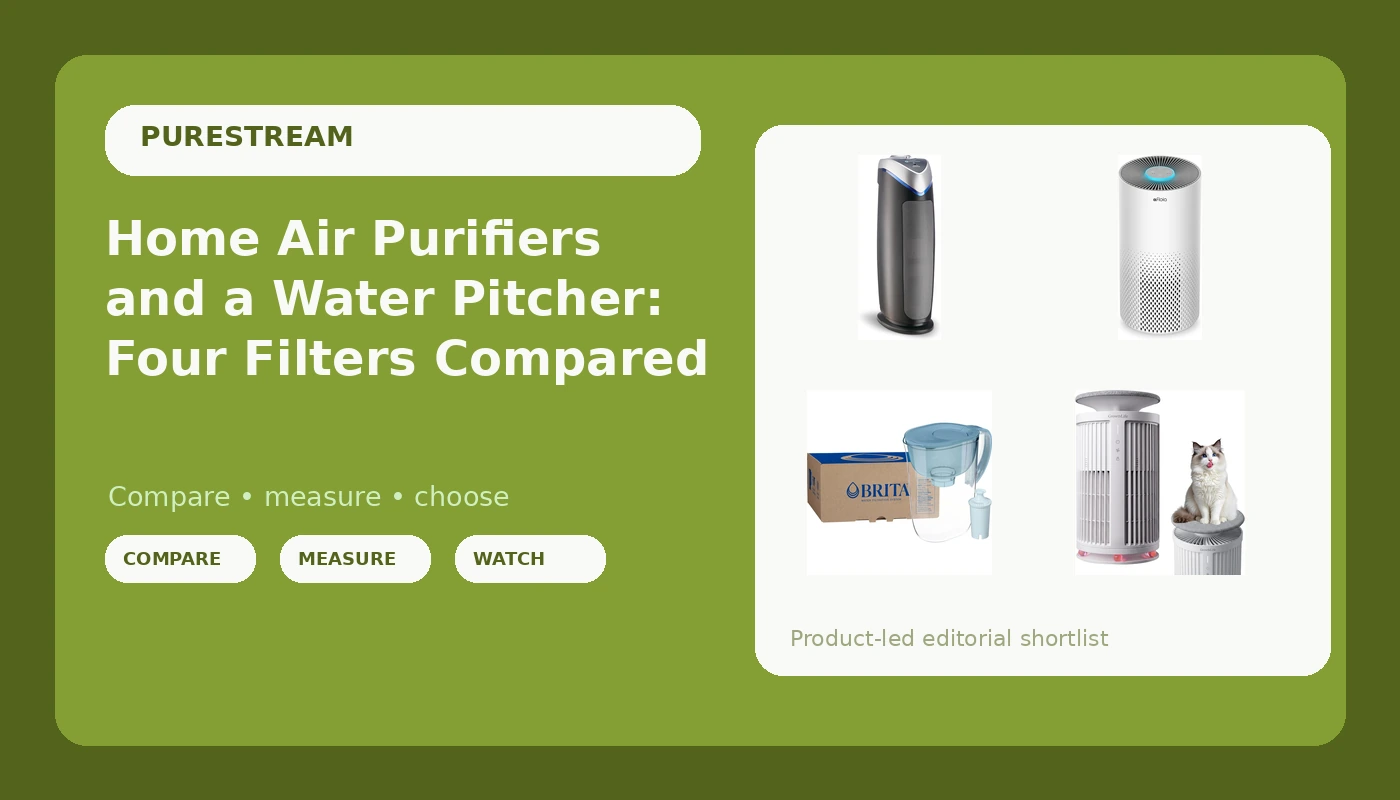
Most households don't have one filtration problem. They have two. The dog sleeps on the bed and the bedroom smells like it, and the tap water tastes like a swimming pool, so nobody in the house drinks a full glass. I spent six years running contaminant analyses in a municipal water lab before I started testing filters on my own bench, and the same lesson shows up in both rooms: the box tells you what the marketing department wants you to believe, and the spec sheet and the replacement schedule tell you what you're actually buying. This comparison of home air and water purifiers lines up four devices side by side, three air purifiers aimed at dust, dander, smoke, and odors, plus one 10-cup pitcher aimed squarely at taste.
If pets are the reason you're shopping, the GermGuardian AC4825E is where I'd start. If the only complaint in your house is how the water tastes, the Brita pitcher fixes that for the least money and the least counter space. Those are different jobs, and the four products below don't overlap as much as the shelves suggest.
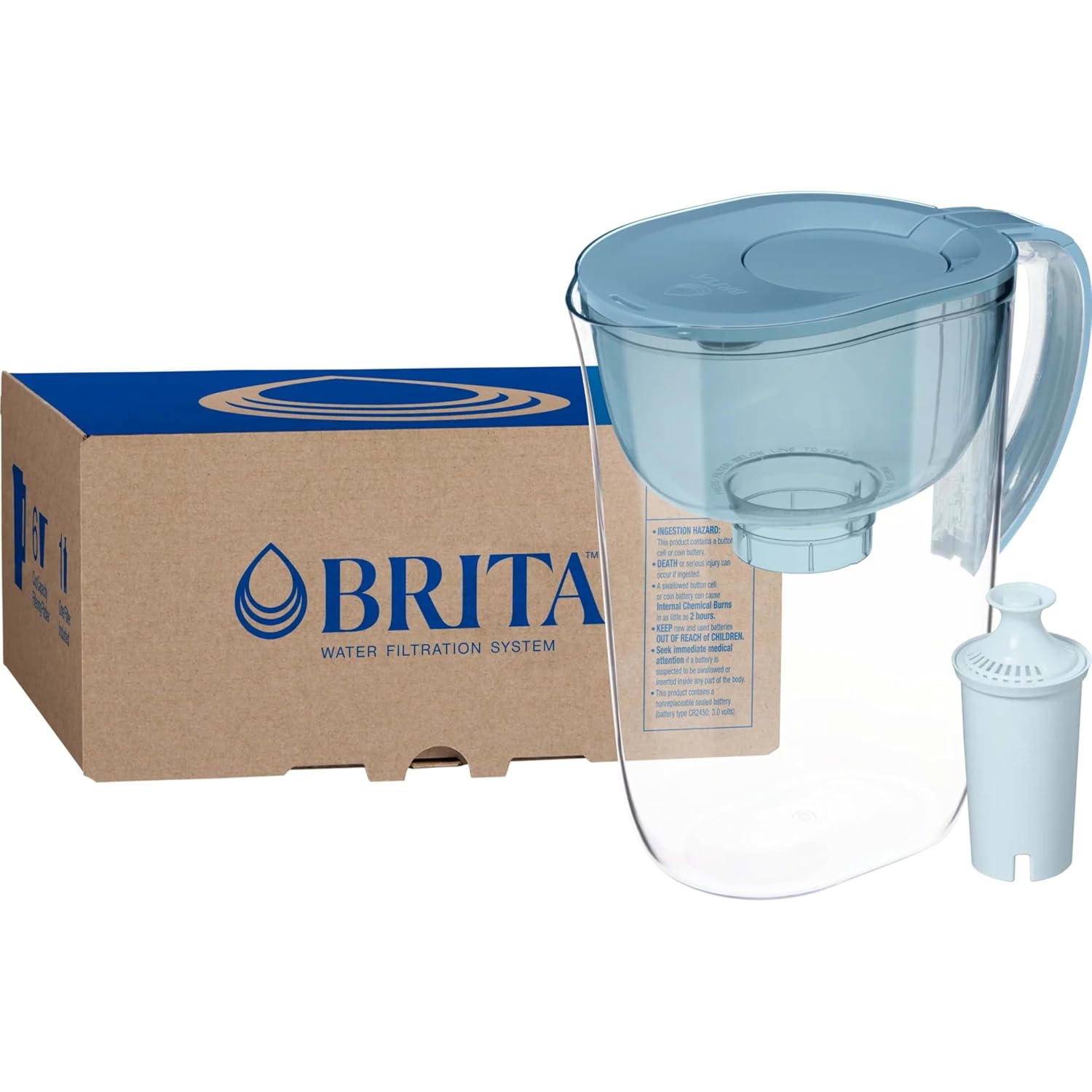
Brita Large 10-Cup Water Filter Pitcher with BritaPlus Filter, Stone Blue
Cheapest way to fix taste and chlorine in a glass of water, 10 cups means fewer refills, no installation, no electricity
Taste and chlorine are the job it's built for, so check the certification on the cartridge before assuming it touches lead or dissolved solids, and you buy filters forever
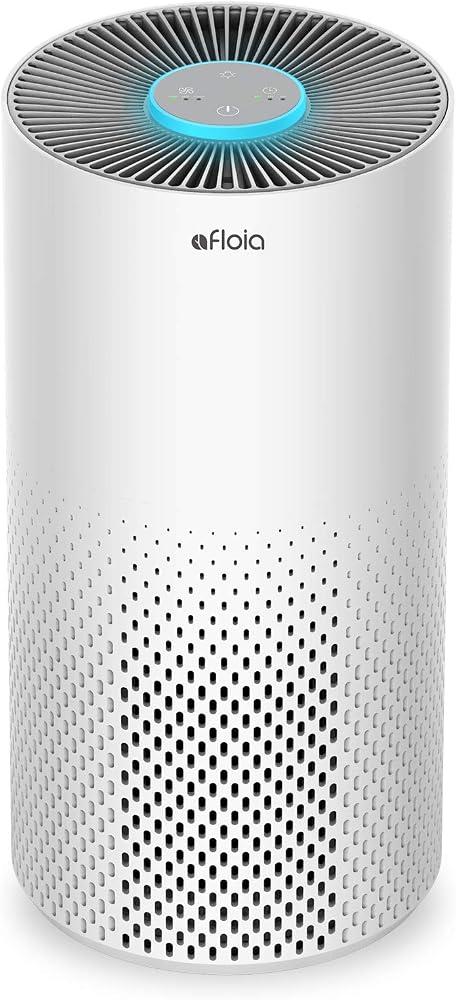
Afloia Air Purifier for Home Bedroom Large Room up to 1500 Sq Ft, Kilo White
Upgraded HEPA 4-stage filtration with a washable pre-filter, sleep mode rated at 22dB, 7-color light, and 2/4/8/16-hour timer options
The 1500 square foot coverage figure is a box claim, the color light is decoration, and the HEPA stage still has a replacement schedule you should price out first
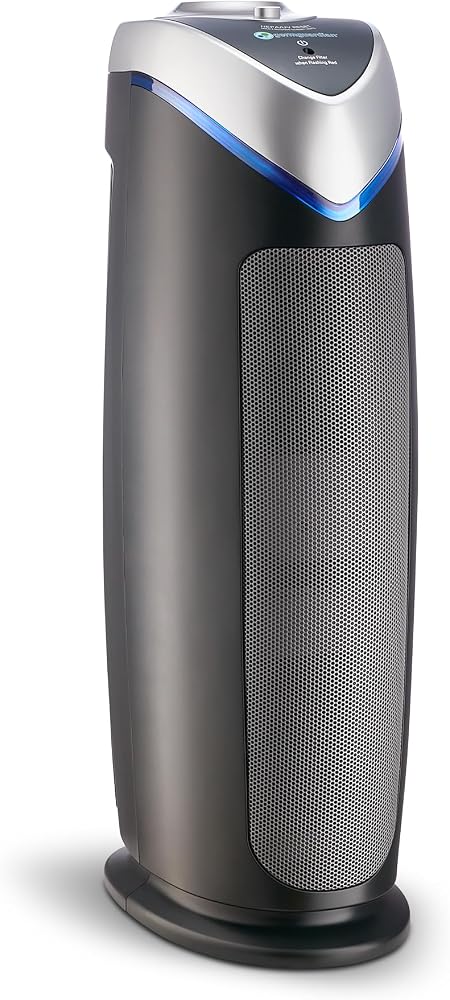
GermGuardian HEPA Air Purifier, AC4825E, 22" Tower, Gray
Built and marketed around the four things people actually complain about: pet dander, dust, pollen, smoke, and scents, in a 22 inch tower that fits a bedroom corner
Tower footprint is bigger than a desktop unit, there are no connected features, and the filter is the real recurring cost
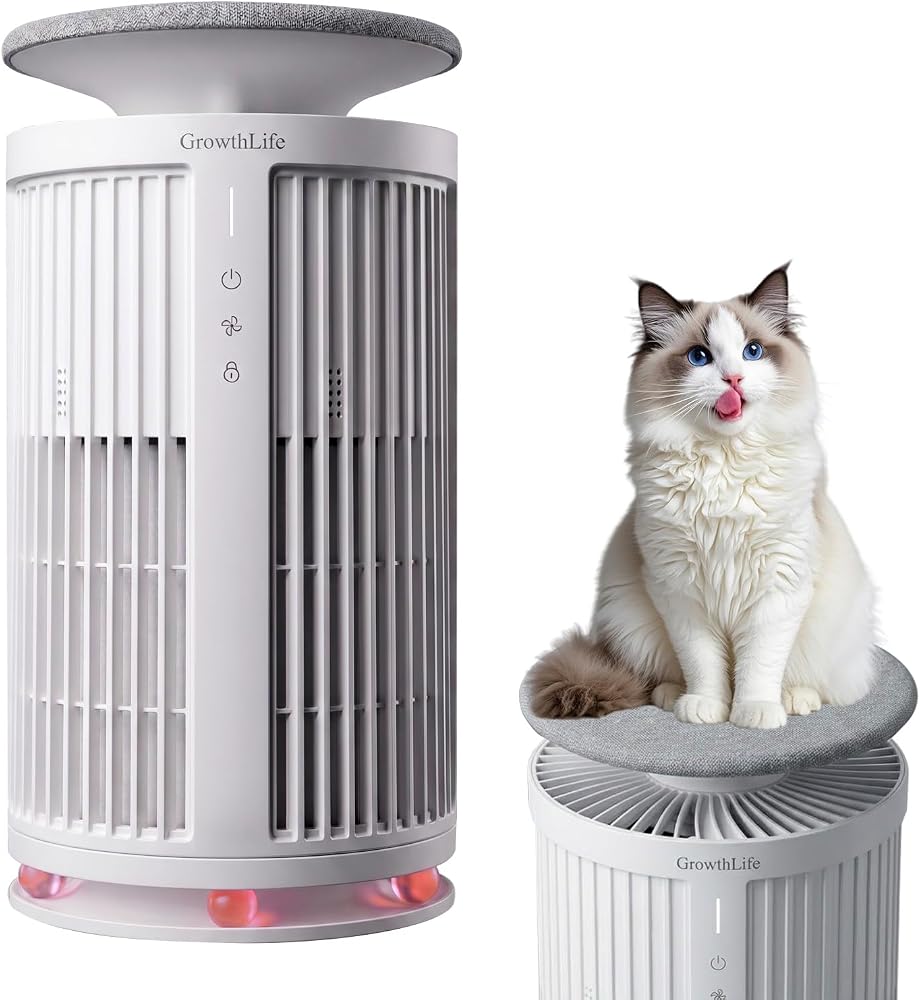
GrowthLife Pet Air Purifier for Dust Smoke Odors, KZ150G-A02 White
Pet-focused 3-in-1 filtration in a small 8.2 x 8.2 x 15.6 inch body, whisper-quiet, easy to tuck next to a litter box or a dog crate
The smallest unit here, so treat it as a one-room machine, and check what each of the three filtration stages costs to replace
Prices and availability were captured from Amazon Creators API and may change.
How I evaluate anything that claims to filter
Every device that comes through my basement gets the same four questions, and none of them are about the sticker price.
First, what does it actually remove, and what is the evidence behind that claim? For water, that means an NSF/ANSI number. Standard 42 covers taste and chlorine reduction. Standard 53 covers health contaminants like lead. The phrase "tested to NSF standards" without a certification number next to it means nothing, and I say that as someone who has watched a lab sheet contradict a package insert more than once. For air, the equivalent question is whether the HEPA media is real HEPA and what the manufacturer tested it against, not a percentage with no list attached.
Second, what is the performance after 50 gallons or 50 hours, not at minute one? A filter that delivers great numbers on day one and chokes by week six is a faucet decoration. Water pitchers are the worst offenders here because gravity does all the work and there's no pump to compensate for a loaded cartridge. Air purifiers have the same curve, just measured differently: a clean HEPA filter moves air easily, and a loaded one doesn't.
Third, what does it cost per gallon, or per year, including replacements? I keep a logbook of every filter change and every cost-per-gallon calculation, because the pitcher is the bait and the cartridge is the real price. That math applies to air purifiers too, and a unit with a cheap purchase price and an expensive proprietary filter is not a bargain.
Fourth, would I use it every day, and would I serve it to my kid? That's the test that overrides the spec sheet. A pitcher that takes four minutes to fill a glass will end up in the back of the fridge, and an air purifier that's too loud on high will spend its life on low.
One vocabulary note before the details. TDS stands for total dissolved solids, measured in parts per million. It is not a health meter, but it's an excellent filter-performance meter, and it's the fastest way to see whether a water device is doing anything at all. Breakthrough is what happens when filter media is exhausted and contaminants start passing through, which is the entire reason replacement schedules exist. If a filter claims to remove "everything," it is either lying or it's stripping minerals you might have wanted to keep.
The air purifiers: three towers, three jobs
All three air purifiers here do the same basic thing, pull room air through a filter and send it back cleaner. The differences are in size, filtration stages, and how honestly the coverage numbers are framed.
The GermGuardian AC4825E is the most straightforward of the group. It's a 22 inch tower, and the manufacturer lists it against pet dander, dust, pollen, smoke, and scents, which is a realistic list of what a HEPA unit in a bedroom can accomplish. Nothing about it is clever, and that's a point in its favor. There's no app to abandon, no light show, no mode you'll never use. What you're buying is a box with a fan and a filter, and the recurring question is what that filter costs and how often it needs changing. Ask that before you buy, not after.
The Afloia Kilo White is the spec-sheet winner on paper. Upgraded HEPA with four filtration stages, a washable pre-filter that catches the big stuff before it reaches the HEPA media, a sleep mode rated at 22dB, seven color light options, and a 2/4/8/16-hour timer. The washable pre-filter is the detail I care about most, because pre-filter maintenance is what separates a HEPA filter that lasts its rated interval from one that loads up early. The 1500 square foot coverage claim is the detail I care about least. Coverage numbers are usually calculated on a single air exchange per hour in an empty room with the fan on high, and a real bedroom with furniture, a closed door, and a sleeping human is not that room. Use the big number as a hint that the fan is decent, not as a promise about your whole floor. The color light is decoration. It's fine to like it, just don't pay for it.
The GrowthLife KZ150G-A02 is the smallest of the three at 8.2 x 8.2 x 15.6 inches, and it's positioned for pets: dust, smoke, and odors, with 3-in-1 filtration and a whisper-quiet claim. Small body, small footprint, small room. That's not a criticism, it's physics. A compact unit moves less air than a tower, so it belongs beside a litter box, in a crate corner, or on a nightstand, not in the middle of an open-plan living room. Three filtration stages also means three things to check when you're pricing replacements, so read the schedule carefully before you commit to the platform.
If you're comparing the three, my ordering logic is simple. Pick by room size first, then by filter cost, then by features. Buying the biggest coverage number for a 120 square foot bedroom is how people end up with a machine that runs on low forever.
The water side: what a 10-cup pitcher actually gets you
The Brita Large 10-Cup Pitcher with the BritaPlus filter is the odd one out in this comparison, and I want to be precise about what it is and isn't.
It is a taste machine. Ten cups of capacity means you fill it less often than a smaller pitcher, the Stone Blue body fits a fridge door shelf, and there's no plumbing, no electricity, and no installation. If your household's complaint is that the tap water smells like a pool and the kid won't drink it, this is the cheapest fix on the page, and fixing that complaint is worth more than most people admit. I've watched my own kid finally drink a full glass of water. That's what you're actually buying here.
It is not a contaminant solution. Pitchers built for taste and chlorine reduction are certified for exactly that, and lead, dissolved solids, and PFAS are a different certification and a different media. Before you assume a pitcher is handling lead because the box has a checkmark graphic on it, find the NSF/ANSI number on the specific cartridge and read which standard it's certified to. Standard 42 is taste and chlorine. Standard 53 is where the health claims live. If you have a real lead or dissolved-solids problem, a pitcher is the wrong tool, and you should be looking at an under-sink or reverse osmosis system instead.
The other thing to understand is the cost curve. A pitcher is cheap to buy and the filters never stop. Figure out your household's daily drinking water volume, divide by the cartridge's rated capacity, and multiply by the current filter price. That's your cost per gallon, and it's the only honest way to compare a pitcher against anything else. Do that math with today's numbers, because it changes.
Where each one loses
Trade-offs, plainly.
The Brita pitcher loses on scope. It fixes taste, and it does not fix chemistry you can't taste. It also loses on speed. Gravity pitchers are slow by design, and no amount of marketing changes that.
The Afloia loses on claim inflation. The feature list is genuinely strong, but the coverage number and the light show are there to sell units, not to clean air. Judge it on the pre-filter, the HEPA stage, and the replacement cost.
The GermGuardian loses on footprint and features. It's a 22 inch tower with no connected anything, and if you want an app or a schedule in your phone, this isn't it. What it offers instead is a plain, readable set of jobs: dander, dust, pollen, smoke, scents.
The GrowthLife loses on room size. It's the compact, pet-focused option, and compact means one room. If you buy it expecting whole-floor coverage, you'll be disappointed by a product that never promised that.
Sizing, placement, and the numbers people skip
Two numbers decide whether any of these devices work in your house.
For air, it's the room volume, not the floor area on the box. A bedroom with a closed door is its own little system, and a purifier placed in the corner behind a curtain is doing half the job it could do. Put it where air actually moves, keep the intake clear, and run it on a speed you can tolerate overnight. Sleep mode ratings exist because noise is the reason people turn purifiers off, and a purifier that's off filters nothing.
For water, it's capacity and flow. A 10-cup pitcher is a good fit for one or two people drinking throughout the day, and it's a bottleneck for a family of five filling water bottles every morning. That's not a filter problem, that's a throughput problem, and the fix is a bigger reservoir or a faucet-mounted unit, not a different cartridge.
Who should buy which
- GermGuardian AC4825E if you have pets or allergies and want a no-nonsense HEPA tower in a bedroom. (Visit on Amazon →)
- Afloia Kilo White if you want the longest feature list, a washable pre-filter, and a sleep mode quiet enough for a nursery. (Visit on Amazon →)
- GrowthLife KZ150G-A02 if the problem is localized, a litter box, a crate, a small office, and you want a small quiet unit there. (Visit on Amazon →)
- Brita Large 10-Cup Pitcher if the only complaint is taste and you want to stop buying bottled water this week. (Visit on Amazon →)
What I'm testing next
The pitcher category is where the marketing is loudest and the data is thinnest, so that's where I'm spending bench time: running cartridges through their rated capacity and logging flow decline week by week, because flow is the spec nobody publishes and the one you feel every single morning. On the air side, I'm watching how replacement filter pricing moves across these three form factors, since a $20 difference at checkout can flip the winner over two years of ownership.
The through-line is the same in both rooms. Buy the device for the job you actually have, then price the consumable before you fall in love with the machine. The cartridge and the HEPA filter are the real product. The box is just the packaging it arrives in.