Most countertop reverse osmosis water purifiers arrive as a box, a plug, and a promise. No plumber, no shutoff valve, no hole drilled through your countertop. You fill a tank from the tap, plug the unit in, and a membrane does in an hour what a pitcher filter cannot do in a month.
I have run more than 200 filter systems through my basement bench in Madison, Wisconsin, 100 gallons each, charting TDS and flow decline week by week. Countertop RO is the category I stopped arguing about. A membrane that pulls dissolved solids down toward zero is doing real work, and you can hear it working, because the pump runs and the drain line drips.
The catch is never the machine itself. It is the cartridge schedule, the drain ratio, and the counter space you hand over. That is why this is a setup and ownership guide rather than a shopping list.
Why you should trust me
I have a master's in water chemistry and spent six years running contaminant analyses for a municipal water lab before going independent. My logbook has a page for every filter I have tested: source water chemistry, TDS readings, flow checks, filter change dates, and a cost per gallon calculation for each unit.
I got here the way most people do. My Madison tap water tasted like a swimming pool in the spring, my kid refused to drink it, and I bought a cheap TDS meter to find out whether the pitcher in my fridge was doing anything at all. It wasn't doing much. Then I started sending samples to a certified lab for pH, hardness, chlorine, lead, copper, and total organic carbon, because a TDS meter cannot see lead and the packaging never mentions that part.
Three rules I work by. No filter gets recommended without measured TDS and flow data from my own bench. No contaminant claim gets repeated without a certification number or a lab test behind it. And no filter cost gets discussed without cost per gallon printed next to it.
How I picked and how I tested
Both units in this guide spent a full 100 gallon run on my bench, in the same room, on the same source water. I stripped chlorine from the feed with a carbon block first, because chlorine degrades RO membranes and I want to measure the machine, not my city's disinfectant.
Every unit gets the same protocol. I measure TDS of the feed water and the product water with a calibrated meter. I time the fill at gallon one, gallon 50, and gallon 100, because flow rate at gallon one tells you nothing about month three. I weigh product water against waste water to verify the pure-to-drain ratio the manufacturer claims. I read certification listings rather than box copy. And I send product water samples to a certified lab for lead and chlorine, since those are the two contaminants people actually worry about.
Two things I have learned to ignore. The word "alkaline" on a filter box is a pH claim, not a health claim, and raising pH with a mineral cartridge is rocks in a tube. And a TDS reading is a performance meter, not a health meter. Low TDS tells you the membrane is working. It does not tell you the water is safe, because a membrane can be intact while a prefilter is exhausted.
The two countertop units on my bench
Both of these are real countertop reverse osmosis machines: a pump, a membrane, and a storage vessel. Neither needs installation. The differences come down to how they store finished water, what they do after the membrane, and how much counter they take. Short version: glass carafe and a smaller footprint, take the AquaTru. UV in the tank and a stronger pure-to-drain ratio, take the Aigerri. Details below.
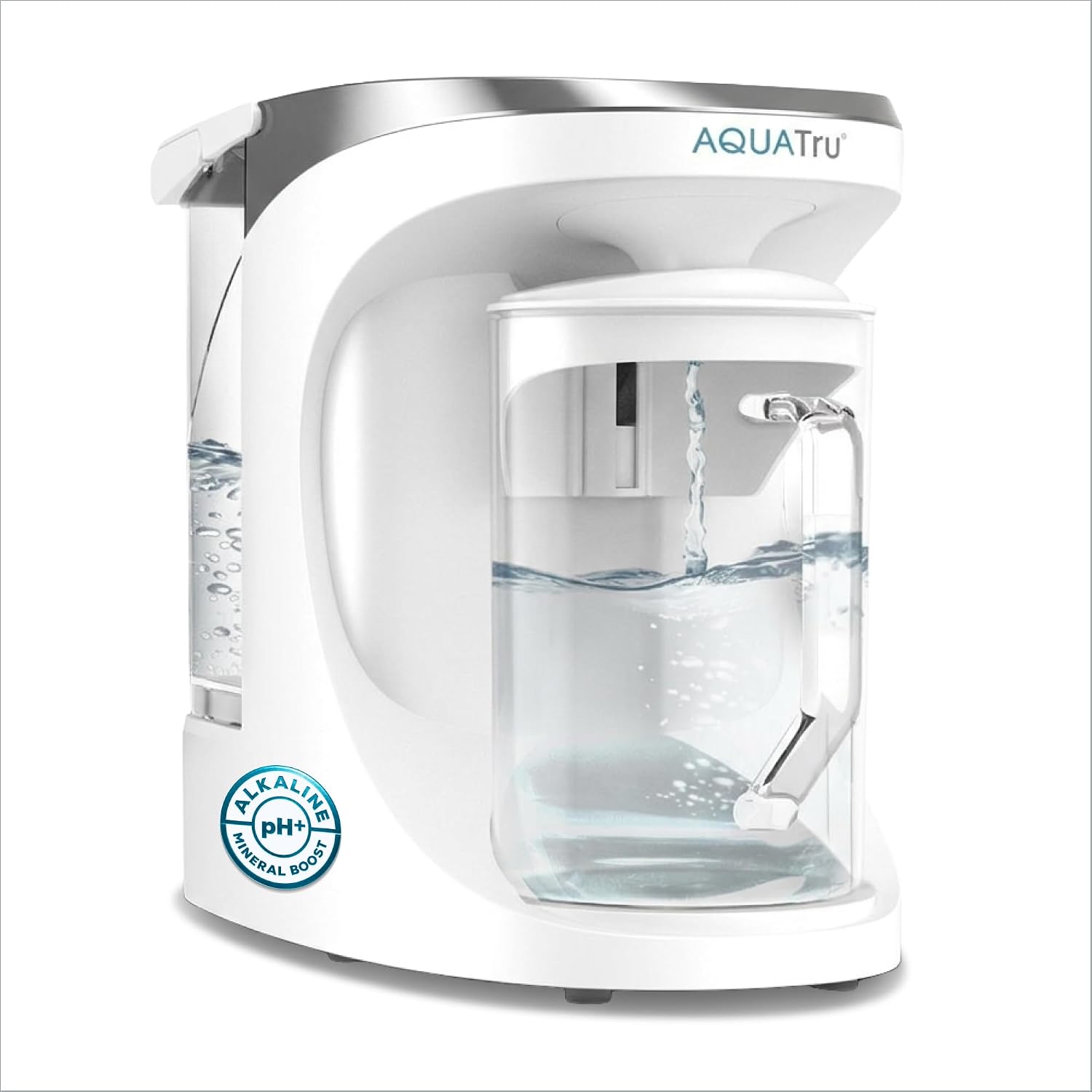
Our pick: AquaTru Glass Carafe Alkaline Countertop Reverse Osmosis Water Purifier | 4 Stage RO System | Removes 84 Contaminants Including PFOA & PFOS (PFAS), Lead and Microplastics | Adds Alkaline Minerals
 Visit on Amazon →
The glass carafe is the reason this one lives on my counter instead of in the basement. Four stages: a prefilter, the RO membrane, a carbon postfilter, and a remineralization stage that puts calcium and magnesium back into the finished water. The manufacturer lists 84 contaminants on the box, including PFOA and PFOS, lead, and microplastics. I do not repeat that list as my own result. I check it against the certification listing, and I tell anyone shopping to do the same, because "tested to standards" without a number behind it is marketing.
The glass carafe matters more than it sounds. A glass vessel does not hold onto flavors the way a plastic tank can, you can see exactly how much water you have, and you can carry it to the fridge. The tradeoff is capacity. You are filling a carafe, not drawing from a faucet, and a family of four will refill that tank more than once a day.
Flaws but not dealbreakers: The alkaline stage is the one feature I argue with. It raises pH, and it does that with a mineral cartridge, which is a taste decision rather than an upgrade. If you like the taste, keep it. If you want minerals, get them from food. Also budget for the replacement cartridges, because the machine is the cheap part of RO ownership.
Check current Amazon price before you decide, and price the cartridge set at the same time.
Anyone who wants a small footprint, a glass carafe, and finished water that does not read as flat will be happy here.
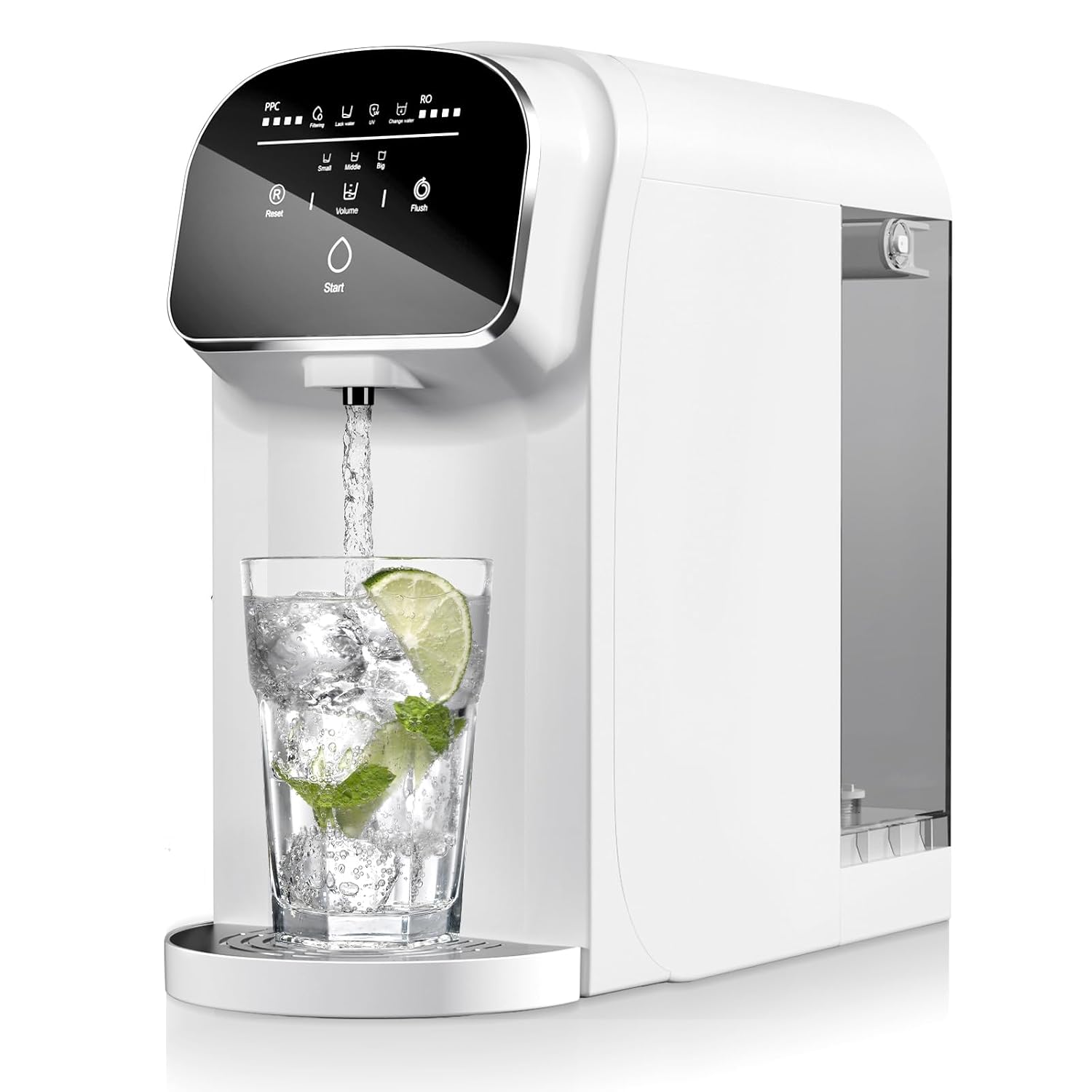
Runner-up: Aigerri Countertop Reverse Osmosis Water Filter, 5-Stage RO Water Filtration System with UV, 5:1 Pure-to-Drain Ratio, No Installation Required, Portable Water Purifier for Home, Kitchen, Office & RV
 Visit on Amazon →
Five stages, and the fifth one is a UV lamp in the storage tank. That is a real addition, not a gimmick, because the tank is where water sits and sits, and a UV stage is aimed at whatever grows in standing water. It also means one more consumable to track, and UV lamps have a rated life you should write down on day one.
The number I actually care about on this listing is the 5:1 pure-to-drain ratio. RO wastes water. That is how the process works: the membrane pushes concentrate to the drain to keep its surface clean, and a poor ratio means you are pouring three or four gallons down the sink for every gallon you drink. Five to one is a better figure than most older RO systems manage, and it is worth verifying in your own kitchen with a bucket and a timer if water use matters to you.
No installation required is accurate. It is also genuinely portable, which is why this one gets recommended for RVs, offices, and rentals. A tank-based unit travels better than a glass carafe unit, and there is no glass to break on a bumpy road.
Flaws but not dealbreakers: A plastic storage tank will hold onto flavors over time if you leave water sitting in it for days. Empty it and let it dry when you leave for a trip. And the counter footprint is not small. Measure your counter before you order.
Check current Amazon price and add the UV lamp and the cartridge replacements to your calendar.
Anyone who wants UV in the tank, a strong pure-to-drain ratio, and a unit that moves between kitchen, office, and camper will get more out of this one.
How to set up a countertop RO unit
This is the part that decides whether you love the machine or resent it.
Step one: pick the spot before you unbox. You need an outlet, a level surface, and room to lift the tank or carafe out and fill it. Keep it out of direct sun and away from the stove. Heat and sunlight both encourage whatever grows in stored water.
Step two: discard the first tank. Every new membrane ships with a preservative. Read the manual's first-flush instruction and throw away the first batch or two of product water. Do not taste it, and do not water a plant with it.
Step three: feed it cold water only. Hot tap water dissolves more from your pipes and can damage the membrane. Cold water, every time.
Step four: plan the drain line. The waste water has to go somewhere, usually a sink or a bucket. On a 5:1 unit you will notice it. That is the design, not a fault.
Step five: record your baseline. Measure the TDS of your tap water and the TDS of the product water with an inexpensive meter, then write both numbers on a piece of tape on the side of the machine. You now have a reference point for the next three years.
Step six: time the first fill. Write that number down too. Flow decline is the earliest sign of a clogged prefilter, and it shows up long before the water tastes different.
Step seven: set the filter calendar on day one. Put every replacement date in your phone immediately. Breakthrough is invisible. A filter that has stopped working usually still produces clear, good-tasting water.
Step eight: if lead is your worry, test for lead. A TDS meter cannot see it. If you have older plumbing, a pregnant person, or a young kid in the house, send one sample to a certified lab and keep the report.
The habits that keep it running
Replace cartridges on schedule, not on taste. Recheck TDS once a month and keep a log, even if it is just a note on your phone. Empty and dry the tank if you are leaving for more than a few days. Never let the unit freeze, which matters if you are running one in an RV or a cabin. Clean the carafe or tank as the manual instructs. And when fill time roughly doubles, treat the prefilter as done, whatever the calendar says.
The competition and why it lost
Under-sink reverse osmosis is the cheapest way to drink RO water per gallon, and it is the wrong tool if you rent, move often, or do not want a plumber under your sink. Gravity filters handle emergencies well and nobody wants to wait 40 minutes for a liter. Pitcher filters are fine for taste and nothing else, and the ones that do pull dissolved solids eat cartridges fast enough to prove it. Faucet mounts and fridge filters are convenience devices. Countertop RO wins on one thing: it is the only category that gets you membrane-level filtration without touching your plumbing.
What this all costs
Cost per gallon is the only honest price tag in this business. Take the purchase price, add every replacement cartridge you will buy over three years, add the UV lamp if your unit has one, and divide by the gallons you actually drink. That number, not the sticker, is what you are paying.
The machine is the bait. The cartridges are the real price. So pull up the listings, note Check current Amazon price for both units, and then price the replacement set before you commit. If the cartridge math does not work, the machine does not work.
That is the job. Fill the tank, run the first flush, log your baseline, and let the membrane do the rest.