Related: How to Read a Water Filter Spec Sheet Without Getting Fooled
I moved to Madison and my tap water smelled like a hotel pool. My kid, who was four at the time, took one sip and handed the glass back. That is how most people end up shopping for a countertop reverse osmosis water filter, or a pitcher, or whatever the store puts at eye level. It is not a hobby. It is a Tuesday.
I spent six years running contaminant analyses for a municipal water lab before I went independent, and I still keep a bench in my basement with a TDS meter, a flow gauge, and a logbook that has outlived three of my phones. When a new filter lands here it goes through the same routine: fill, measure, log, repeat until the media is spent. The number I care about most is not printed on the box. It is the point where performance starts to fall off, because that is the day you actually have to buy the next cartridge.
That is the buried part of this category. A countertop reverse osmosis water filter is a subscription with a machine attached. The machine is the fun purchase. The cartridge is the real cost, and it is the reason two systems that look identical on a shelf can cost very different amounts over three years.
So here is how I think about the four products on this page. Three of them handle water. One of them handles the air in the same room, which matters more than people expect once you start paying attention to what you are breathing while you drink.
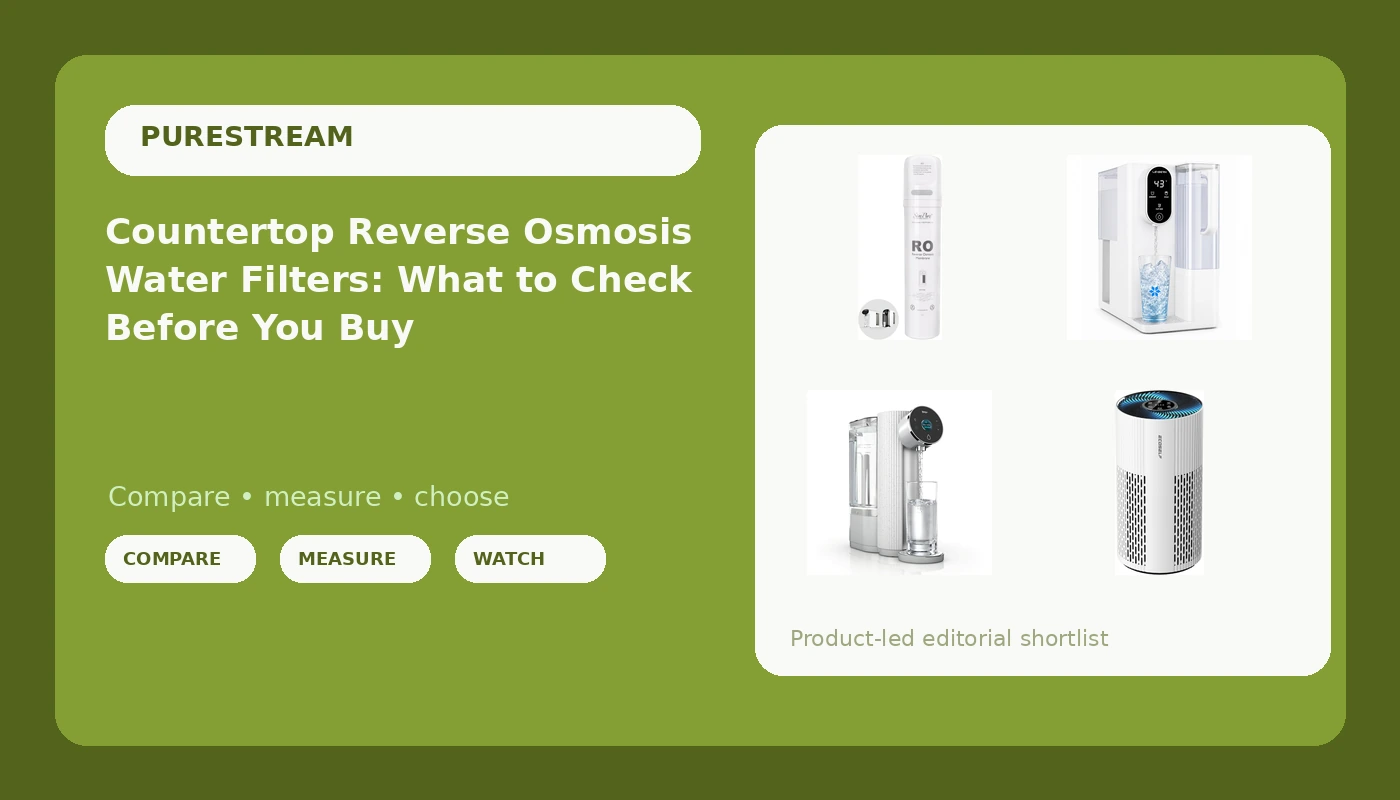
The consumable that decides everything: SimPure Y7P replacement cartridge
This is the replacement cartridge for the SimPure Y7P series, rated at 100 GPD, sold as a single pack. If you already own a Y7P, this is not an upgrade. It is maintenance, and maintenance is the whole ballgame in reverse osmosis.
RO works by pushing water through a membrane that rejects dissolved solids. The membrane does not fail in a way you can see or taste. It keeps producing water while its rejection rate quietly slides, and that slide is what we call breakthrough. By the time your water tastes different, you have usually been drinking through a tired membrane for weeks.
Two things I tell friends about any RO cartridge. First, buy the replacement before you need it, because the moment you notice the decline is the moment you want the box already on the shelf. Second, verify your model before you order. The series name in that title is doing real work, and an RO cartridge that does not seat properly is a very expensive piece of plastic.
If you own a Y7P, this is the line item that keeps the system honest. If you do not own a Y7P, skip it entirely, because it will not fit anything else.
 Visit on Amazon → on Amazon.
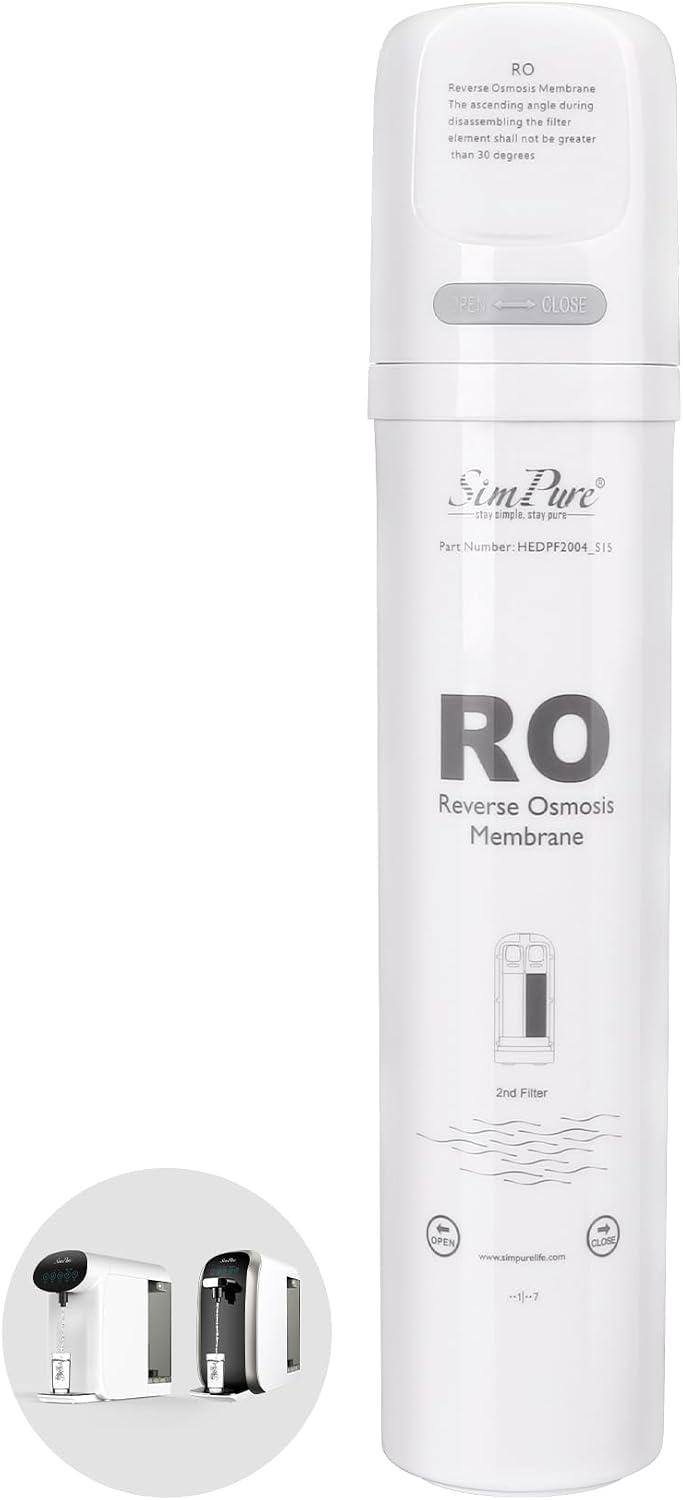
No plumbing, no landlord permission: Leysern cold countertop RO
A countertop reverse osmosis water filter solves the problem that keeps most renters out of RO: there is no hole in the cabinet, no drain saddle, no under-sink real estate to give up. You set it on the counter, fill it, and it does the membrane work in front of you.
The honest tradeoffs are counter space and patience. Countertop RO units move water more slowly than an under-sink system with a storage tank, and every one of them takes up a footprint you have to live with. I have watched people buy a countertop unit for the convenience and then resent it by month two because it lives where the cutting board used to be. Measure your counter before you fall in love with a spec sheet.
The question I would ask before buying any countertop RO is the one nobody puts in the marketing: what does the cartridge schedule look like, and are those cartridges proprietary? A system with a cheap entry point and a locked cartridge is a trap. The machine is the bait.
For renters, apartment dwellers, dorm rooms, and anyone whose lease says no drilling, this category is the practical answer, and the no-installation design is the entire reason it exists.
 Visit on Amazon → on Amazon.
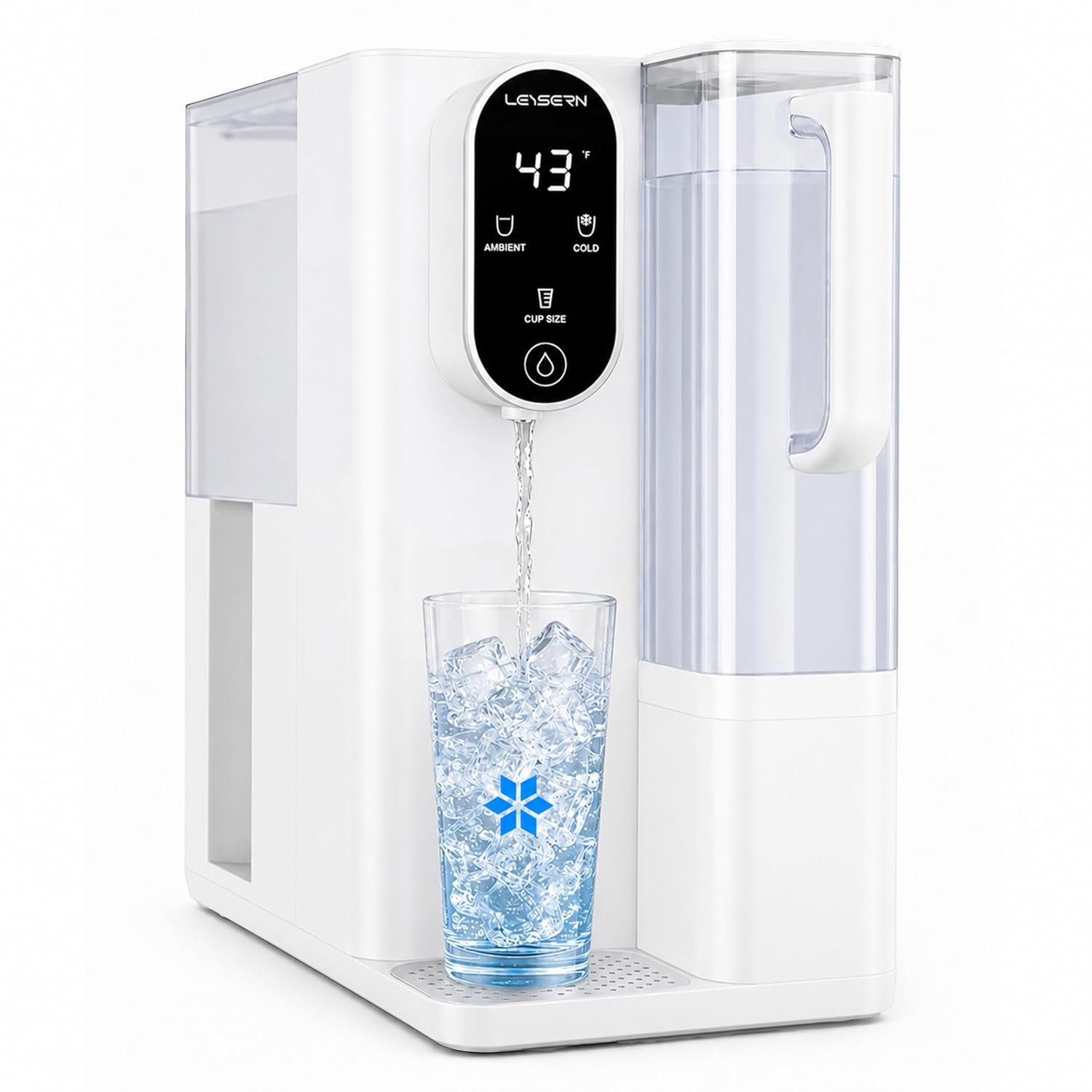
Smart filtration without the membrane: Ninja HydraSense WF1001WH1
The HydraSense is a countertop filtration system, not an RO system, and that distinction is the single most important thing on this page. A carbon-based system is very good at what it does: chlorine, taste, odor, and a defined list of contaminants, assuming the certification backs it up. It will not drive your TDS toward zero the way a membrane does.
That is not a knock. Most municipal water problems in this country are taste and disinfection byproducts, not dissolved solids, and a well-built carbon system handles those without wasting a drop. My rule is simple: match the technology to the problem. If your water is hard, high in TDS, or you want mineral-stripped water for a specific reason, you want RO. If your water tastes like a swimming pool and your kid will not drink it, carbon does the job.
What I would verify before buying: the certification numbers, not the marketing language. "Tested to NSF standards" without a certification number means nothing to me. Look for the actual standard cited for the actual contaminant you care about. And check the cartridge cost and availability, because a smart system with cartridges you cannot find in eight months is a countertop decoration.
The intelligence here is convenience, not chemistry. If that is what you want from a countertop system, this is a reasonable way to get it.
 Visit on Amazon → on Amazon.
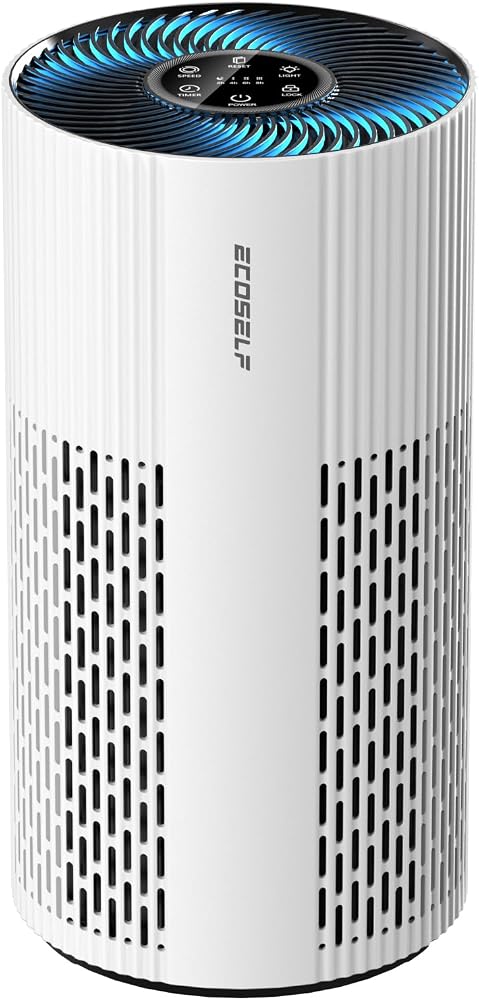
The room-side companion: HAP604 True HEPA air purifier
Let me be clear about what this is. The HAP604 is an air purifier, not a water filter. It does not touch your tap water, and if you came here for a glass of better-tasting water, scroll back up.
It is in this guide because home filtration is not only a plumbing question. I run a TDS meter on my water and I still had to buy a separate machine for the pet dander and the smoke that drifts in from the neighbor's fire pit. Once you start paying attention to what your family takes in, the air in the bedroom and the kitchen joins the conversation, and it has its own filter schedule.
What the spec sheet gives you: a True HEPA filter, a 360 degree air intake and outlet, coverage listed up to 1500 square feet, a sleep mode listed at 20dB, a night light, and timer settings. The features I would actually use are the sleep mode and the timer. The features I would ignore are the night light, unless you have a kid who insists.
The HEPA filter is the consumable here, exactly like the RO membrane is the consumable in the water world. Same principle, different medium: when the media loads up, performance drops and airflow gets louder. Check the replacement filter's price and availability before you commit, because a purifier with a discontinued filter is a fan.
 Visit on Amazon → on Amazon.
How I evaluate a filter
Every unit that comes through my basement lab gets the same treatment, and none of it requires a degree.
I start with a baseline reading of my own tap water: TDS, pH, hardness, chlorine, and a lab panel for lead and copper sent out to a certified lab. Without a baseline you cannot tell whether a filter is doing anything at all. Then I run the unit through a long volume test, logging TDS and flow rate at set intervals until the numbers move. A filter that holds steady for a hundred gallons is a different product than one that tapers off at twenty, even if the boxes look the same.
I measure flow with a stopwatch and a graduated container, not the display. I check whether the housing seals without weeping, whether cartridges seat without a fight, and how much counter space the thing actually eats versus what the listing implies.
And I keep a cost-per-gallon column in the logbook, because the only honest way to compare two systems is to divide the total cost of the machine plus every cartridge it will eat by the gallons it produces. That number is rarely on the box, and it is always the one that matters.
What the numbers tell you
TDS is not a health meter. It is a filter-performance meter. High TDS does not automatically mean unsafe water, and low TDS does not automatically mean clean water. What TDS does beautifully is show you when a membrane is still working and when it has started to let things through.
Flow rate is the spec people ignore until they are standing at the sink waiting for a glass. A system that starts strong and slows to a trickle in a month is a faucet decoration. If you cannot get a full glass in a reasonable amount of time, you will stop using the filter, and a filter you do not use removes exactly nothing.
Breakthrough is the concept that should drive every purchase in this category. Filter media has a finite capacity. When it is exhausted, contaminants pass through, and the water still looks and tastes fine. That is why replacement schedules exist, and why the cartridge, not the machine, is the real price of admission.
Certification is the other half. An NSF certification number tied to a specific standard tells you an independent lab verified a specific claim. "Tested to NSF standards" with no number tells you nothing. I will repeat that until it stops being true.
Reference table: what each product is for
| Product | Type | Best for | What to verify | Where to buy |
|---|---|---|---|---|
| Visit on Amazon → SimPure Y7P replacement cartridge |
RO replacement cartridge, 100 GPD, 1 pack | Existing Y7P owners who need the consumable | That your system is the Y7P series before ordering | Visit on Amazon → |
| Visit on Amazon → Leysern cold countertop RO |
Countertop reverse osmosis, no installation | Renters and apartments where under-sink work is impossible | Counter footprint and whether the cartridges are proprietary | Visit on Amazon → |
| Visit on Amazon → Ninja HydraSense WF1001WH1 |
Countertop carbon filtration system | Taste, chlorine, and everyday drinking water without a membrane | The certification numbers for the contaminants you actually care about | Visit on Amazon → |
| Visit on Amazon → HAP604 True HEPA air purifier |
Room air purifier, not a water product | Bedrooms and living rooms with pet dander, dust, or smoke | HEPA replacement filter price and availability | Visit on Amazon → |
Should you buy the SimPure Y7P replacement cartridge?
If you own a Y7P, yes, and buy it before the system tells you it needs one. The whole value of a reverse osmosis system lives in the membrane, and a membrane running past its window is producing water you think is filtered. That is the worst possible outcome: paying for filtration and getting the illusion of it.
If you do not own a Y7P, this is not for you. There is no universal fit in RO cartridges, and I would rather you hear that here than after the return window.
Should you buy the Leysern cold countertop RO?
Yes, if your blocker is installation. Renters, small apartments, and anyone who is not going to drill into a cabinet will get more real filtration out of a no-install countertop reverse osmosis water filter than out of a pitcher they replace twice a year. The membrane does work that carbon cannot, and you can see the difference on a TDS meter within the first few gallons.
Go in knowing you are trading counter space and fill speed for that performance, and check the cartridge supply before you buy. If the cartridges are proprietary and pricey, the machine is the bait.
Should you buy the Ninja HydraSense WF1001WH1?
Yes, if your problem is taste and chlorine, and no, if your problem is dissolved solids. This is a convenience-first countertop filtration system, and it does the job most households actually need without a membrane, a tank, or a drain line. Match it to the water you have, not the water you imagine.
And if your kid will not drink the tap water, that is the real test. Mine drank from a filtered tap for the first time and asked why the water at school tasted weird. That is what you are buying. Not a spec sheet. A glass that gets emptied.
Should you buy the HAP604 air purifier?
Yes, if you want the other half of the indoor air and water picture, and if the room you care about fits inside the coverage the listing claims. It is a separate machine with a separate filter schedule, and it will not do anything for your water.
Buy it for the sleep mode and the timer, keep up with the HEPA replacement, and treat it like the water side: the filter is the product, and the box it sits in is just the housing.