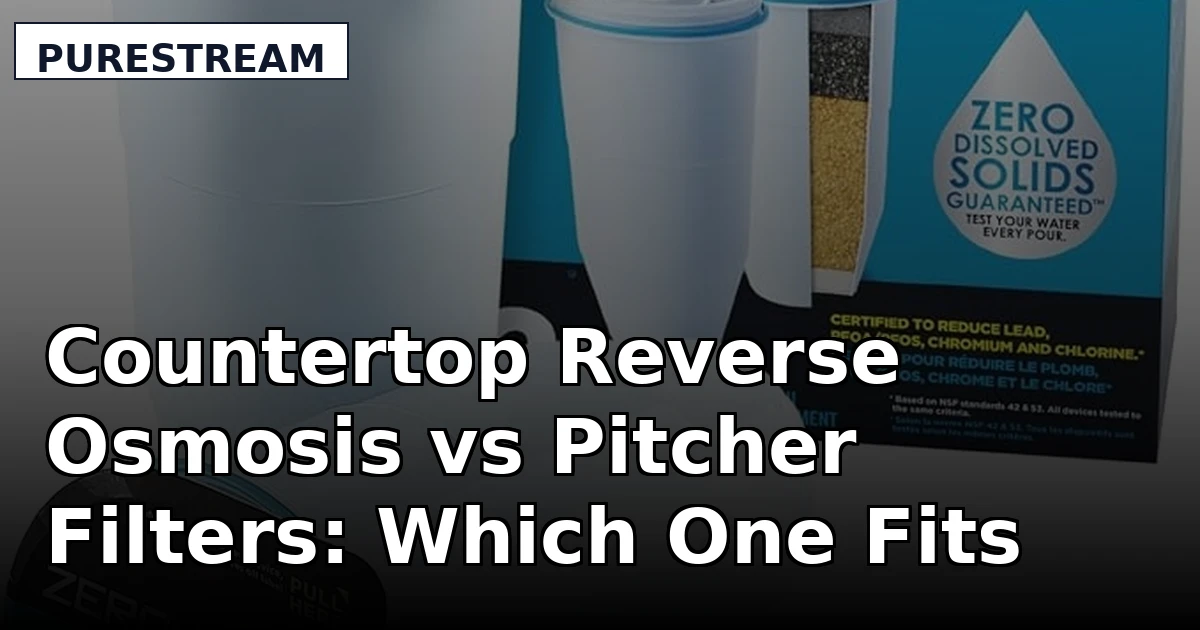
Most people who start shopping for a countertop reverse osmosis water filter are really asking a different question: do I need to strip everything out of my water, or do I just need it to taste like water again? I spent six years running contaminant analyses for a municipal water lab before I went independent, and those are two different purchases with two different price tags.
My own kitchen is where this started. Madison tap water came out of the faucet tasting like a swimming pool, and my kid refused to drink it. A cheap TDS meter told me more in ten minutes than an evening of review sites, because it handed me a number instead of a feeling. That number is not a health verdict. It is a filter performance meter, and it is the fastest way to see whether the thing on your counter is doing anything at all.
So that is the lens here. Two of these four products are countertop reverse osmosis systems. One is an OEM refrigerator cartridge. One is a replacement filter pack for a pitcher you may already own. They solve different problems, and the mistake I see most often is buying the one with the loudest label instead of the one that matches what is actually in the glass.
The short answer: if you want water with genuinely low dissolved solids and you have counter space but no interest in plumbing, a countertop RO system is the pick, and the Aigerri unit here carries the more complete feature set. If you already own a compatible Frigidaire fridge, the PurePour cartridge is the cheapest way to fix taste. The ZeroWater two-pack only makes sense if a ZeroWater pitcher is already sitting on your counter.
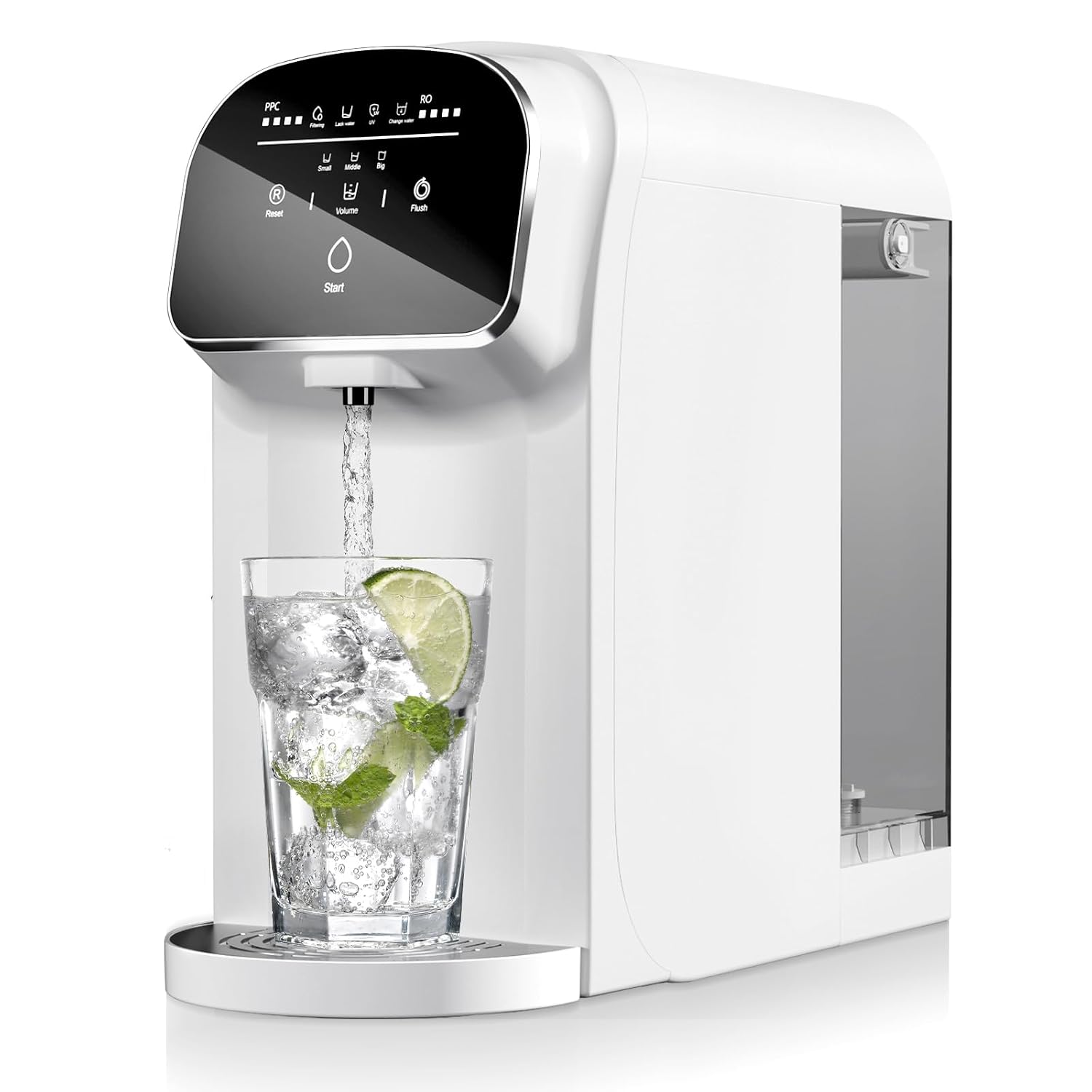
Aigerri Countertop RO Water Filter
Five stages plus a UV step and a 5:1 pure-to-drain ratio, with no installation required
Countertop footprint, RO reject water, and a multi-cartridge schedule you have to keep up with
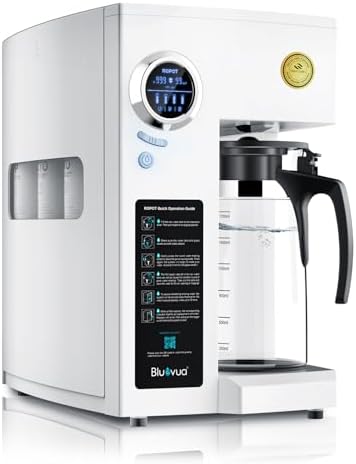
Bluevua RO100ROPOT Countertop RO System
Countertop RO without plumbing, which makes it workable for renters and RV owners
Same counter footprint and wastewater as any RO unit, and proprietary cartridges set the long-term cost
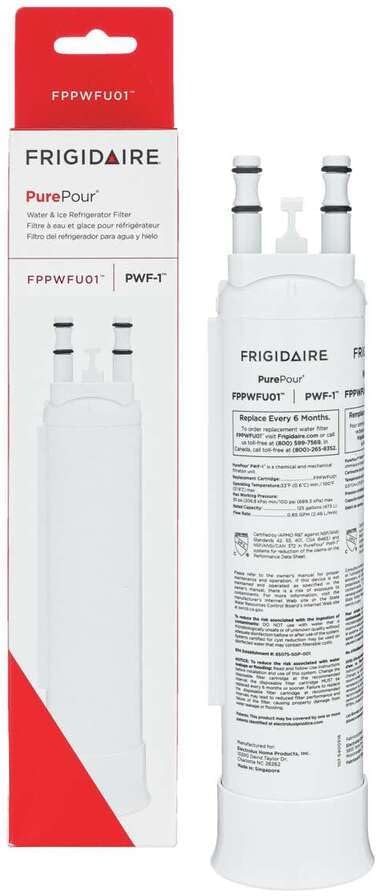
Frigidaire FPPWFU01 PurePour PWF-1 Water Filter
OEM replacement for compatible Frigidaire fridges, fixing taste right at the dispenser you already use
Only fits the fridges it fits, does nothing for dissolved solids, and it is a consumable rather than a system

ZeroWater Official Replacement Water Filter 2-Pack
These cartridges are the part of a ZeroWater pitcher that actually pulls dissolved solids, and the listing names PFOA/PFOS reduction
Media this aggressive exhausts quickly at high TDS, so cost per gallon climbs, and the pack is useless without the pitcher
Prices and availability were captured from Amazon Creators API and may change.
What each of these four products actually is
It helps to sort them by what they replace, not by what they promise.
The Aigerri Countertop Reverse Osmosis Water Filter is a five-stage RO unit with a UV stage, and the listing calls out a 5:1 pure-to-drain ratio. It sits on the counter, needs no installation, and is aimed at kitchens, offices, and RVs. That last part matters more than it sounds: no plumbing means no landlord conversation and no hole drilled in a countertop.
The Bluevua RO100ROPOT Countertop Reverse Osmosis Water Filter System is the other countertop RO unit in this comparison. Same category, same basic promise: RO-level dissolved solids reduction without a plumber. The differences between these two live in the staging, the drain ratio, and how the cartridges are sold, which is where your money actually goes over a couple of years.
The Frigidaire FPPWFU01 PurePour PWF-1 Water Filter is not a system. It is a replacement cartridge for a compatible Frigidaire refrigerator, and its job is taste and odor work at the dispenser you already use twenty times a day. If your fridge takes it, this is a consumable purchase, not a filtration strategy.
The ZeroWater Official Replacement Water Filter two-pack is also a consumable. ZeroWater pitchers are the pitcher design that removes the most dissolved solids, and these cartridges are the reason why. They are also the reason those pitchers get expensive, because media that removes that much has to be replaced that much sooner.
How I judge a filter without trusting the box
Four things, in this order.
What does the certification number say? NSF/ANSI 42 covers taste and chlorine reduction. NSF/ANSI 53 covers health contaminants like lead. "Tested to NSF standards" without a certification number is marketing, not a claim. When a listing gives you a number, look it up. When it does not, treat the claim as unproven and decide whether you care.
What does the TDS reading do? I use total dissolved solids as a performance meter, not a health meter. If the number does not move after the water passes through, the filter is not removing dissolved material, whatever the packaging says. That does not make it useless. It makes it a taste filter, and you should pay taste-filter money for it.
What is the flow rate after fifty gallons, not after one? Every filter is fast on day one. The question is whether you are still filling a glass in a reasonable time in month two, because a filter that has slowed to a trickle is a decoration with a cartridge bill attached.
What does it cost per gallon, replacements included? The purchase price is the entry fee. The filter schedule is the rent.
What RO does, and what it does not do
Reverse osmosis pushes water through a membrane that rejects dissolved solids, which is why RO water measures near zero on a TDS meter. That is the whole appeal, and it is real.
What RO does not do is read your problems off a label for you. It strips minerals along with the contaminants, which is why some people add a remineralization stage and some people do not care. It produces reject water. A 5:1 pure-to-drain ratio means five parts drinking water for every one part sent down the drain, which is more efficient than older ratios but still not zero. And it is slower than a faucet, because a membrane does not care about your schedule.
The UV stage on the Aigerri unit is a disinfection step. It targets microbes, not dissolved solids, so it is a different job than the membrane is doing. Do not let one stage's marketing cover for another stage's limits.
Replacement filters are the real price
This is where these four products stop being comparable and start being a math problem.
The Frigidaire cartridge is a single consumable for a fridge you already own. Simple, predictable, and limited to taste and odor work at the dispenser.
The ZeroWater two-pack is a single consumable for a pitcher. It removes more dissolved solids than any other pitcher media I have worked with, and it exhausts faster because of it. If your water starts high on the TDS scale, those cartridges are doing heavy work every single day.
The two countertop RO units are multi-cartridge systems. Sediment and carbon stages deplete on one schedule, the membrane lasts much longer on another, and the UV lamp has its own interval if it uses one. That makes the machine cheap to admire and expensive to maintain if you let the schedule slip.
Flow rate is the spec nobody reads until they are standing at the sink
I have watched more people give up on filtration over waiting than over water quality. Nobody wants to stand at the counter for a minute and a half to fill a glass, and no amount of contaminant reduction fixes that frustration.
Countertop RO units are slow by design. They make water at membrane speed and store it, or they make it on demand at membrane speed, and either way you wait. ZeroWater pitchers are slow for the same underlying reason: media that removes a lot of dissolved material restricts flow. Refrigerator cartridges feel fast because they push water at line pressure through a small carbon block, and they feel slow the day they clog.
Pick the speed you will actually tolerate, then pick the filtration. Not the other way around.
Cost per gallon, in plain math
Take the cost of the replacement filter, divide it by the number of gallons the manufacturer rates it for, and write the number down. That is your cost per gallon, and it is the only honest way to compare a cartridge against a system.
Two things to add to that number. First, RO reject water is part of the cost. If you send one gallon down the drain for every five you keep, your effective cost per gallon of drinking water is higher than the cartridge math suggests. Second, cartridges rarely hit their rated gallons in real kitchens, because rated gallons assume a feed water quality you may not have. Hard water and high TDS shorten every schedule.
Which one I would put in my own kitchen
If I wanted the most complete countertop RO package in this group, I would start with the Aigerri unit. Five stages, a UV step, a 5:1 drain ratio, and no installation is a lot of capability in one box, and the no-plumbing part is what makes it workable in a rental or an RV. Visit on Amazon →
If I were comparing countertop RO platforms specifically, the Bluevua RO100ROPOT belongs on the same shortlist, and the deciding factor would be cartridge cost and availability rather than the machine itself. Visit on Amazon →
If my fridge already took the Frigidaire PurePour cartridge, I would stop reading and buy that instead. There is no reason to park a countertop appliance next to a dispenser you already own when a cartridge fixes the taste. Visit on Amazon →
If I already owned a ZeroWater pitcher and my TDS readings were stubborn, I would buy the two-pack and accept the replacement rhythm, because nothing else in the pitcher category does that work. Visit on Amazon → If I did not already own the pitcher, I would not buy the cartridges first.
Trade-offs worth saying out loud
Countertop RO gives you the lowest dissolved solids and the highest ongoing attention. Two systems, several cartridges, reject water, and a counter footprint.
Refrigerator cartridges give you convenience and almost nothing else. They are a taste and odor fix, and they only exist for fridges that take them.
Pitcher cartridges give you real dissolved solids reduction in the smallest possible package, at the highest cost per gallon, with the slowest pour.
None of these is a mistake. Buying one of them for the wrong reason is.
What is on my bench right now
I keep a logbook of every reading, every filter change, and every cost-per-gallon calculation, and the current batch is running through its hundred-gallon cycles now. The pattern that keeps repeating is the one that shapes everything above: the purchase price is the easy number, and the filter schedule is the one that decides whether you still like the thing in month eight. Check the certification number, check the cartridge price, check the flow rate at fifty gallons, and then buy.