Madison tap water in late spring tastes like a lap pool. That is chlorine doing exactly what it is supposed to do, and it is also the reason my kid refused the kitchen faucet for two straight weeks.
Most people answer that problem by grabbing the first pitcher on the shelf at the grocery store. I understand the impulse. But the two filters in this guide solve completely different problems, and picking the wrong one gets you either a machine you never plumb in or a camping filter doing daily duty it was never built for.
So here is how to choose a water filter without guessing. First, find out what is actually in your water. Then figure out where you drink it. Everything after that is a spec sheet argument, and spec sheet arguments are the easy part.
Why you should trust me
I spent six years running contaminant analyses for a municipal water lab before going independent, and I hold a master's in water chemistry. Since then I have bench-tested more than 200 filter systems in my basement, running each unit through 100 gallons while logging TDS and flow decline week by week.
I keep a logbook of every reading, every cartridge change, and every cost-per-gallon calculation, mostly because I got tired of review sites that quote the box instead of the data. I do not repeat a removal claim unless there is an NSF certification number behind it or a lab sheet in front of me. And I test what filters remove. I do not test what water cures, because water does not cure anything.
The four numbers that decide everything
Ignore the marketing panel on the box and look for four things.
What it is certified to remove. NSF/ANSI 42 covers taste and chlorine. NSF/ANSI 53 covers health contaminants like lead and VOCs. NSF/ANSI 58 covers reverse osmosis. A package that says "tested to NSF standards" without a certification number is telling you nothing at all, and that phrasing is not an accident.
Dissolved solids. A TDS meter is not a health meter, but it is a very good filter-performance meter. If your water reads 320 ppm at the tap and you want it near zero, you need a membrane, not a carbon block. Carbon changes how water tastes. It does not pull dissolved salts out.
Flow rate at 50 gallons, not at gallon one. Every filter is fast on day one. The question is what it delivers after a month of real use. A unit that slows to a trickle is a faucet decoration with a warranty.
Cost per gallon, replacements included. The purchase price is the bait. The cartridge schedule is the price.
The kitchen job: stripping dissolved solids
If you own the place, have an outlet under the sink, and your water report shows lead, nitrate, or a TDS number in the triple digits, reverse osmosis is the honest answer. An RO membrane pushes water through a semipermeable barrier and leaves dissolved solids behind, which is why RO water reads near zero on a TDS meter. It also strips minerals you might have wanted, and that is a diet question, not a filter problem.
Tankless RO units skip the pressure tank that older systems hid under the sink, which means less standing water and a smaller footprint.
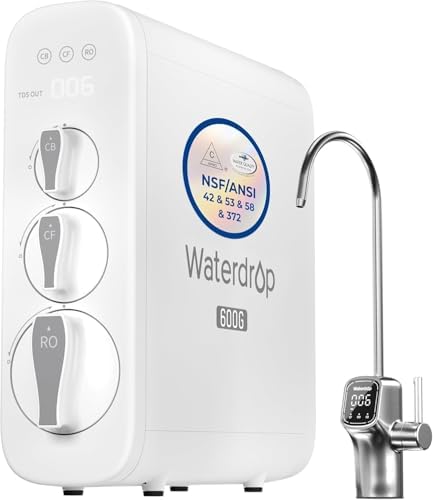
Our pick: Waterdrop G3P600 Tankless Reverse Osmosis Water Filter System, 600 GPD
 Visit on Amazon →
This is the unit I point homeowners toward when they want one faucet in the house that does all the drinking water. The tankless design is the part that matters. There is no pressure tank slowly refilling, no bladder to lose charge, and no four gallons of water sitting in a plastic vessel waiting for you to want a glass. The system produces on demand.
The 600 GPD figure in the name is a daily production rating, not a faucet flow rate, and those two numbers are not the same thing. Read the listing's flow spec if you plan to fill stockpots, because a membrane that makes plenty of water over a day can still feel deliberate when you are standing there with a five-quart pot.
Flaws but not dealbreakers: Tankless RO needs a dedicated faucet, a drain connection, and power under the cabinet. In a rental, or in an older kitchen with no outlet below the counter, that is a real installation project rather than a swap. Plan for an afternoon and check whether you have an open outlet before you order.
Anyone who owns their home, drinks a lot of tap water, and has a water report worth acting on should start here.
The road job: water of unknown quality
Portable filters are a different category with a different job. They exist for the times you are away from a treated municipal supply and the water in front of you is questionable: a backcountry stream, a campground spigot of unknown origin, a well at a hunting lease, an emergency kit in the garage.
Most portable units pair a hollow-fiber or ceramic membrane with a carbon element. That combination handles sediment, protozoa, and bacteria. It does not lower TDS, and it does not remove dissolved lead. If you want a number on a TDS meter to move, no handheld filter will do it.
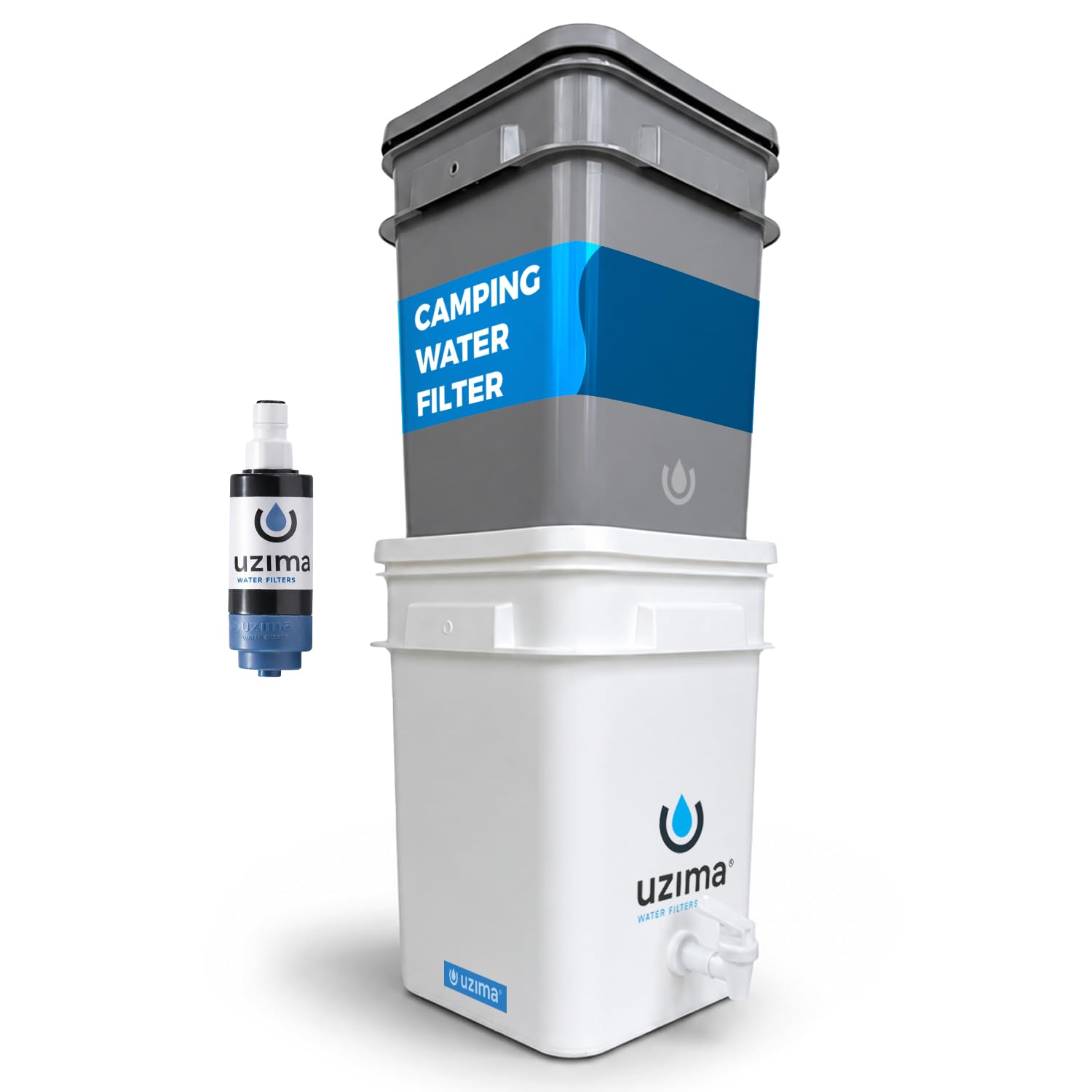
Portable pick: Uzima UZ-2 Camping Water Filter and Drinking Water Filter System, Portable Survival Camping Essentials, Backpacking Purification Gear for Glamping, Hiking, and Hunting Essentials and Military Gear
 Visit on Amazon →
This one is built for the road, not the countertop. It belongs in the backpacking, hunting, and emergency-prep category, and you should judge it on those terms rather than against an under-sink system. Three questions matter for any portable filter, and the listing answers all three if you read it carefully: how many gallons the cartridge is rated for, whether replacement cartridges are sold separately, and whether you can clean or backflush the element in the field.
That second question is the one people skip. A portable filter with a proprietary cartridge that is only sold in a bundle is a subscription, not a purchase. Check availability before you commit.
Flaws but not dealbreakers: Portable and gravity-fed filters are slow on purpose. Pumping or waiting is the trade you make for a device that needs no plumbing and no electricity. Nobody wants to stand there for 40 minutes to fill a liter, and that is the honest cost of the category. Treat it as your away-from-home filter and keep a faster system at the kitchen sink.
Campers, hunters, backpackers, and anyone building a real emergency kit will get their money's worth. Someone hoping to replace their kitchen filter with it will not.
How to decide, step by step
Step one: get the water report. If you are on municipal water, your utility publishes a Consumer Confidence Report every year, and it is free and online. If you are on a private well, order a lab panel, because nobody is testing that water but you.
Step two: read for numbers, not adjectives. Lead, copper, nitrate, chlorine residual, hardness, and TDS. Those six lines tell you more than any product page.
Step three: match the contaminant to the certification. Lead or VOCs means NSF 53 or reverse osmosis. Chlorine taste and odor means NSF 42, which is where most pitchers live. Bacteria in a private well means you need disinfection first, and a pitcher will not fix it.
Step four: count your actual usage. How many times a day do you fill a pot, a pitcher, a water bottle? A household that drinks two gallons a day has different needs than one that fills a single glass at dinner.
Step five: do the cost-per-gallon math. Purchase price plus replacement cartridges over their rated life, divided by the gallons you will realistically run through it. This is the only honest comparison between two filters.
Step six: check your install constraints. Outlet, drain line, countertop space, whether you rent. A great filter you cannot install is a worse filter than an average one you can.
Step seven: buy the second filter second. If you need clean water away from home, that portable unit is an addition to your kitchen setup, not a replacement for it.
What this costs, and the math that matters
I am not going to quote you today's price on either unit, because prices move and a stale number is worse than no number. Check current Amazon price on both, then run the real math.
For the kitchen system, add the purchase price to the membrane and filter replacements you will buy over five years, then divide by the gallons you will actually drink. For the portable unit, divide the price by the cartridge's rated gallon life. That second number is the one that separates a filter you keep for a decade from one that gets retired to a shelf.
Two patterns worth avoiding: proprietary cartridges that cost more than the machine after a year, and pitchers rated for six months that choke to a trickle after six weeks. Both show up in the cost-per-gallon column long before they show up in a review.
What I skip, and why
Alkaline filters that raise pH by running water over rocks and calling it a health feature. Cartridges that promise to "add minerals," which is rocks making your water harder, not healthier. Any box claiming it "removes 99.9% of contaminants" without listing which contaminants, because that sentence has never once been accompanied by a certification number. And remineralizers sold on the fear of "dead water," which is a marketing phrase, not a water chemistry term.
Reverse osmosis water is low in minerals. You get your minerals from food. That is the whole argument, and it takes less time to settle than the checkout page does.
The short version
Get your water report. Read the certification numbers instead of the adjectives. Do the cost-per-gallon math before you fall in love with a machine. Then buy for the two places you actually drink: a tankless reverse osmosis system under the kitchen sink for the water your family drinks every day, and a portable filter for the trail, the lease, and the emergency bin.
The filter that works is the one matched to your water and your habits. Everything else is packaging.