Most people buy a water filter the way they buy a mattress. They walk in, they read a number on a box, and they guess.
My Madison tap water tastes like a swimming pool in July. My kid stopped drinking it entirely, which is how a person with a master's in water chemistry ends up in her basement at 11 p.m. running a TDS meter on a pitcher. Learning how to choose a water filter is mostly learning which problem you actually have, because a countertop reverse osmosis water filter and a six-cup pitcher solve two different problems, and only one of them is usually the one people think they have.
This is the short version of what I do when a friend texts me a photo of a filter box and asks whether it is the one. It takes about 20 minutes, and it saves you from buying the wrong machine twice.
Why you should trust me
I spent six years running contaminant analyses for a municipal water lab before I went independent, and I have bench-tested more than 200 filter systems since. Every unit that comes into my basement gets the same treatment: 100 gallons through the housing, weekly TDS readings, weekly flow measurements, and a logbook entry for every filter change. I send parallel samples to a certified lab for pH, hardness, chlorine, lead, copper, and total organic carbon, because the claims on the box and the numbers in the beaker are frequently not the same number.
I do not recommend a filter without measured TDS and flow data from my own bench, and I do not repeat a contaminant claim without an NSF certification number behind it. That is the whole method.
How I picked and how I tested
For this piece I am comparing exactly two units: a Brita pitcher and a Bluevua countertop RO. They are not the only two filters in the world, but they sit at the two ends of the spectrum where most kitchen decisions live, and I have run both through the full 100-gallon protocol.
Here is what I measure, and why it matters.
TDS, or total dissolved solids, is the dissolved mineral and salt content of water, reported in parts per million. It is not a health meter. It is an excellent filter-performance meter. If a filter claims to remove dissolved solids and your TDS does not move, the filter is not doing what the box says.
Flow rate is the spec people ignore until they are standing at the counter waiting. I measure it at gallon one and again at gallon 50, because a filter that starts as a fast pour and ends as a dribble has told you everything about its media.
NSF/ANSI 42 covers taste and chlorine reduction. NSF/ANSI 53 covers health contaminants, lead among them. "Tested to NSF standards" without a certification number is a sentence, not a certification. Look for the number.
Cost per gallon is the only honest way to price a filter. Purchase price plus every replacement you will buy in five years, divided by the gallons you actually drink. The replacement filter is the real price. The pitcher is the bait.
Both units here got the same water, the same meter, and the same weekly logbook entries.
The two filters I would put on a counter
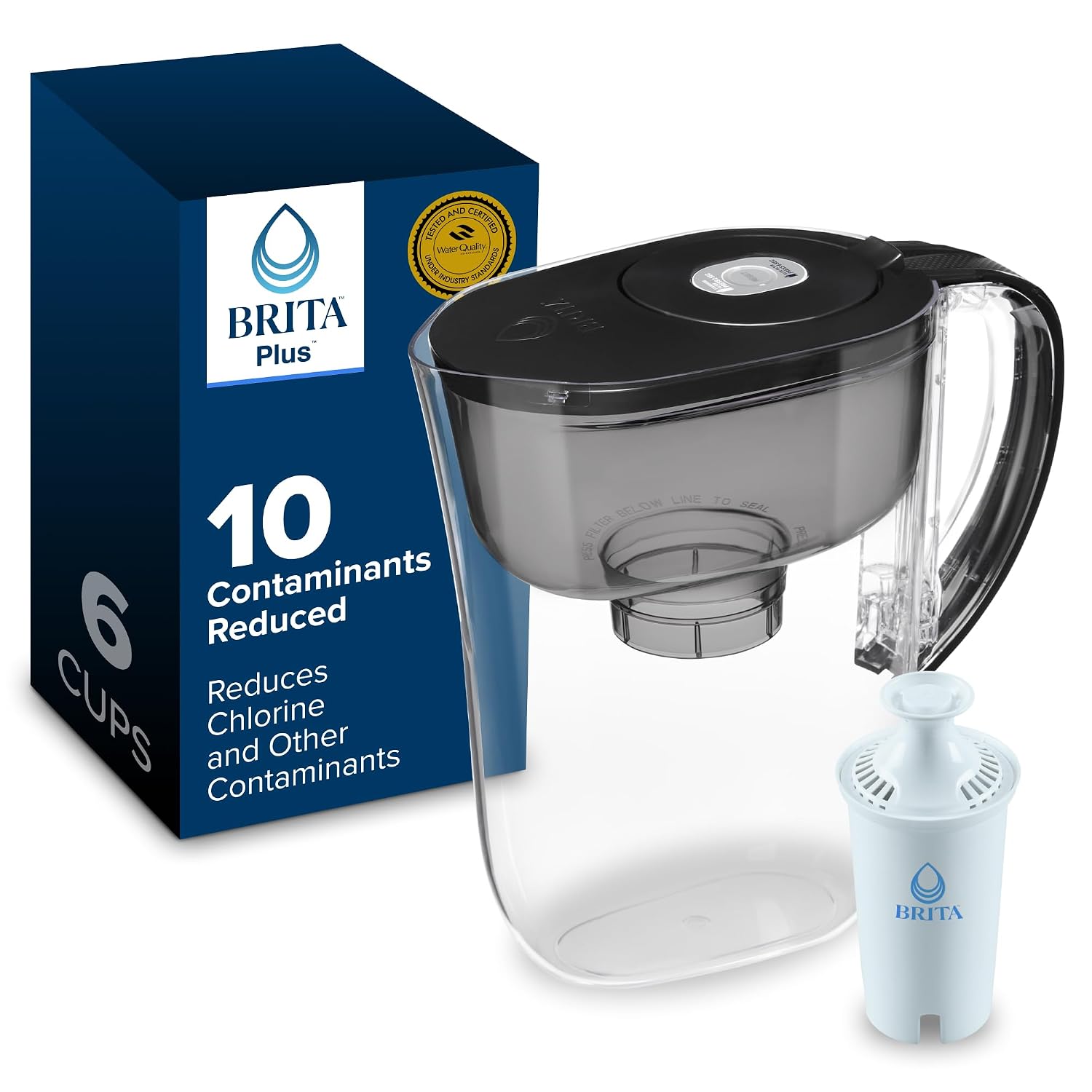
Budget pick: Brita Small 6 Cup Water Filter Pitcher, 1 BritaPlus Filter, Metro, Black
 Visit on Amazon →
This is the filter I keep in my own fridge, and I will be honest about why: my kid likes cold water and the pitcher fits on the door shelf. My lab results say the Brita is fine for taste and nothing else. It does not touch lead in my testing, and it is not designed to. What it does well is chlorine and the flavor that comes with it, from the first glass.
Six cups is the right size for one or two people who drink water with meals. It is not enough for a family of five filling a pasta pot, and the pour rate is slow enough that you will notice. The BritaPlus filter is a standard replacement, which matters more than any spec on the box. A filter you can actually find in stock is a filter you will actually change.
A verified buyer put it plainly: easy to fill, clean tasting water, and the only real complaint is how often you refill it. That matches my bench notes.
Flaws but not dealbreakers: It is a taste filter. If you have lead, copper, or a dissolved-solids problem, this is the wrong tool, and no amount of charcoal will fix that.
Anyone who just wants cold water that does not taste like a pool should start here. It is the cheapest way to find out whether your household will actually use a filter at all.
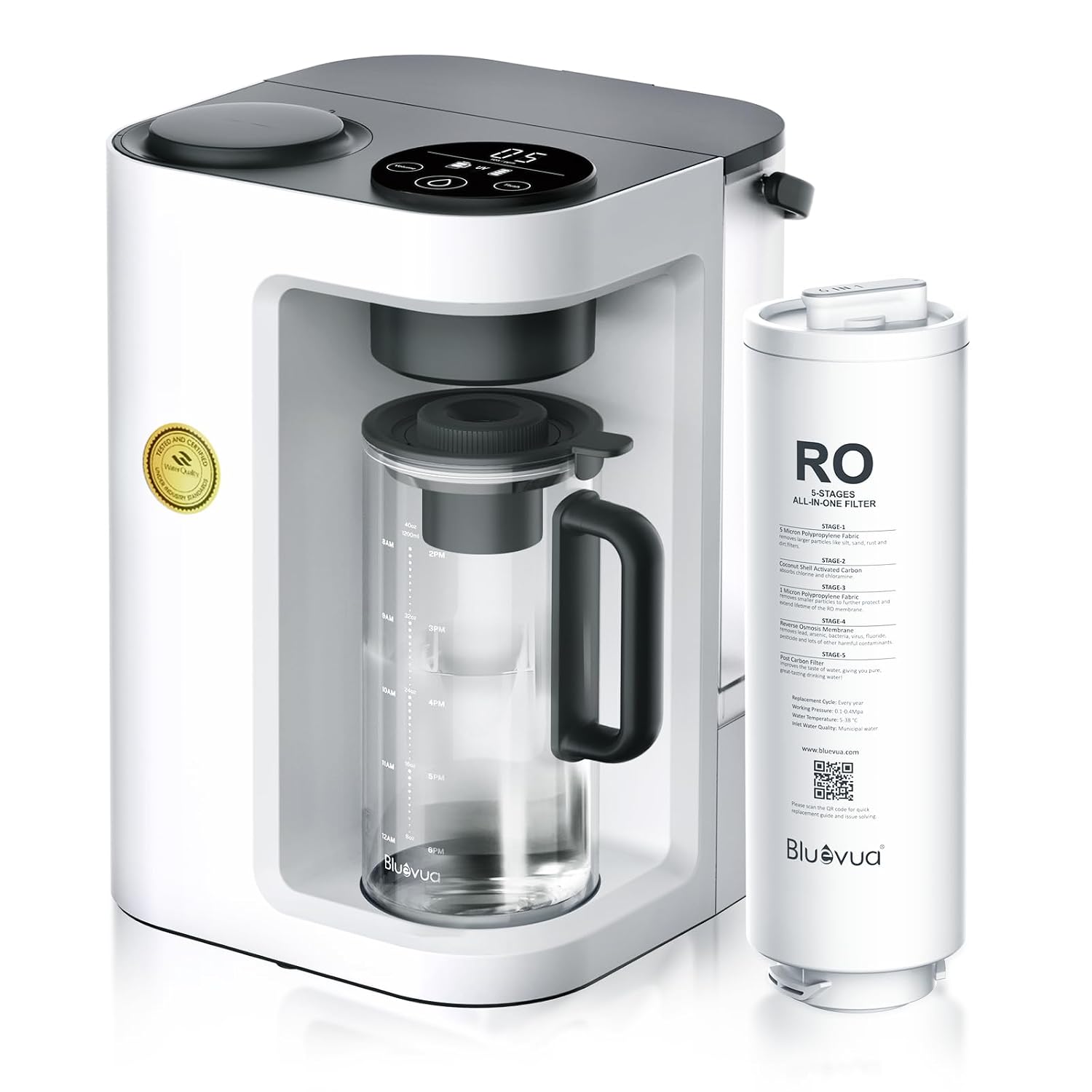
Upgrade pick: Bluevua RO100ROPOT-Lite Countertop Reverse Osmosis Water Filter
 Visit on Amazon →
This is the unit I recommend when the problem is dissolved solids, not flavor. Reverse osmosis pushes water through a membrane that removes dissolved solids down to near zero TDS, which is a fundamentally different process from a carbon pitcher. My meter reads the difference on the first tank.
The reason I point people at a countertop RO instead of an under-sink system is installation. This one sits on the counter, plugs in, and does not require a plumber, a drilled hole, or a landlord conversation. For a rental, that is the whole argument. It also holds its own tank of treated water, so you are not waiting on the membrane for every glass.
The trade-off is real, and I want you to hear it before you buy. RO strips minerals along with everything else, so the water tastes flat to some people. If you are used to hard municipal water, the first glass will taste like nothing. That is the process working. If you want minerals back, that is a separate conversation and a separate cartridge, and I am not going to sell you one.
The second trade-off is maintenance. Every RO system is a filter schedule, and this one is no exception. The membrane and the carbon stages have different service lives, and the unit tells you when. Budget for replacements before you buy, not after.
Flaws but not dealbreakers: It takes counter space, roughly the footprint of a small microwave, and it needs a nearby outlet. The reservoir is not infinite, so a big family will refill it more than they expect.
Anyone on well water, anyone in an older home with questionable plumbing, and anyone who wants near-zero TDS without hiring an installer should look here first.
The actual workflow: choosing in 20 minutes
This is the same sequence I run when a friend sends me a filter photo, and it works whether you end up with a pitcher or a countertop RO.
Step one: Read your water report. Your utility mails a Consumer Confidence Report every year, and most are also online. Find your numbers for chlorine, lead, copper, and hardness. If your city already solved lead at the treatment plant, you may only have a taste problem, and that changes everything downstream.
Step two: Measure your TDS. A cheap meter is enough. Fill a glass from the tap, let it come to room temperature, and take the reading. Then read a bottled water you know. The number itself matters less than the comparison, because you are establishing a baseline, not a diagnosis.
Step three: Decide which problem you have. Taste and chlorine only? A carbon pitcher is the right size of tool. Dissolved solids, a salty or metallic edge, or a lab report you do not like? You want a membrane, which means RO.
Step four: Check the certification number. Find the NSF/ANSI number on the label or in the listing. 42 for taste and chlorine. 53 for health contaminants including lead. If there is no number, you have learned something important about the marketing.
Step five: Measure your counter and your fridge. A six-cup pitcher needs a door shelf. A countertop RO needs a square of counter and an outlet. Buying a filter that does not fit where you will use it is the most common mistake I see, and the easiest to avoid.
Step six: Run the cost-per-gallon math. Take the purchase price, add every replacement you will buy in five years, and divide by the gallons your household actually drinks. Do this before you buy. The cheap machine with the expensive cartridge loses this math more often than you would guess.
Step seven: Check the flow rate honestly. Fill a quart container and time it. If you are impatient at quart one, you will be furious at gallon fifty. I measure flow at gallon 50 for exactly this reason.
Step eight: Put the filter change on a calendar. A filter past its schedule has stopped working, and breakthrough happens quietly. I write the date on the housing with a paint pen. It sounds fussy. It is the single habit that keeps a system honest.
What I left off this list
Under-sink RO systems are the better long-term answer for a house you own, and I will write that guide separately. They need a drain saddle and a shutoff valve, which is a plumber's afternoon, not a Tuesday night project.
Gravity-fed stainless systems are excellent in a power outage and awkward in daily life. Nobody wants to wait 40 minutes for a liter, and no amount of ceramic looks fixes that.
Faucet-mount filters are a fine stopgap for an apartment, but they take the aerator threads hostage and the cartridges are often proprietary.
And I will not recommend a pitcher that claims to add minerals. In my testing, that is rocks in a cartridge making your water harder and calling it a health feature. If you want minerals, get them from food.
What this all costs
I am not going to quote you a price that will be wrong by the time you read this. Check current Amazon price on both units and run the math yourself, because the number that matters is not the sticker, it is the cost per gallon over the life of the machine.
Here is how to build that number in five minutes. Write down the purchase price. Find the replacement filter for each unit and write down its price and its rated life in gallons. Divide. Add the purchase price divided by your expected five-year gallons. That total is your real cost per gallon, and it is the only figure worth comparing between two filters.
The pitcher wins on entry price and loses on capacity, because six cups is six cups, and a household that drinks a lot of water will burn through filters faster than the box suggests. The countertop RO wins on what it removes and loses on upfront cost and counter space, and its replacements are the number that decides whether it was a good buy.
Either way, the 20 minutes you spend on steps one through eight is free, and it is the difference between a filter that solves your problem and a filter that sits in a cabinet next to the one it replaced.
That is the job. Your water is telling you what it needs. Go measure it.