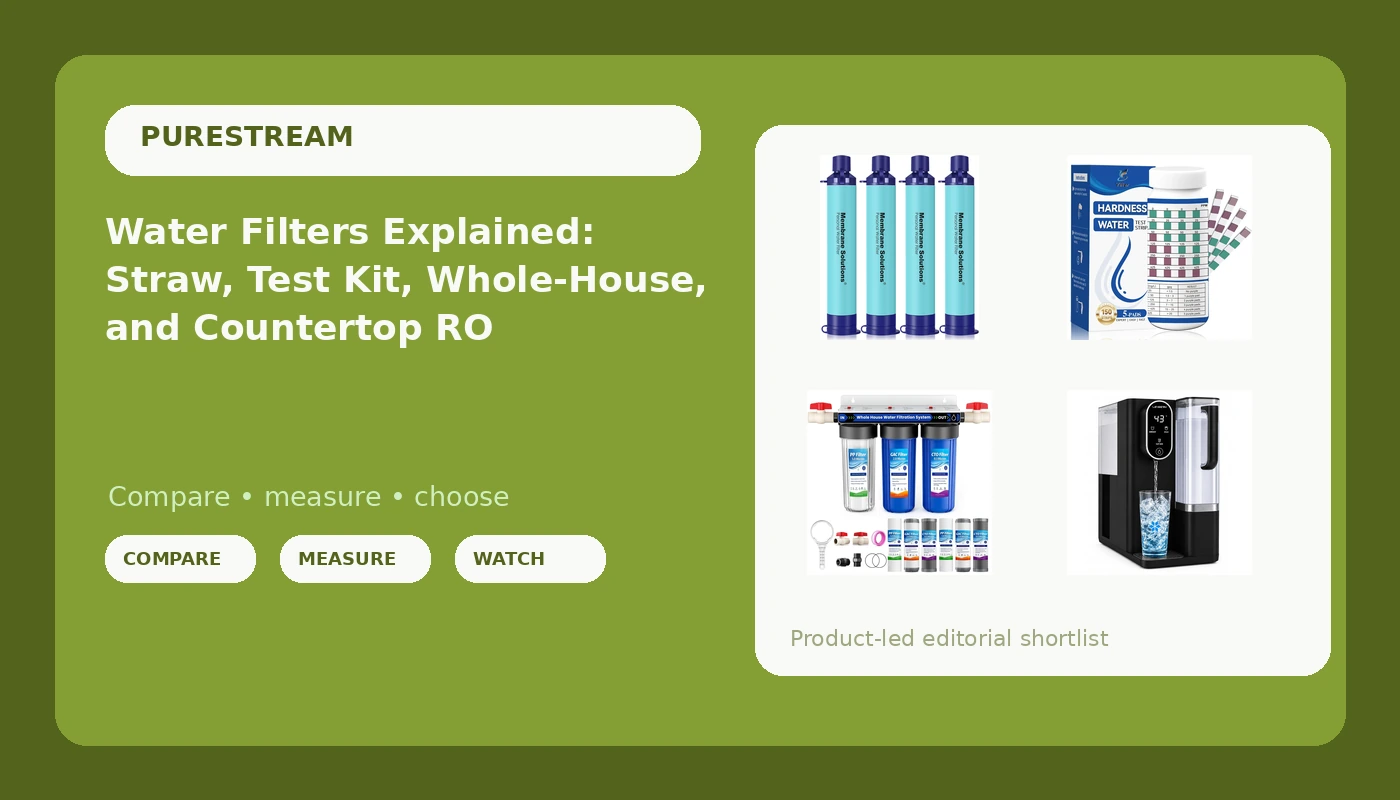
Most people shopping for home water filter options are trying to fix a problem they have not actually named yet. The water tastes like a swimming pool, or the glasses come out of the dishwasher spotted, or the well runs a little cloudy after a storm, and the instinct is to buy the biggest filter on the shelf. That instinct is expensive and often wrong, because the four most common household water complaints, chlorine taste, hardness, dissolved solids, and biological risk in untreated water, are four different problems, and no single device handles all four well.
I spent six years running contaminant analyses for a municipal water lab before I started testing filters on my own bench, and the pattern has not changed. The people who get the best results are the ones who spend nine dollars identifying the problem before they spend four hundred dollars treating it. What follows is an explainer, not a ranking. These are four genuinely different tools aimed at four different jobs, and the right one depends on what your water is actually doing.
Related: How to Read Your Water Quality Report Without a Chemistry Degree →
Quick answer
There is no single best home water filter, and any page that names one is selling you something. The honest sequence is test first, then treat. A hardness test kit tells you whether you have a mineral problem worth treating at all. A whole-house system is the right shape of answer when your source is a private well and the issue is sediment or the whole house, not one faucet. A countertop reverse osmosis unit is the right shape of answer when the problem is dissolved solids and you want drinking water without cutting into a cabinet. A personal straw filter is the right answer when the water source itself is unknown or untreated. Match the device to the problem and the volume of water you use, not to the marketing on the box.
Four useful options
| Model | Best fit | What stands out |
|---|---|---|
| Membrane Solutions Personal Water Filter Straw S1 | Emergency kits, hiking, travel | A personal, portable filter format that needs no plumbing or power |
| Water Hardness Test Kit with 5-Pads(150strips) | Diagnosing hard water before you buy anything | Enough strips to test repeatedly over time and watch a trend |
| Whole House Water Filter System for Well Water,3-Stage,2-Year Filter Supply | Private well households treating water at the point of entry | Three stages of treatment plus a stated two-year filter supply |
| Leysern Cold Countertop Reverse Osmosis Water Filter, No Installation | Renters and anyone who wants RO without plumbing work | Countertop RO format with no installation required |
The emergency and travel filter: Membrane Solutions Personal Water Filter Straw S1
This is the one category where I will happily recommend a product without a TDS curve, because the job is different. A straw filter is not competing with a countertop RO system. It is competing with drinking untreated water from a stream, a spigot of unknown quality, or a case of bottled water you have to carry. The trade-off is throughput: a personal straw delivers water at drinking speed, one mouthful at a time, which is fine for one person on a trail and useless for filling a stockpot. If you want a household solution, keep reading. If you want something that works when the household solution has no water pressure behind it, this is the format that makes sense.
The starting point: Water Hardness Test Kit with 5-Pads(150strips)
Hardness is the most misdiagnosed problem in home water treatment, mostly because the symptoms get blamed on the wrong thing. Spotted glassware, soap that will not lather, and a scaly kettle are hardness signals. A metallic taste or a chlorine smell is not. I have watched people buy a whole-house filter for a hardness problem, which does nothing for it, and I have watched people buy a softener for a chlorine taste problem, which also does nothing. The strip count matters more than it sounds: one test tells you a number, a dozen tests over a few months tell you whether that number moves, and whether the treatment you installed is holding. Water chemistry changes with source switching, snowmelt, and drought, which is exactly why I keep a logbook instead of a memory.
The whole-house option for well water: Whole House Water Filter System for Well Water,3-Stage,2-Year Filter Supply
A whole-house system is the only one of these four that changes the water coming out of the shower, the washing machine, and the kitchen sink at the same time. That is its entire argument, and it is a good one for well owners, because a well is not a municipal supply. Nobody is testing it on your behalf, nobody is adjusting the dose, and the water can shift after heavy rain in ways a city plant would correct for automatically. The trade-off is that you are now running a maintenance schedule for the whole house rather than swapping a pitcher cartridge when you remember. Two years of filter supply sounds generous until you are the person standing in the basement in month nineteen. Put the change dates in your phone the day you install it, not the day the water starts tasting off.
The no-install countertop option: Leysern Cold Countertop Reverse Osmosis Water Filter, No Installation
Reverse osmosis is the only process in this group that meaningfully reduces dissolved solids, which is why it is the answer when the problem is TDS rather than sediment. It is also the process that strips minerals along with everything else, and I will say plainly that I think the remineralizer upsell is mostly marketing. If you want minerals, eat food. The real trade-offs with countertop RO are counter space, a reservoir you have to refill, and a membrane and filter schedule that you should price out before you buy, because the replacement cartridges are the real cost of ownership. The upside is that you get RO performance in a rental kitchen without drilling a hole in a landlord's cabinet, and that is worth a lot to people who move every couple of years.
Prices and availability may change. Product images, names, and retailer links must be matched by verified ASIN. Do not state a current price, rating, stock status, or measured result without current evidence.
What TDS, hardness, and micron ratings actually tell you
TDS stands for total dissolved solids, measured in parts per million, and it is the single most misread number in home water treatment. It is not a health meter. A reading of 300 ppm does not tell you whether the dissolved material is calcium, sodium, or lead, and it says nothing at all about biological contamination. What TDS is genuinely good at is measuring filter performance: if water goes in at one number and comes out at a much lower number, the membrane is working, and when that outlet number starts creeping back up, the membrane is exhausting. That is why I keep a meter on the bench and why I do not trust a TDS number as a safety claim.
Hardness is a specific subset of TDS, the calcium and magnesium fraction, and it behaves differently from everything else in the water. It does not usually pose a health concern, but it scales plumbing, kills soap lather, and shortens the life of every appliance that heats water. Hardness is also the one parameter a homeowner can screen cheaply and repeatedly, which is why a strip kit belongs in the drawer before any treatment device belongs in the basement.
Micron rating describes the pore size of a filter medium, and the common mistake is assuming smaller is always better. A one-micron absolute cartridge catches more particles than a five-micron nominal one, and it also clogs faster, drops flow rate sooner, and costs more per gallon over a year. Sediment filtration is a flow-rate decision as much as a filtration decision, and the spec people ignore until they are standing at the sink waiting is the one that determines whether they keep using the system.
Certification numbers: the only claim that carries weight
"Tested to NSF standards" and "NSF certified" are not the same sentence, and the difference is the entire ballgame. Certification means an accredited body reviewed the product against a specific standard and listed it, with a number you can look up. Testing to a standard means somebody ran a test, possibly in-house, and you have no way to verify what was tested, at what flow rate, or for how long.
The two standards you will see most often are NSF/ANSI 42, which covers aesthetic claims like chlorine taste and odor and particulate reduction, and NSF/ANSI 53, which covers health-related contaminants including lead and certain volatile organic compounds. A filter certified to 42 only is a taste filter. That is not a knock. Taste is the reason most people start shopping. But if your concern is lead, a 42 certification tells you nothing about it, and no amount of confident packaging changes that.
When a product claims to remove "99.9% of contaminants" without listing which contaminants, treat the claim as a design statement rather than a measurement. The useful version of that sentence names the contaminant, names the standard, and points to a certification listing. If those three things are missing, you have learned something about the marketing, not the filter.
- Identify the symptom before the solution: taste, spots, cloudiness, or a known contaminant from a water report.
- Get a real number where you can. A hardness strip kit or a TDS meter costs less than a single replacement cartridge.
- Read the certification number, not the certification language, and match the standard to your actual concern.
- Size the system to your volume: one drinking glass, one faucet, or the entire house.
- Calculate cost per gallon including replacements before you buy, then put the change dates in your calendar.
Practical guidance for a real kitchen
- Test the cold kitchen tap specifically. Hot water dissolves more from your plumbing, and it is never the right sample for a drinking water question.
- Run the test after the system has been sitting overnight. First-draw samples are where problems show up, not samples taken after five minutes of flushing.
- Keep a written log of test dates, readings, and filter changes. Trends beat single readings, and memory is a terrible record keeper.
- Budget for replacements from day one. A system whose cartridges you cannot afford to change on schedule is a system that stops working quietly.
- Match the device to the volume of water you actually use. A personal straw is the wrong tool for a family of four, and a whole-house system is the wrong tool for an apartment.
Which option should you choose?
Choose the Water Hardness Test Kit with 5-Pads(150strips) when you have symptoms but no numbers, and you want to know whether hardness is even part of your problem before you spend anything meaningful. Choose the Whole House Water Filter System for Well Water,3-Stage,2-Year Filter Supply when your source is a private well and you want treated water at every tap, not just the kitchen. Choose the Leysern Cold Countertop Reverse Osmosis Water Filter, No Installation when dissolved solids are the concern and you want RO drinking water without under-sink plumbing or a cabinet cutout. Choose the Membrane Solutions Personal Water Filter Straw S1 when the water source is unknown or untreated and you need something that works with no plumbing and no power.
None of these four replaces a laboratory analysis of your specific water, and none of them should be selected purely on the strength of a product page. Water chemistry varies by source, by season, and by the age of your plumbing, which is why the sequence matters more than the purchase. If your water has never been tested, a certified lab panel costs less than most of the devices on this list and tells you what to actually solve for. If you are on a municipal supply, your annual water quality report is free and worth reading before you buy anything.
The bottom line
Home water treatment works when the device matches the contaminant and the volume of water you use, and it fails when it does not, no matter how good the hardware is. Test first, treat second, and treat the smallest thing that solves the actual problem. A hardness strip kit that costs less than lunch can save you from buying a four hundred dollar machine that does nothing for your water. A whole-house system is the right call for a well and an expensive mistake for a municipal supply that already meets standards. A countertop RO unit earns its counter space when dissolved solids are the issue and you want cold drinking water without construction. And a personal straw filter is not a household solution at all, which is precisely why it belongs in the emergency kit rather than on the kitchen counter. Check current Amazon price on the one that matches your water, not the one with the loudest box.