Most people buy a water filter pitcher the way they buy a shower curtain: quickly, cheaply, and without reading the label. Six weeks later the thing is dribbling into the reservoir, the water still tastes like a swimming pool, and they blame the water. I have run more than 200 filter systems through the bench in my basement lab in Madison, charting TDS and flow decline across 100-gallon runs, and here is the short version. A water filter pitcher is a gravity-fed cartridge sitting in a reservoir, and only three numbers decide whether you will still be using it next year: what the media is certified to remove, how fast it still pours at gallon fifty, and what the replacements cost per gallon.
Everything below is how to get those three numbers before you spend a dime.
Why you should trust me
I spent six years running contaminant analyses for a municipal water lab before going independent, and I hold a master's in water chemistry. My own Madison tap water tasted like a pool, which is how I ended up with a cheap TDS meter on my counter and a lab account on my credit card. Since then I have bench-tested more than 200 filter systems, sent samples out for pH, hardness, chlorine, lead, copper, and total organic carbon, and logged every filter change and every cost-per-gallon figure. I will not repeat a contaminant claim that does not have an NSF certification number or a lab sheet behind it, and I will not recommend a filter I have not watched decline across a long run.
What a gravity pitcher can and cannot do
Start with the honest scope. A pitcher is a taste-and-polish device. It sits in the fridge, it works while you sleep, and it has no pump, no pressure, and no drain line.
What it can do: reduce chlorine and the chloramine taste that makes tap water smell like a pool, cut sediment and rust, and, if the cartridge carries the right certification, reduce lead and a handful of other dissolved metals. What it cannot do: soften hard water in any meaningful way, remove nitrate without a media built for it, kill bacteria, or strip everything dissolved out of your water. If you are on a well with a bacteria problem, a pitcher is not the answer and no amount of counter space will make it one.
The label is where this gets decided. NSF/ANSI 42 covers taste and odor, which means chlorine and particulates. NSF/ANSI 53 covers health contaminants, including lead. NSF/ANSI 401 covers emerging contaminants like some pharmaceuticals and pesticides. "Tested to NSF standards" with no number is marketing. "NSF Certified" with a listing you can look up is a fact.
One more thing about meters. A TDS meter is a filter-performance meter, not a health meter. It reads dissolved solids in parts per million, and lead is regulated in parts per billion, so a pitcher can be doing real work on lead while your TDS number barely moves. Use TDS to watch a cartridge age. Use a lab test to answer health questions.
Two pitchers worth the counter space
Both units below are gravity pitchers, and their listings carry NSF certification. They sit at opposite ends of the capacity question. One is a fridge pitcher. One is a counter dispenser. Pick the size that matches how much water your household actually drinks in a day.
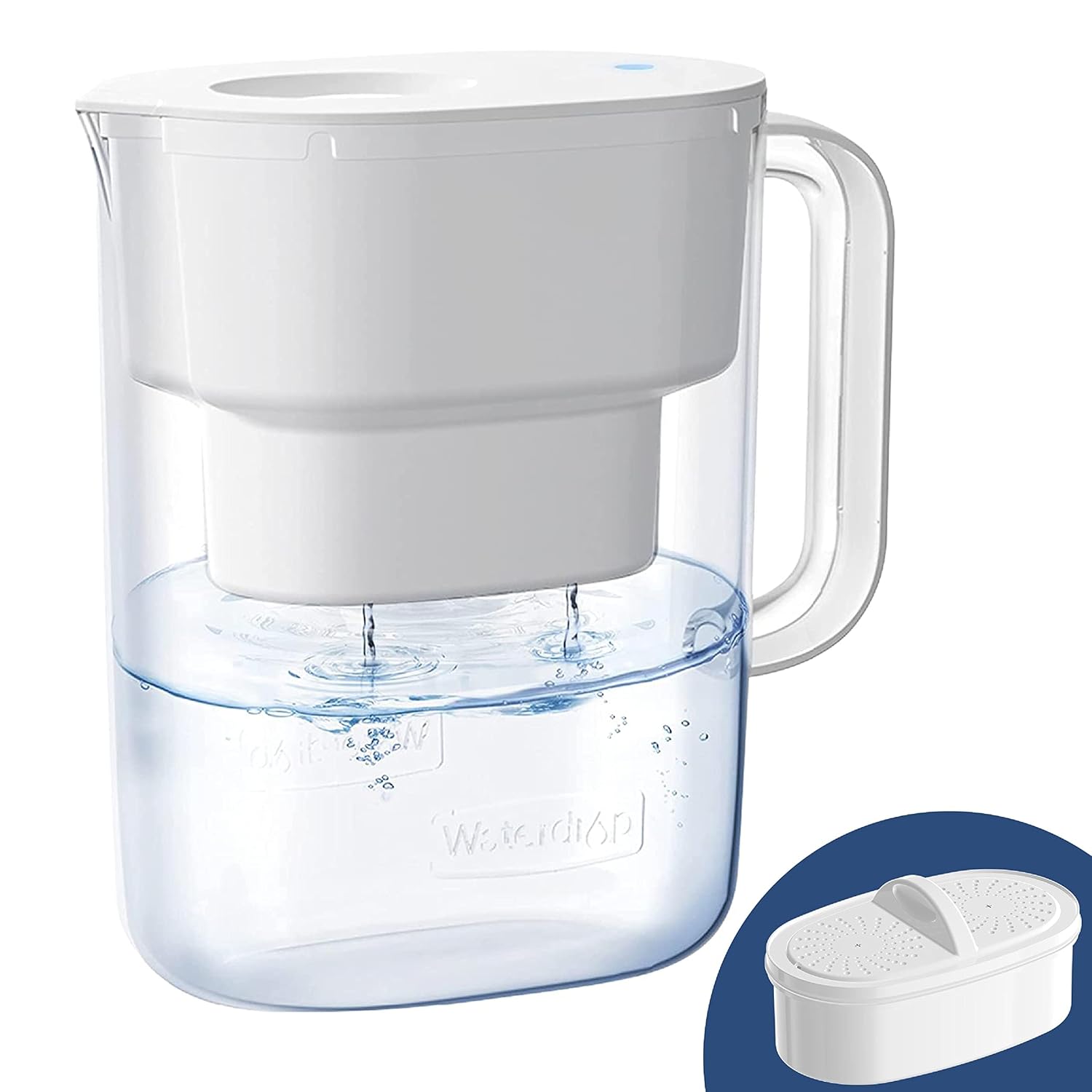
Countertop pick: Waterdrop PT-07W Water Filter Pitcher, 10-Cup, NSF Certified, White
 Visit on Amazon →
The 10-cup format is the one I tell single people and couples to start with, because it fits a fridge shelf and it forces you to refill it, which means you notice when the flow slows down. That is a feature, not a bug. A pitcher you refill twice a day tells you its own maintenance story. The white body makes it easy to see the reservoir level at a glance, and the lid design on this class of pitcher keeps the pour from splashing.
Before you buy, do the certification check on the listing itself: find the NSF/ANSI number and match it to the certified product listing. That step takes two minutes and it is the difference between a filter and a water-flavored decoration.
Flaws but not dealbreakers: Ten cups is roughly two people for one day. If you cook with filtered water or fill a coffee maker and a dog bowl every morning, you will refill this twice before dinner. Gravity pitchers are also slow by design, so plan the first glass around the pour, not the other way around.
Anyone with a standard fridge and one or two regular water drinkers will get years out of this size.
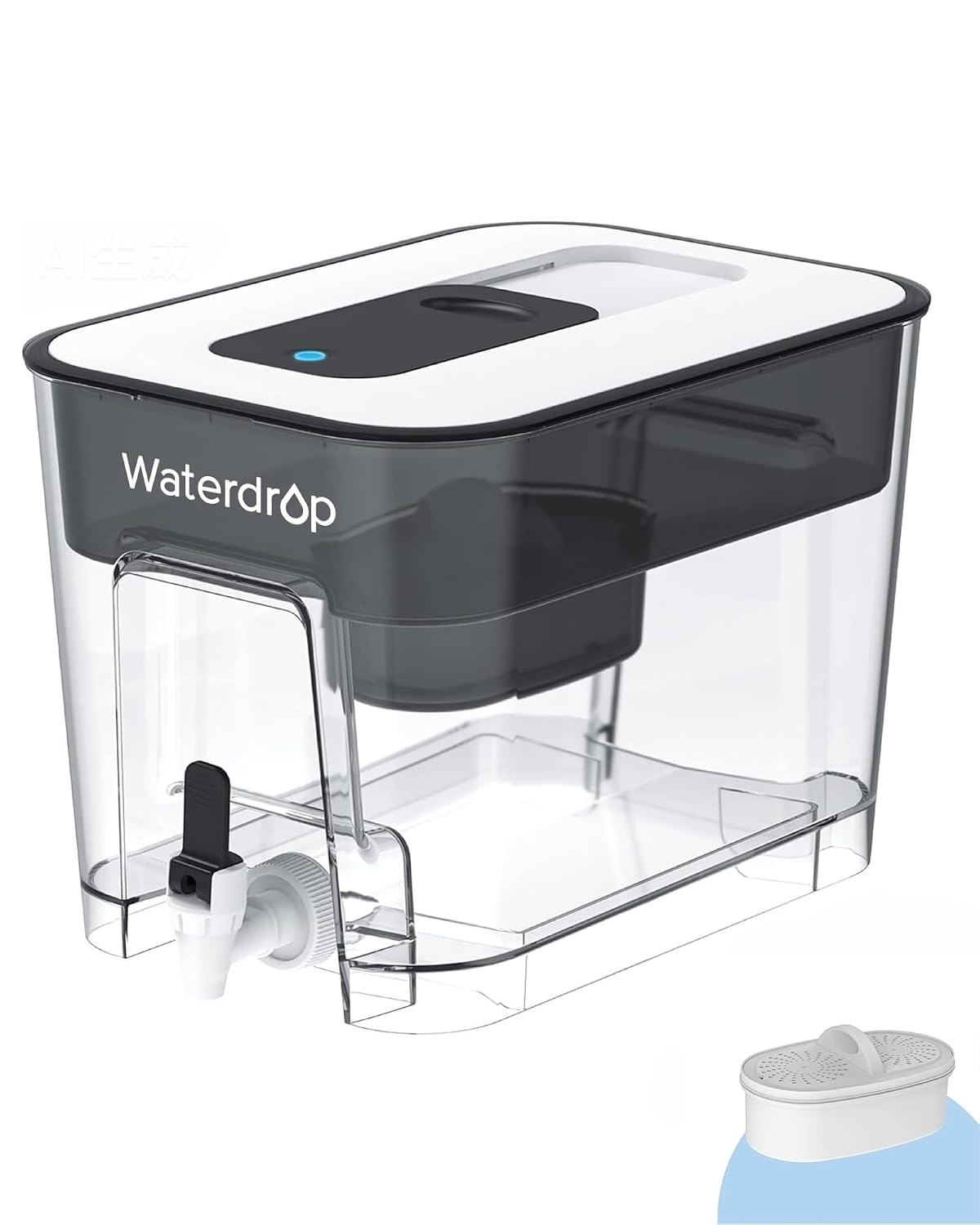
High-volume pick: Waterdrop WFD-22L Large Water Filter Dispenser, 40-Cup Capacity, Black
 Visit on Amazon →
Forty cups is the family answer. This is the dispenser you set on a counter or a shelf and pour from a spigot, which matters more than it sounds like it should. Kids can fill their own bottles without lifting a heavy pitcher, and you are not refilling the reservoir every time someone wants water at dinner. A larger reservoir also means fewer refills, which means the water sits longer, so be honest about how fast your household actually goes through it.
The trade is footprint and fridge space. Forty cups of water is heavy, and a dispenser this size lives on the counter or a dedicated shelf, not in a door bin. Measure the spot before you order, including the height you need to lift the lid off for refilling.
Flaws but not dealbreakers: A big reservoir hides a slow cartridge. If the flow drops, you will not notice as quickly as you would with a small pitcher, so put a reminder on your calendar instead of relying on your eyes.
Anyone with three or more people in the house, or anyone filling bottles for the gym and the kids' lunches, should start here.
How to choose one in five steps
Step one: find the certification number. Not the badge, the number. Look for NSF/ANSI 42 for chlorine and taste, NSF/ANSI 53 for lead and other health claims, and NSF/ANSI 401 for the emerging-contaminant list. Then look that number up on the certifier's public listing and confirm the manufacturer and model match. If the box says it meets NSF standards and prints no number, put it back on the shelf.
Step two: count your actual daily glasses. Not the household average, your number. One person drinking eight glasses a day is a 10-cup pitcher that gets refilled once. Four people, plus coffee, plus cooking, is a dispenser. Buying the small one for a family means standing at the sink three times a day, and buying the big one for one person means water sits in the reservoir for a week, which is its own problem.
Step three: measure the space before you buy. Fridge shelf height, door bin depth, counter footprint, and the clearance you need to remove the lid. I have watched more people return a pitcher over two inches of fridge shelf than over any performance issue.
Step four: baseline your water. Fill a clean glass from the tap, let it come to room temperature, and read it with a TDS meter. Then filter a batch, flush the first run, and read the filtered water the same way. Log both numbers with the date. That baseline is what tells you later whether a cartridge is still working or has broken through.
Step five: time the pour on day one and again at gallon fifty. Fill a known container and count the seconds. Gravity pitchers slow down as the media loads up, and a filter that has choked to a trickle is a filter you will stop using long before the manufacturer's replacement date arrives. Write the day-one time in your logbook.
Where pitchers go wrong
They get run past the replacement date. Filter media has a capacity, and when it is exhausted, contaminants start passing through. That is breakthrough, and it does not announce itself with a warning light. The replacement interval on the package is a starting point, not a guarantee, especially if your water is heavily chlorinated or high in sediment.
They sit in the sun. A clear reservoir on a windowsill is a biology experiment. Keep the pitcher in the fridge or a shaded spot, and do not leave stagnant water in it for days.
They get judged by TDS alone. A pitcher that drops your TDS by 40 ppm is working, but a pitcher that barely moves TDS can still be pulling lead. Read the certification, not just the meter.
They get bought for the wrong claim. Skip any pitcher that advertises added minerals or an alkaline boost. That is rocks in a cartridge making your water harder, not healthier, and it is the most common upsell in this category.
They get trusted with a microbial problem. A gravity pitcher is not a disinfection device. If you are on a boil-water notice or a well with coliform, you need a different tool entirely.
What it costs per gallon
The pitcher is the bait. The cartridge is the price. Do the math this way: take the listed price of the unit, add the cost of every replacement cartridge you will buy in a year at your household's volume, and divide by the gallons you actually filter. That number, in cents per gallon, is the only honest comparison between two pitchers, because a cheap pitcher with expensive cartridges loses to a mid-priced one with a long replacement interval every time.
Two variables move that number more than anything else: how many gallons your household really drinks, and how long a cartridge lasts at your water chemistry. Track both for a month and you will know your cost per gallon better than any review site does.
Check current Amazon price on the unit you are considering, then check the price of a multi-pack of its cartridges before you commit. If the cartridge pack costs more than the pitcher, you have your answer about what you are actually buying.
The bottom line
Pick the certification number first, the capacity second, and the color last. A water filter pitcher earns its counter space by holding its flow rate and staying on schedule, not by looking good in a photo. Buy the size your household will actually empty, put the replacement date on your calendar the day the unit arrives, and keep a logbook with two columns: date and flow time. That is the whole system. It costs nothing, and it beats every claim printed on the box.