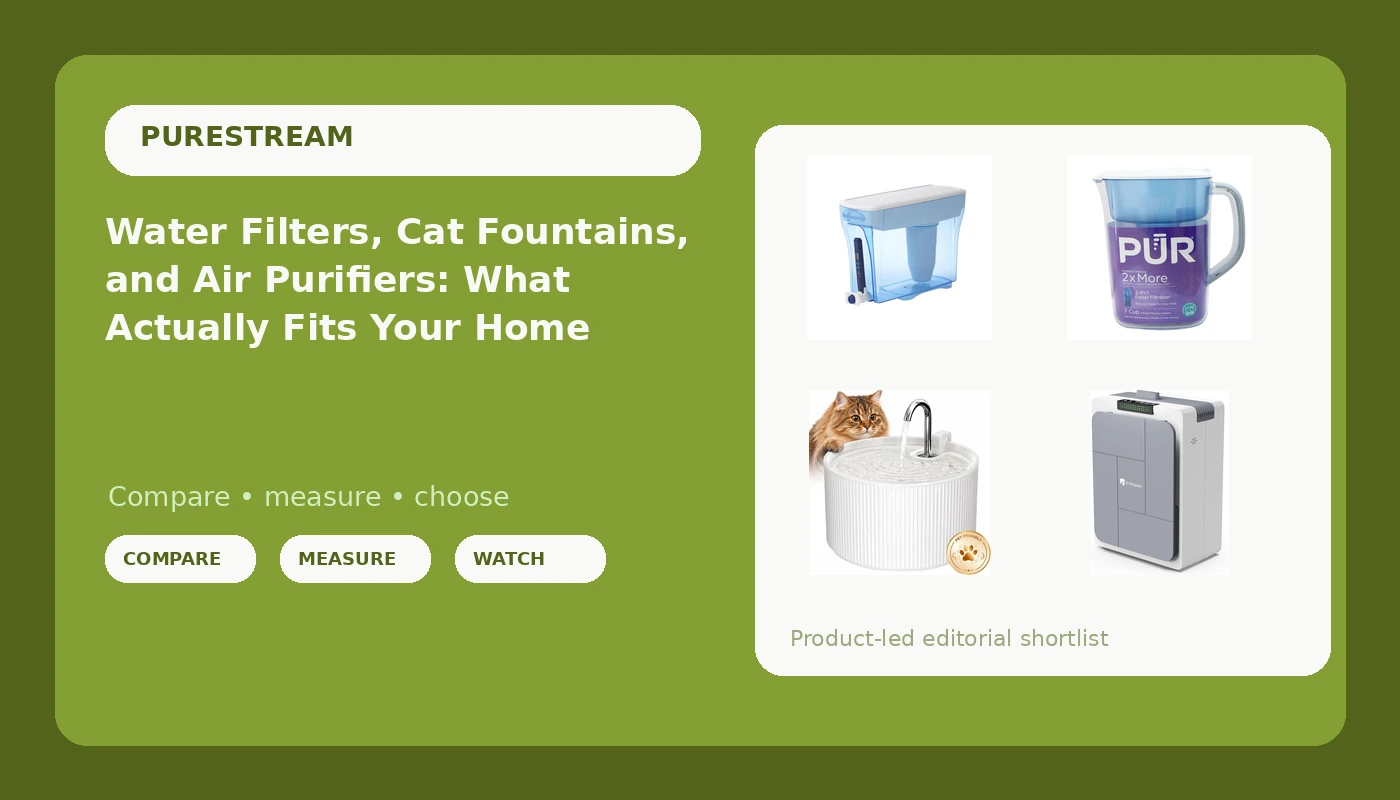
Most people do not set out to build a home water filter and air purifier setup. They start with one specific annoyance. The tap water tastes like a swimming pool, so the kid stops drinking it. The cat ignores the bowl and gets sluggish. The living room smells like a dog no matter how often you vacuum. Each of those problems has a different cause, and the device that fixes one usually does nothing for the others. Buy one gadget and hope it covers all three, and you end up with a counter full of hardware you stopped using by March.
This explainer covers four devices that solve four different problems: dissolved solids in drinking water, everyday taste and chlorine in a small pitcher, standing water for a cat, and airborne particles in a large room. For each one, it lays out what the device actually does, what it does not do, and the numbers worth checking before you spend anything.
Related: How to Read an NSF Certification Number on a Water Filter →
Quick answer
No single device handles drinking water, pet hydration, and room air at the same time, so match the tool to the problem first. A high-capacity dispenser is the right call when you want dissolved solids pulled out of your drinking water. A small pitcher is the right call when taste and chlorine are the issue and counter space is tight. A ceramic fountain is the right call when a cat needs a reason to drink more. A HEPA air purifier is the right call when the problem is particles, pet hair, and odor in a room. Compare replacement filter costs before you compare anything else, because the cartridge is the real price and the housing is the bait.
4 useful options
| Model | Best fit | What stands out |
|---|---|---|
| ZeroWater 23-Cup Water Filter Dispenser | Households pulling dissolved solids out of drinking water | Large 23-cup reservoir, listed as removing PFOA and PFAS |
| PUR 7-Cup Water Filter Pitcher | Small kitchens and renters who want better tasting water | Compact 7-cup body, ships with one genuine PUR filter |
| Voluas Ceramic Cat Water Fountain | Cats that drink more from running water | 2.2L / 74 oz ceramic body, ultra-quiet pump, one filter included |
| Dr.Prepare Air Purifier | Large rooms with pet hair, dust, smoke, or pollen | Double-sided HEPA intake, rated up to 1130 ft², 22dB sleep mode |
The high-capacity dispenser: ZeroWater 23-Cup Water Filter Dispenser
ZeroWater's approach is ion exchange resin, and resin behaves differently from carbon. Carbon is a surface: it grabs chlorine, taste compounds, and some volatile organics, and it keeps working for a while. Resin is a trade: it swaps dissolved mineral ions until its sites are full, and then it stops. That is why a TDS meter is the useful way to track this dispenser. When the resin is exhausted, TDS climbs back toward your tap water baseline, and that reading is your signal to change the filter, not the calendar. Two practical consequences follow. Replacement frequency scales with how hard your incoming water is, so a household on very hard water will go through cartridges faster than the box suggests. And a 23-cup dispenser gets heavy when full, which decides whether it lives on the counter or on a fridge shelf. The trade-off is straightforward: more dissolved solids removed than a carbon pitcher manages, at the cost of more frequent filter changes and a higher cost per gallon.
The everyday pitcher: PUR 7-Cup Water Filter Pitcher
Carbon pitchers are the least glamorous category in home filtration and the one most people actually use every day. What a pitcher like this does well is chlorine, taste, and odor, and that is worth real money if your tap water tastes like a pool and your household has quietly switched to bottled water instead. What carbon-only media generally does not do is pull dissolved solids or lead out of water. That is not a defect in this model so much as a limit of the medium. If lead is your concern, look for a certification number for that specific contaminant on the exact filter you buy, not a general brand claim, because "tested to NSF standards" without a number on the label tells you nothing you can verify. The trade-off runs opposite to the dispenser: smaller capacity, less frequent filter changes, and a much lower entry cost. Seven cups is roughly two or three generous glasses for a family, so plan on refilling it more than once a day.
The pet water station: Voluas Ceramic Cat Water Fountain
Cats evolved to get most of their moisture from prey, which is why so many of them drink less than they should from a still bowl. Moving water gets their attention, and that is the entire reason fountains exist. Ceramic is the material worth noting here. It is heavier, so a cat cannot slide it across the floor at 3 a.m., and it does not scratch the way plastic does, which matters because scratched plastic harbors biofilm that is genuinely difficult to clean out. The 2.2 liter capacity is roughly two to three days of water for a single cat and less with two. The maintenance is the part buyers underestimate. The pump needs to be disassembled and cleaned, the ceramic needs rinsing, and the filter needs replacing on schedule or the fountain is simply recirculating what it should be catching. Budget for those filters the same way you budget for pitcher cartridges, and count the pump as a wear item with a lifespan of its own.
The room air cleaner: Dr.Prepare Air Purifier
Air purifiers are sold on room size, and room size is the number to interrogate. A rating like 1130 square feet usually assumes a specific air exchange rate at a specific fan speed, and the same unit running at a lower speed covers less floor. What a HEPA filter does is mechanical: fibers trap particles in a size range that includes pet dander, dust, smoke particles, and pollen. It does not remove gases, which is why odor control in a purifier comes from a separate carbon layer or, in this case, an aroma function that adds scent rather than removing the source. The double-sided intake is about pushing more air through the same cabinet footprint. The 22dB sleep mode figure comes from the manufacturer and describes the lowest fan setting, not the speed you will run when the room is smoky. Washable pre-filters cut down on how often the main cartridge loads up, but the HEPA cartridge is still the recurring cost, so price it before you buy the machine.
Prices and availability may change. Product images, names, and retailer links must be matched by verified ASIN. Do not state a current price, rating, stock status, or measured result without current evidence.
What each filter medium actually removes
Filter media are not interchangeable, and most disappointing purchases trace back to buying the wrong medium for the contaminant.
Activated carbon handles chlorine, taste, and odor, plus some volatile organic compounds. It is cheap, it works fast, and it is what almost every pitcher uses. It does not meaningfully reduce dissolved solids, and its lead performance depends entirely on the specific cartridge.
Ion exchange resin trades dissolved mineral ions for others, which is why resin-based systems drop TDS readings sharply. The resin has a finite number of exchange sites, so it exhausts on a schedule set by your water chemistry, not by the label.
Reverse osmosis membranes push water through a semipermeable barrier and strip dissolved solids down toward zero, including minerals you might have wanted. RO systems are effective and also the most maintenance-heavy option, often with several cartridges on different replacement intervals.
HEPA media is for air, not water. It captures particles by interception and impaction. It does nothing for gases or odors on its own, which is why purifiers pair it with carbon.
The pattern to remember: carbon is for taste, resin and RO are for dissolved content, HEPA is for particles. A device that claims to do all three in one cartridge is usually doing one of them well.
The numbers to check before you buy
- Start with your water. Pull your municipal consumer confidence report, or send a sample to a certified lab if you are on a well. Buying a filter before you know what is in the water is guessing with extra steps.
- Match the contaminant to a certification number. NSF/ANSI 42 covers taste and chlorine. NSF/ANSI 53 covers health contaminants including lead. If the label does not name a standard and a number, treat the claim as marketing.
- Calculate cost per gallon, not cost per filter. Take the cartridge price, divide by the gallons it is rated to treat, and compare that number across the systems you are considering. This is where pitchers and dispensers separate.
- Check capacity against your real daily use. A family of four drinking two liters each per day moves roughly two gallons, so a 7-cup pitcher means multiple refills and a 23-cup dispenser means one.
- For air, size to the room and check the cartridge price. Measure the actual room, not the whole floor plan, and price the replacement HEPA filter before the machine, because that is what you will keep paying.
Practical guidance
- Buy one replacement filter with the device. A filter that arrives after the first cartridge dies is a filter that never gets installed on time.
- Log your filter changes with a date and a TDS reading if you have a meter. The reading, not the sticker, tells you when the media is spent.
- Clean pet fountains weekly. Pumps clog with hair and biofilm, and a clogged pump is the most common reason fountains get retired to a cabinet.
- Keep ceramic and glass in mind for anything that holds water long term. Plastic scratches, and scratches hold onto things you would rather rinse away.
- For purifiers, vacuum the washable pre-filter regularly and place the unit where air can actually circulate around it. A purifier against a wall in a closed corner is a decorative box.
- Rinse any new pitcher or dispenser and discard the first batch or two of water. Fine carbon dust is normal and harmless, but it tastes terrible.
Which option should you choose?
Choose the ZeroWater 23-Cup Water Filter Dispenser when dissolved solids are the problem you are trying to solve and you want a large reservoir that fills once instead of four times. Choose the PUR 7-Cup Water Filter Pitcher when your complaint is taste and chlorine, your counter is small, and you want the lowest entry cost in the category. Choose the Voluas Ceramic Cat Water Fountain when a cat needs encouragement to drink and you would rather clean ceramic than scratched plastic. Choose the Dr.Prepare Air Purifier when the issue is airborne particles in a large room and you want a sensor handling fan speed for you.
The limitation worth naming: none of these devices substitutes for knowing what is actually in your water or your air. Contaminant removal claims vary by cartridge, and the certification number on the specific filter you install is the only claim you can check. Room size ratings assume conditions you may not have. Treat every listed spec as a starting point and verify the one that matters for your household.
The bottom line
Water and air problems look similar from the kitchen table and are not. Dissolved solids, chlorine and taste, pet hydration, and airborne particles each call for a different mechanism, and buying one device to cover all four usually means covering none of them well. Pick the problem that actually bothers you first, check the certification number and the replacement cartridge cost, and buy the device whose medium matches the contaminant. The purchase price is the small number. The filters are the real one.