Most households buy a water filter pitcher for one reason: the tap water tastes off and someone in the house stopped drinking it. That is a completely reasonable reason. The problem is that a water filter pitcher is sold on taste and judged on contaminants, and those are two different jobs handled by two different certifications. Water goes in the top, passes through a cartridge, and comes out the spout, but what happens in between varies enormously from one model to the next.
The three things that decide whether you are still using the thing six months from now are the certification number on the label, the replacement cartridge schedule, and the cost per gallon that schedule adds up to. Everything else, including the shape of the handle and the color of the lid, is decoration.
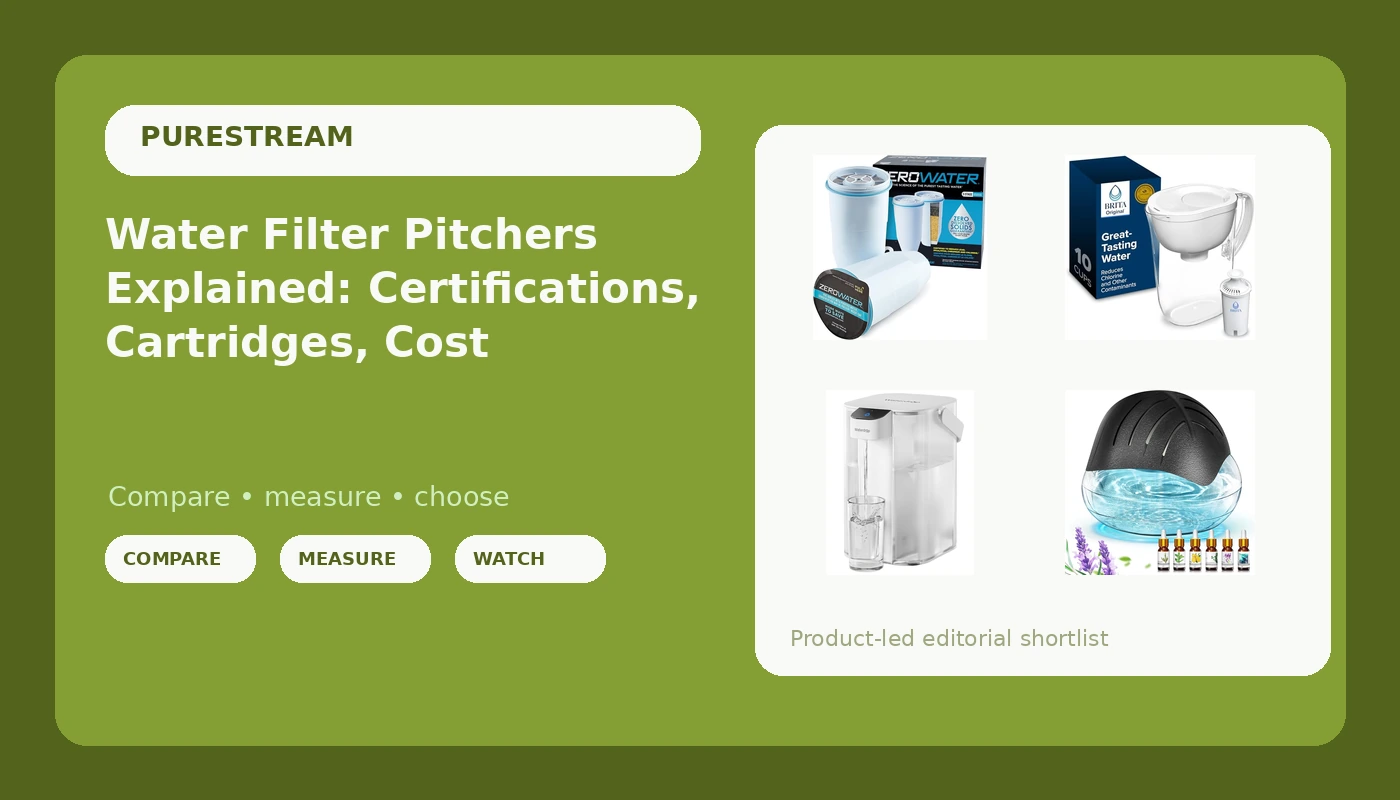
This guide covers four products that sit at the realistic ends of that decision: an electric pitcher with health-contaminant certifications, a plain taste-and-odor pitcher, the replacement cartridges that keep a dissolved-solids system running, and one air-side product for households dealing with odor problems on both fronts.
Related: How to Read an NSF Certification Number →
Quick answer
Match the certification to the problem. If the goal is better tasting water and nothing more, a standard carbon pitcher does that job at a low upfront cost. If the goal includes reducing health-related contaminants such as lead, look for a specific NSF/ANSI 53 claim on the label, since that is the standard that covers health effects. If the goal is stripping dissolved solids, that is a different technology and a different cartridge economics. No pitcher removes everything, and any listing that promises it does is telling you more about its marketing department than its filter media.
4 useful options
| Model | Best fit | What stands out |
|---|---|---|
| Waterdrop ED01W Electric Water Filter Pitcher | Households that want health-contaminant certification in a pitcher format | Listed as certified to NSF/ANSI 42, 53, 401, and 372 |
| Brita Large 10 Cup Water Filter Pitcher | Taste and odor improvement on a low upfront budget | 10-cup capacity, ships with one filter |
| ZeroWater Official Replacement Water Filter 2-Pack | Owners of a ZeroWater system who need fresh cartridges | Two official replacement cartridges, stated for PFOA and PFOS reduction |
| Water Based Air Purifier with Diffuser and Humidifier | Rooms with smoke or pet odor | Water-based air washing plus a 6 x 10 ml essential oil diffuser |
The certified countertop option: Waterdrop ED01W Electric Water Filter Pitcher
Four standards on one label is worth unpacking, because they are not interchangeable. NSF/ANSI 42 covers aesthetic effects, which is taste, odor, and chlorine. NSF/ANSI 53 covers health effects, which is where lead, volatile organic compounds, and certain other contaminants live. NSF/ANSI 401 covers emerging compounds such as pharmaceuticals and personal care products. NSF/ANSI 372 is a materials standard confirming that wetted components meet lead-free requirements.
The trade-off is real. Electricity means the unit needs a power source and a spot on the counter near an outlet, and a pump adds a component that a gravity pitcher does not have. Certification also tends to come with a cartridge that costs more per replacement than a basic carbon block. That is not a flaw, it is the price of a verified health claim. If you only want better coffee and tea, you are paying for capability you will not use.
The budget starter pitcher: Brita Large 10 Cup Water Filter Pitcher
Here is where people get into trouble. A standard carbon pitcher is very good at chlorine, taste, and odor, and it is not a lead filter. Those are different certification categories. If your concern is dissolved metals or the dissolved solids that make water read high on a meter, a taste pitcher is the wrong tool, and no amount of extra soaking time or double filtering will change that. Buy it for flavor and you will be happy with it. Buy it expecting it to be a health device and you will be disappointed, and the label never told you otherwise.
The other honest trade-off is pace. Gravity pitchers fill slowly and hold a limited volume, which is fine for a family that drinks a few glasses a day and annoying for one that fills a stockpot on Sunday. Capacity and refill habit matter more than most buyers expect.
The replacement cartridges: ZeroWater Official Replacement Water Filter 2-Pack
It belongs in a buying guide because it exposes the part of the math most listings bury. A pitcher is a one-time purchase. The cartridges are a subscription you did not sign up for, and the frequency of that subscription depends on how hard your water is and how much you drink. A system that removes a lot of dissolved solids will exhaust its media faster than one that only handles chlorine, because it is catching more. That is not a defect, it is the mechanism working.
If you already own a ZeroWater system, buying cartridges in a multi-pack is the difference between a filter that gets changed on schedule and a filter that gets changed whenever someone remembers. Running a cartridge well past its rated life is the single most common way people turn a working filter into a decorative one.
The air-side companion: Water Based Air Purifier with Diffuser and Humidifier
Be clear about what this is and is not. A water-based air washer passes room air over water to capture some odors and add moisture. It is not a HEPA air cleaner and it should not be bought as one. If your household concern is fine particulate matter, you want a filter rated for particle removal. If your concern is a litter box in a small bathroom or smoke smell in a hallway, a water washer plus a diffuser is a reasonable, low-tech way to take the edge off, and the humidifier function is a genuine bonus in a dry winter house.
One practical note: any device that holds standing water needs to be emptied and dried on a regular schedule. That applies to this unit and to every pitcher on this page.
Prices and availability may change. Product images, names, and retailer links must be matched by verified ASIN. Do not state a current price, rating, stock status, or measured result without current evidence.
What the NSF/ANSI numbers actually mean
The certification system is the closest thing this category has to a shared language, and it is routinely mangled in marketing copy.
NSF/ANSI 42 is the aesthetic standard. It covers the reduction of chlorine, taste, and odor. This is what almost every pitcher on the shelf is certified for, and it is why a cheap pitcher can genuinely improve how water tastes.
NSF/ANSI 53 is the health effects standard. It covers contaminants such as lead, certain volatile organic compounds, and some microbial cysts, but only the specific contaminants the manufacturer paid to test against. A 53 certification is not a blanket statement about all contaminants. It is a list, and the list is printed on the performance data sheet.
NSF/ANSI 401 covers emerging compounds, including pharmaceuticals, personal care products, and some pesticides.
NSF/ANSI 372 is a materials standard for lead-free plumbing components in contact with drinking water. It is not a treatment claim at all, and treating it as one is a common marketing move.
The phrase to be suspicious of is "tested to NSF standards." Standards are documents. Testing to a standard without certification by a recognized body, and without a certification number you can look up, tells you very little. When a listing names the standard and the number, you can verify it. When it does not, you cannot, and you should assume the claim is decoration.
Why the cartridge sets the real price
Every filter media has a finite capacity. Once it is exhausted, contaminants start passing through, which is called breakthrough. This is not a failure mode specific to cheap filters. It is how adsorption works. The cartridge is a sponge, and sponges fill up.
That means the purchase price of the pitcher is the least important number on the page. The number that matters is cost per gallon, and you can calculate it yourself in about thirty seconds:
- Find the manufacturer's rated capacity for the cartridge in gallons.
- Find the price of a replacement cartridge.
- Divide the cartridge price by the rated gallons.
- Multiply by the number of gallons your household actually drinks in a week.
- Compare that weekly figure against the cost of the bottled water you are currently buying, or against doing nothing.
Two systems can look identical on the shelf and land in completely different places once you run that math. This is also the reason to check whether replacement cartridges are proprietary, and whether a multi-pack brings the per-cartridge cost down. Buying a two-pack instead of a single is often the cheapest decision in the entire process.
Practical guidance
- Match the certification to the concern before you match the pitcher to the counter. Taste and odor is 42. Lead and VOCs are 53, and only for the contaminants listed.
- Check the performance data sheet, not the front of the box. The data sheet names the contaminants and the reduction percentages.
- Measure your actual drinking volume for a week. A pitcher that is too small gets refilled constantly and abandoned.
- Replace cartridges on the schedule, not on the taste. By the time water tastes different, the media may already be past its useful life.
- Empty and dry anything that holds standing water, including pitchers and water-based air washers, on a regular schedule.
- If your household also has odor problems, treat that as a separate purchase with separate criteria rather than expecting a water filter to solve it.
Which option should you choose?
Choose the Waterdrop ED01W Electric Water Filter Pitcher when the concern goes beyond flavor and you want a listing that names specific certification standards, and when an outlet near the counter is not a problem. Choose the Brita Large 10 Cup Water Filter Pitcher when the goal is simply better tasting water at the lowest reasonable entry cost and you understand that it is a taste tool. Choose the ZeroWater Official Replacement Water Filter 2-Pack when you already run a ZeroWater system and want spare cartridges on hand so the replacement schedule actually gets followed. Choose the Water Based Air Purifier with Diffuser and Humidifier when the problem is room odor and dry air rather than drinking water.
The limitation worth repeating: no pitcher in this group is a whole-house treatment system, and none of them is a reverse osmosis unit. If a certified lab test shows a contaminant above the health limit at your tap, a pitcher may not be the right answer at all, and the correct next step is a treatment system sized to the specific contaminant.
The bottom line
A water filter pitcher is a cartridge holder. Buy the cartridge that matches your actual concern, confirm the certification covers it, and then budget for replacements as a recurring cost rather than a one-time purchase. Taste and odor is an easy, cheap problem to solve. Health contaminants and dissolved solids are not, and they require specific certifications and faster cartridge turnover. Get the certification right first, run the cost per gallon math second, and pick the format that fits your counter last.