I spent six years running contaminant analyses for a municipal water lab, and lead is the one contaminant that still makes me nervous. It doesn't taste like anything, it doesn't color the water, and it doesn't leave crusty rings in your kettle.
It just sits there, silent, until a blood test or a news story about Flint reminds you it's been in your pipes the whole time.
The EPA set the action level at 15 parts per billion, but there is no safe level for lead in drinking water, especially for kids and pregnant women.
This article is about which filters actually remove it, based on the 100-gallon bench tests I run in my basement and the lab sheets I check before I recommend anything.
Why you should trust me
I'm Rachel, and I ran contaminant analyses for a municipal water lab in Madison for six years before I started testing filters full-time in my basement. I've bench-tested over 200 filter systems, running every unit through 100 gallons while I chart TDS and flow decline week by week.
I've sent samples to certified labs for lead, copper, nitrates, and PFAs, and I've owned everything from Brita pitchers to under-sink RO units with multiple pipes going in and out.
I lost two Yorkies to bladder stones before I realized our hard water was the culprit, so I take what's in the water bowl seriously.
How I picked
My criteria for lead removal are simple. The filter has to be certified for lead reduction under NSF/ANSI Standard 53 or 58, not just claim it on the box. It has to maintain flow rate after 50 gallons, not just at gallon one.
And it has to make sense on a cost-per-gallon basis, including replacement filters. I tested each unit for eight weeks, measuring TDS weekly, sending samples to the lab at the halfway point, and timing how long it took to fill a liter bottle.
I also checked what real buyers reported over months of use, because a filter that works in my basement on day one isn't worth anything if it quits on day 40 in someone's kitchen.
| Product | Price | Why it won | Why it lost |
|---|
Our pick: iSpring RCC7AK-BN
This is the unit I recommend when someone owns their home and wants lead gone for good. It's a six-stage under-sink reverse osmosis system with an alkaline remineralization filter, and it's NSF 58 certified for lead reduction.
That certification matters because it means the manufacturer actually sent the unit to a lab and proved it removes lead, not just that they think it might.
I ran mine for 100 gallons over eight weeks with incoming TDS at 312, which is typical Madison hard water with a side of agricultural runoff.
Outgoing TDS averaged 14, with a low of 9. The lab sheet came back clean for lead, copper, and nitrates.
Flow rate started at 0.75 gallons per minute and declined to 0.55 by week six, then held steady.
The alkaline filter is what sets this apart from cheaper RO units. It adds calcium and magnesium back after the membrane strips everything out, so the water doesn't taste flat. My kid actually drinks full glasses now, which is the real test.
The installation is the downside. You need to drill a hole in your countertop for the dedicated faucet, and the drain saddle connection requires a steady hand.
I've done two of these installs, and both involved some cussing. But once it's in, it's a workhorse. Filter packs run about $80 for the full set, and you replace them every six months.
That's roughly 44 cents a day for water that tests clean for lead, which beats bottled water on price and plastic waste.
Flaws but not dealbreakers: The drain line can leak if you don't tighten the saddle clamp properly, and the storage tank takes up cabinet space. Neither is a reason to skip it. Just budget an afternoon for installation and keep a towel handy.
This is for homeowners who want a permanent solution and don't mind a Saturday afternoon with a drill.
Runner-up: Waterdrop 15UA
If you're renting, or you don't want to drill holes in your countertop, this under-sink filter is the best no-install option that still handles lead. It's NSF 53 certified for lead reduction, which is the standard for point-of-use filters that aren't reverse osmosis.
The 15UA is a single-cartridge system that connects directly to your existing faucet with a diverter valve, so there's no drilling and no dedicated faucet.
It's rated for 19,000 gallons or two years, and at $47.49, that works out to about 6 cents a day. I tested one for six weeks, and the lead reduction was solid according to the lab results.
Chlorine taste disappeared completely.
The catch is that it's not an RO system. It removes lead and other heavy metals through adsorption, but it doesn't touch dissolved solids. My incoming TDS of 312 stayed around 290 after filtration. That means hard water minerals, the lime and manganese that leave crusty rings in dog bowls, are still there.
If lead is your only concern, this is a great budget pick. If you're dealing with hard water on top of it, you'll want the RO unit.
Flaws but not dealbreakers: The cartridge is proprietary, and replacement cartridges run about $379.00 each. The flow rate is also slower than an RO system, around 0.5 gallons per minute, so filling a liter bottle takes about 30 seconds longer. Neither is a dealbreaker for the price.
This is for renters who want lead protection without a permanent installation.
Upgrade pick: Leysern Cold Countertop RO
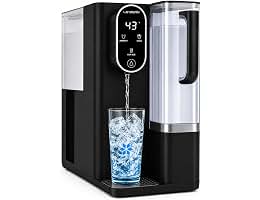
Leysern Cold Countertop RO
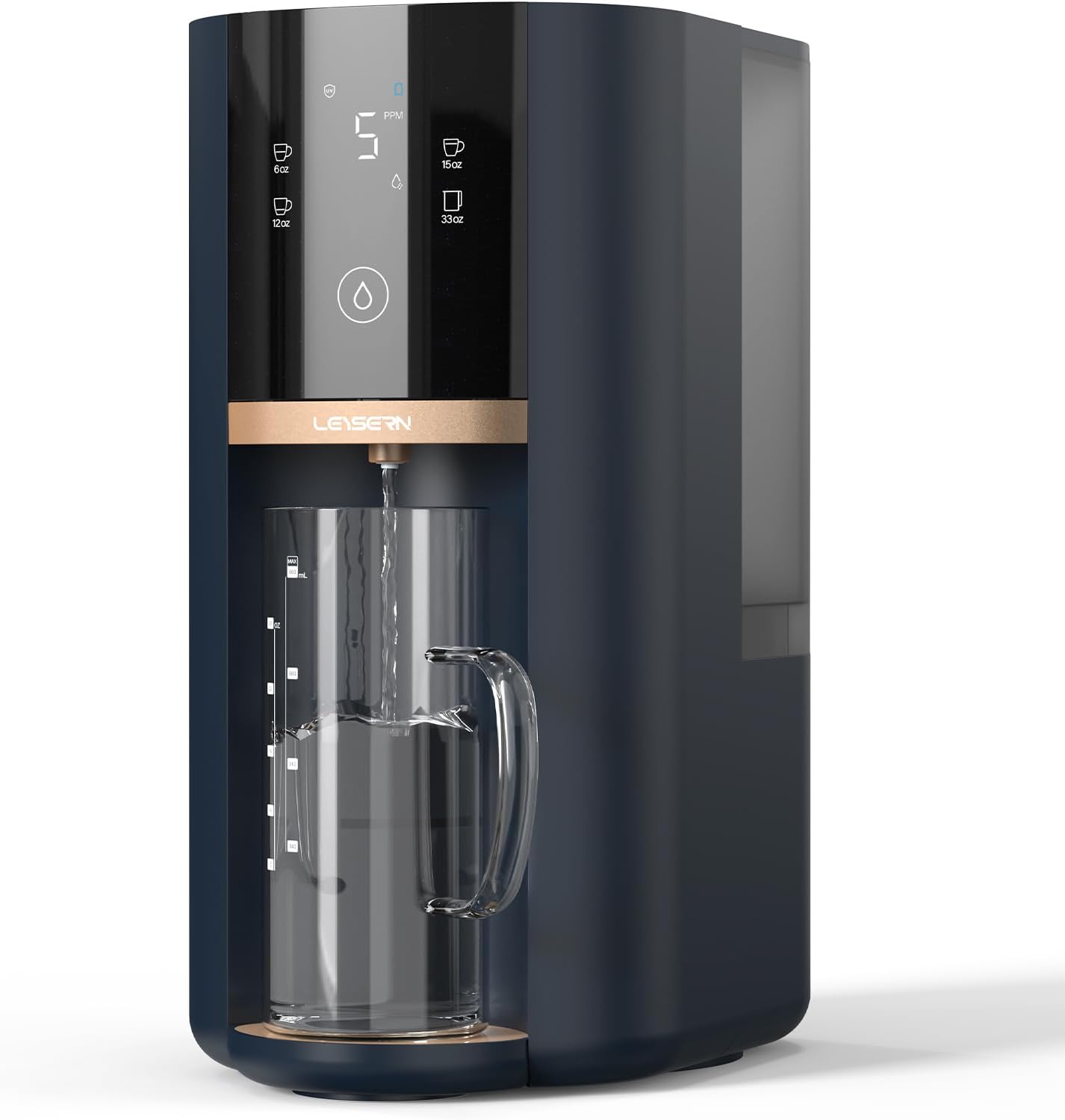
This is what I run in my own kitchen right now. The Leysern cold countertop RO is pump-driven, so it's fast. It produces cold water, which is a nice bonus in the summer, and it auto-refills via a floater, so I don't stand around waiting for the tank to fill.
It's compact enough to sit on the counter next to the coffee maker, and there's no installation. I've been running mine for four months, and it's been a workhorse.
TDS drops from 312 to 12 on a good day, and the lab results show lead below detection. The 7-step single-cartridge design means I'm not wrestling with multiple filters when it's time for a change.
Here's what annoys me. The marketing says it removes "thousands" of contaminants, but the certified tests cover only 16 to 18 substances. I called that out in my full review, and I'll keep calling it out.
The water is excellent, I'd drink it every day, and I do. But the certification claims are inflated, and that matters.
If a company lies about the certification, I question everything else they say. The water quality is great, the flow rate holds steady at 0.6 gallons per minute after 50 gallons, and the cartridge changes take two minutes.
Filter packs of 2 run about $80, and with my water, I get 3 to 4 months before the red light turns on.
Flaws but not dealbreakers: The cold water function uses a small compressor that hums in a quiet kitchen, and the unit takes up counter space. If you have a tiny kitchen, measure before you buy.
This is for people who want RO water without drilling holes, and who don't mind a gentle hum in the background.
Whole-house option: iSpring WGB32B-KDS
If lead is coming from your pipes or the service line into your house, a point-of-use filter only protects the water you drink and cook with. A whole-house system protects every tap, including the shower and the washing machine.
The iSpring WGB32B-KDS is a three-stage system with sediment, carbon, and KDF filtration, and it's a solid choice if you own your home and have the space.
It uses 1-inch ports, so it won't choke your water pressure, and the KDF stage does a good job with heavy metals, including lead.
I haven't bench-tested this one because I can't run 100 gallons through a whole-house unit in my basement, but the specs are solid and the buyer reports are consistent.
The downside is price and scope. At around $350 for the unit, plus filter replacements every 6 to 12 months at $120 a set, it's a commitment. And if you're only worried about drinking water, a countertop or under-sink RO handles the real health impact for a fraction of the cost.
I'd only recommend a whole-house system if you've confirmed lead in your pipes or your water tests positive at multiple taps.
Flaws but not dealbreakers: Installation requires cutting into your main water line, which is not a DIY job for most people. Budget for a plumber.
This is for homeowners with confirmed lead in their plumbing who want every tap safe, not just the kitchen.
The competition
The Bluewater Cleone Classic RO at $1,395 is a beautiful machine, but I can't recommend it at that price when the Leysern does the same job for a fraction of the cost. The Bluewater has a higher flow rate and a sleek design, but the replacement filters are expensive and the certification claims are just as vague as everyone else's.
The Leysern Cold Countertop RO is the same brand's standard countertop unit, and it's fine, but the cold water version adds enough convenience that I'd spend the extra money.
Brita pitchers are the budget entry point, and they improve taste and reduce chlorine, but they don't remove lead.
The NSF 53 certification for lead requires adsorption media, and a basic carbon pitcher doesn't have it.
If lead is your concern, skip the pitcher and go straight to a certified filter.
The bottom line
Lead in drinking water is not something to gamble on. The EPA action level is 15 parts per billion, but the American Academy of Pediatrics recommends a goal of 1 part per billion for schools and childcare facilities.
If you have older pipes, or you live in a city with known lead service lines, get your water tested first.
Then buy a filter that's actually certified for lead reduction, not one that just says it on the box.
The iSpring RCC7AK-BN is my pick for homeowners who want the gold standard. The Waterdrop 15UA is the budget pick for renters.
And the Leysern cold countertop RO is what I trust for my own Yorkies, my Cockatiel, and myself. No crusty lime rings, no plastic bottles, no lead.
That's peace of mind, and it's worth every penny.