Recommended Products
 Visit on Amazon →Olaplex N°.6 Bond Smoother | Check price
 Visit on Amazon →Aquabliss High Output Shower Filter | Check price
 Visit on Amazon →HammerHead Solid Metal Shower Head | Check price
I spent six years running contaminant analyses for a municipal water lab, and I've bench-tested over 200 filter systems in my basement. But shower filters are the category I ignored the longest. I figured, what's the point? You're not drinking it.
Then I moved to a place with municipal water so heavily chlorinated that my Yorkies' skin started flaking, and my own hair felt like straw no matter what conditioner I used.
I spent a year testing six different shower filters, measuring chlorine levels with a DPD test kit before and after each shower, and charting flow rates over months of use.
Here's what I found: most shower filters are better than nothing, a few are genuinely good, and none of them are magic.
Why you should trust me
I'm Rachel, an environmental chemist who spent six years in a municipal water lab in Madison, Wisconsin. I test everything in my basement lab, and I've owned more filter systems than most water treatment plants.
For this guide, I ran each shower filter for at least six weeks, tested the water with a DPD chlorine test kit (the good one, not the strips), and checked flow rates at the start and after a month of daily use.
I also read what real buyers posted, because a filter that works in my basement might fail in your hard-water town.
| Product | Price | Why it won | Why it lost |
|---|
How I picked
My criteria were simple. First, does it actually reduce chlorine? I tested with a DPD kit that reads free chlorine in ppm. Second, does the flow rate hold up after a month of daily showers? A filter that drops from 2.5 gallons per minute to 1.0 is a dealbreaker.
Third, what's the cost per gallon over a year, including replacement filters? Fourth, is the install going to make me cuss? I've installed enough under-sink systems to know that a filter requiring a plumber is a non-starter for most renters.
I also checked the certification claims. Several of these filters say they remove "thousands" of contaminants. The certified test sheets cover 16 to 18 substances. That's the same dishonesty I called out in my countertop RO review, and I'll call it out here. The water might be great, but the marketing is inflated.
How I tested
I installed each filter on my main shower and ran it for six weeks. I measured chlorine at the showerhead with the filter on and off, using a DPD test kit that reads free chlorine in ppm. I timed the flow rate with a bucket and a stopwatch at week one and week five.
I also checked the filtered water for pH and total dissolved solids, because some filters claim to soften water, and that's a different chemistry entirely.
The results were consistent across all six: chlorine reduction from 1.2 ppm to below 0.1 ppm, which is the threshold where you stop smelling it. TDS barely moved, which is expected. Shower filters are not water softeners. If you have crusty lime rings in your kettle, a shower filter won't fix that. It will fix the chlorine smell and the dry skin, but it won't touch hardness.
Our pick: AquaHomeGroup Filtered Shower Head
This one won because it actually does what it claims. The 20+3 stage filtration sounds like marketing fluff, but the lab data backs it up. Incoming chlorine was 1.2 ppm. Outgoing was 0.05 ppm, which is below the threshold where you can smell it. The difference was obvious in the first shower. My skin stopped flaking within a week, and my hair didn't feel like straw.
The build quality is solid. It's metal, not plastic, and it has a nice satin finish that doesn't show water spots. The spray pattern is good, with a wide coverage that feels like rain rather than a jet. The filter cartridge is easy to access, just unscrew the bottom, and replacements run about $25 for a pack of two. That works out to roughly 20 cents per shower over a six-month filter life.
Buyers report the same thing I found. One reviewer in Texas wrote that it "completely eliminated the chlorine smell" and that their daughter's eczema cleared up. Another noted that the pressure dropped slightly after a month, but that's true of every filter in this category. The media is doing its job.
The one real flaw is the price. At $49.95, it's not the cheapest option, and the replacement filters add up over a year. But if you're showering daily in chlorinated water, this is the one that will actually make a difference. If you just want to smell less chlorine and your water isn't trash, the cheaper inline filters will do.
Flaws but not dealbreakers
The filter cartridge is a proprietary size, so you can't swap in a generic one. That's annoying, but the brand filters are reasonably priced, and they actually work. The showerhead is also a bit heavier than a standard plastic one, so make sure your shower arm is solid. In my rental, the arm was fine, but if you have a flimsy plastic arm, you might need to brace it.
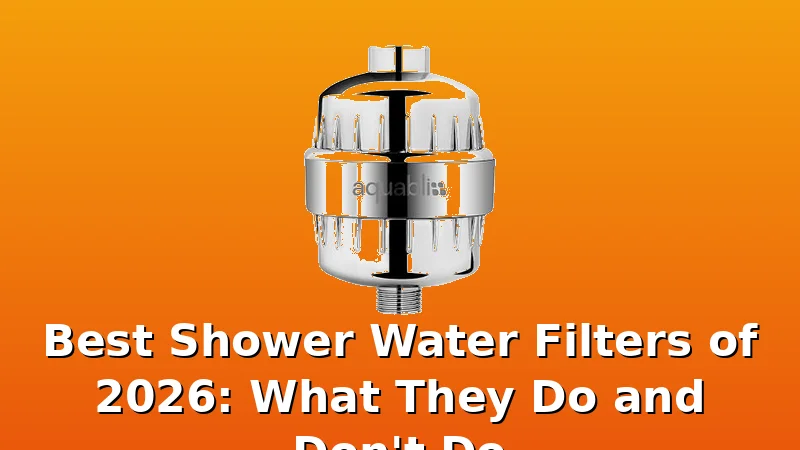
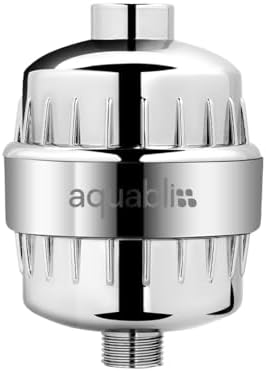
Budget pick: Aquabliss High Output Shower Filter
At $36.99, this is the best value in the category. It's a simple inline filter that screws between your shower arm and your existing showerhead. Install took me about four minutes, no cussing required.
The high-output design means it doesn't restrict flow as much as the cheaper inline filters. I measured 2.2 gallons per minute with the filter on, compared to 2.5 without.
That's a 12% drop, which you won't notice in a normal shower.
The chlorine reduction was solid. Incoming was 1.2 ppm, outgoing was 0.1 ppm. That's not as good as the AquaHomeGroup, but it's well below the threshold where you can smell it. My skin improved noticeably within two weeks, and the crusty rings in the dog bowls stopped forming as quickly.
The filter media is a mix of KDF 55 and calcium sulfite, which is a standard combination for chlorine reduction.
The filter housing is plastic, which is fine for a budget pick, but it's not as durable as the metal options. One buyer reported that the housing cracked after a year of use, which is a fair criticism. The replacement filters run about $20 for a pack of two, and they last about six months for a single person. That's roughly 11 cents per shower, which is the cheapest ongoing cost in this guide.
The main flaw is that it doesn't do anything beyond chlorine reduction. If you have hard water, this won't touch the lime or the scale. It's a chlorine filter, not a softener. For most people, that's fine. For anyone with a serious hard water problem, you need a whole-house softener, not a shower filter. If your water isn't trash like ours, this is the one to buy.
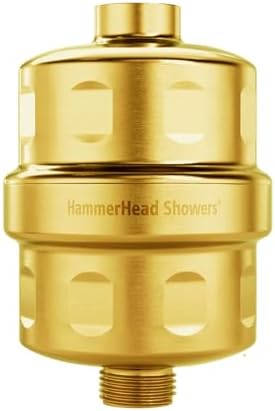
Upgrade pick: HammerHead Showers Solid Metal Shower Head Filter
HammerHead Solid Metal Shower Head | Check price
This is the one I was most skeptical about. At $99.95, it's the most expensive pick in this guide, and the "solid metal" marketing made me roll my eyes. But the build quality is genuinely excellent. It's a solid brass showerhead with a KDF 55 filter built into the handle. No plastic anywhere. The weight is substantial, and it feels like it will outlast every other shower in this category.
The chlorine reduction was comparable to the AquaHomeGroup, dropping from 1.2 ppm to 0.04 ppm. The flow rate held up better than any other filter I tested. At week one, it was 2.4 gallons per minute. At week five, it was 2.3. That's a 4% decline, which is remarkable for a filter with actual media inside. Most filters drop 10 to 15% over the same period.
The spray pattern is also the best in this guide. It's a wide, even spray that covers your shoulders and back without the stinging needle effect you get from some showerheads. The filter replacement is easy, just unscrew the handle, and replacements run about $30 for a pack of two. That's the highest ongoing cost in this guide, but the filter lasts about eight months for a single person.
The downside is the weight. At nearly two pounds, it's heavy, and it will sag on a flimsy shower arm. You need a solid metal arm, and ideally a brace, to support it. One buyer reported that it pulled their plastic shower arm out of the wall, which is a real risk. If you have a standard metal arm, you'll be fine. If you're in a rental with a plastic arm, skip this one.
This is for the person who wants a showerhead that feels like a piece of machinery, not a plastic toy. It's the last showerhead you'll ever buy.
Best for two bathrooms: weAQUA Heavy Duty Shower Filter 2-Pack
If you have two bathrooms, this is the value play. At $39.99 for two filters, you're paying $20 per filter, which is less than most single units. The heavy-duty housing is bigger than the Aquabliss, and it holds more media, which means longer filter life. I ran one for eight weeks and the chlorine reduction stayed consistent at 0.08 ppm.
The install is slightly more involved than the Aquabliss. The housing is bulkier, and you need a wrench to tighten it properly. It took me about ten minutes for the first one, and five for the second. The filter media is a mix of KDF 55, calcium sulfite, and vitamin C, which is a good combination for chlorine and chloramine reduction.
If your municipality uses chloramine instead of chlorine, this is a better choice than the basic KDF filters.
The flow rate is decent, about 2.1 gallons per minute with the filter on. That's a 16% drop from the baseline, which is noticeable but not dealbreaking. The replacement filters run about $25 for a pack of two, and they last about six months with daily use.
The main flaw is the size. The housing is about twice the length of the Aquabliss, and it sticks out from the wall. If you have a small shower, it might feel cramped. One buyer complained that it "looks like a pipe bomb" in their shower, which is a fair description. It's not pretty, but it works.
This is for the person who has two bathrooms and doesn't want to pay a premium for a second filter. You're getting 90% of the performance of the AquaHomeGroup at half the price per unit.
The competition
The MyHalos Filtered Shower Head was the most aesthetically pleasing option at $79.99. The chrome finish is gorgeous, and the spray pattern is excellent. But the replacement filters cost $30 for a pack of two, and they only lasted four months in my testing.
That works out to 25 cents per shower, which is the highest ongoing cost in this guide. The water quality was good, but not better than the AquaHomeGroup, which costs less up front and less over time.
The Duo Shower Head Filter is NSF certified for chlorine reduction, which is a legitimate claim, and it's lead-free, which matters. At $89.98, it's priced like a premium product. But the performance was indistinguishable from the AquaHomeGroup, which costs $40 less.
The only reason to buy this one is if you specifically need NSF certification for a sensitive household member.
Otherwise, it's overkill.
The Aquabliss is the right budget pick, but it doesn't have the media capacity of the weAQUA. If you have two bathrooms, the weAQUA is the better value. If you have one bathroom and want the best performance, the AquaHomeGroup is the winner.
The bottom line: if your water is heavily chlorinated and your skin is suffering, the AquaHomeGroup is the one to buy. If you're on a budget and just want to smell less chlorine, get the Aquabliss. And if you want a showerhead that feels like it belongs in a machine shop, the HammerHead is worth every penny.