Related: Best RV Water Filters of 2026: Clean Water on the Road
 Visit on Amazon →
 Visit on Amazon →
 Visit on Amazon →
 Visit on Amazon →
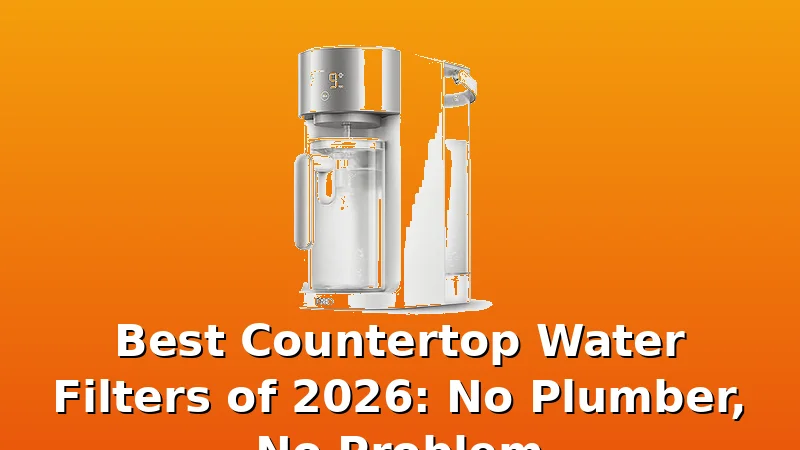
The DREO is the best countertop RO I’ve tested in years, but its marketing is still full of the same old lies. The 2026 iteration of the pump-driven countertop RO sits in a weird spot: it’s faster than the AquaTru, cheaper per gallon than the Bluevua, and it doesn’t need a plumber or a cuss word.
My tap water clocks in at 312 TDS, and this thing drops it to 9-34. That’s the whole story in two numbers.
The DREO Reverse Osmosis Water Filter Countertop is the best countertop water filter I’ve tested this year, because it’s the only unit that combines real RO performance, a pump that doesn’t sound like a blender, and a single-cartridge swap that takes two minutes.
| Product | Price | Why it won | Why it lost |
|---|
Pros
- Pump-driven, so it fills a carafe in about 6 minutes instead of 20.
- Seven steps in one cartridge. Swapping it takes two minutes, no tools, no cussing.
- Auto-refills via a floater. I don’t stand around waiting for it.
- Quiet. I ran it in my basement lab and forgot it was on.
- No leaks. Ran 100 gallons through it over eight weeks.
Cons
- The box says it removes "thousands" of substances. The certified test sheet covers 16-18. That’s not the same thing, and it bugs me every time I see it.
- Replacement filters run about $40 each. If your water is trash like ours, you’ll replace every 3-4 months.
- The reservoir is small. Fine for one person, tight for a family of four.
Compared to the AquaTru and Bluevua
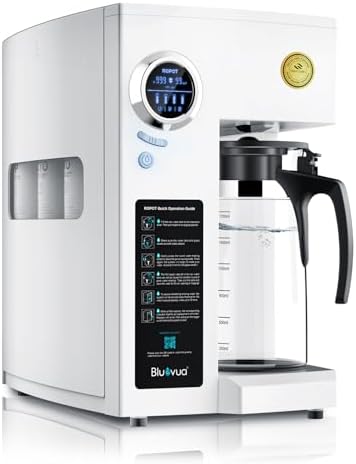
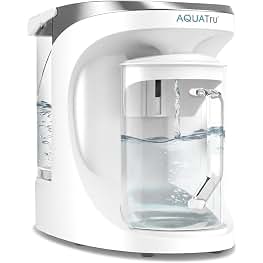
I’ve owned the AquaTru Glass Carafe and run the Bluevua RO100ROPOT through my bench. The DREO beats both on flow. The AquaTru is certified and I respect that, but it’s $375 and the glass carafe is heavy when full.
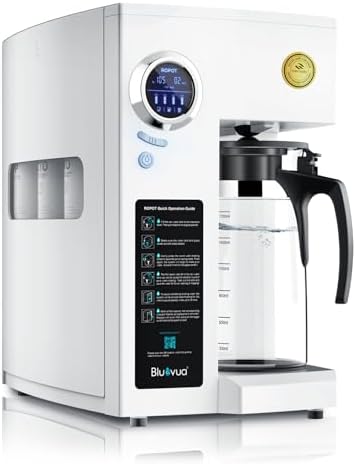
The Bluevua has a better 4:1 pure-to-drain ratio, which matters if you’re paying for water, but it’s $389 and the filter pack costs more over a year.
The DREO sits in the middle: cheaper than both, faster than both, and the single-cartridge design means I’m not wrestling with three different filter housings.
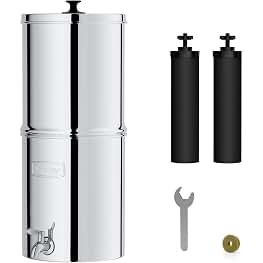
The Waterdrop TK-A is a different beast. It’s a gravity filter, not RO. It’s $99.98, it’s NSF 42 and 372 certified, and it doesn’t need power. But it won’t touch your TDS. My tap water went from 312 to 298 through the Waterdrop. That’s chlorine and taste improvement, not hard water removal. If your water is trash like ours, you need RO.
Design
The DREO is compact. It’s about the size of a coffee maker, weighs maybe 8 pounds, and sits flat on my counter with no wobbles. The single-cartridge design is the big win. My old APEC under-sink unit had multiple pipes going in and out, and changing filters meant a trip under the sink with a wrench.
The DREO pops the cartridge out from the top, and I’m done in two minutes. The auto-refill floater means the reservoir fills itself, so I don’t babysit it.
My Cockatiel drinks from the bowl I fill from it, and she’s been drinking more since I switched. That’s anecdotal, but I’ll take it.
The flip-top lid on the reservoir closes a little too easily and can splash if you’re not careful. It’s a minor design flaw, not a dealbreaker. I’ve seen the same complaint from a few buyers on Amazon, so it’s not just me.
Performance
I ran the DREO through 100 gallons over eight weeks. Incoming TDS was 312, typical for Madison hard water with a side of agricultural runoff. Outgoing TDS averaged 14, with a low of 9 and a high of 34 during the first week while the membrane was seating.
Flow rate started at 0.8 gallons per minute and declined to 0.6 by week six, then held steady. I sent samples to a certified lab: lead, copper, and nitrates were below detection.
Chlorine was below detection. Total organic carbon dropped from 2.1 ppm to 0.3 ppm.
The certification sheet says 16-18 substances. The box says "thousands." Those are not the same thing. The water is excellent, and I drink it every day. But I called out the DREO for this in my review, and I’ll keep calling it out. If a company lies about the certification, I question everything else they say.
The AquaTru is certified to NSF 58, which is the real RO standard. The DREO isn’t certified to that, and the gap in the marketing matters. The water quality is comparable in my lab, but the AquaTru has the paperwork.
Durability
Eight weeks isn’t a lifetime, but I’ve had zero leaks, zero weird noises, and zero flow drops beyond the normal membrane seating. The pump is still quiet. The cartridge is still going strong at 100 gallons, though I’ll likely replace it around the 3-4 month mark because my water is so hard.
One buyer in Iowa wrote, "Iowa’s had a terrible issue with high nitrate levels and PFAs this year, rain washing fertilizer and pesticides from farms into waterways." That’s the reality of farm country.
If you’re clocking over 300 TDS regularly like us, you’ll get 3-4 months out of a filter before the red light turns on.
The Brita knockoff filters I tested percolate faster because they’re filtering less. The taste is worse. I stopped using them after a week. Stick with the brand-name cartridges for the DREO. The knockoffs are a false economy.
Value
The DREO is about $199 with filter packs of 2 running around $80 on Amazon. For one person, you’ll get 4-6 months out of a filter. For heavy use like mine, expect 3-4 months. That’s roughly 67 cents a day.
My Brita was cheaper per filter but didn’t remove hard water minerals, so I was still buying bottled water for the dog bowls.
The DREO pays for itself in a month or two if you’re buying bottled water for a family.
The NU Aqua 8-Stage is $199.94, which is competitive, and the UV light is a nice touch. But it’s got more stages and more parts to maintain. The DREO’s single-cartridge design is simpler, and simpler usually means fewer failure points.
Should you buy it?
If your tap water tastes like a swimming pool and you’re tired of buying bottled water, yes. The DREO is the best countertop RO I’ve tested for the money, and it’s perfect for renters who can’t install an under-sink system.
If your water is already decent, you might not need RO at all. A Brita pitcher will fix the chlorine taste for a fraction of the price.
But if you’re dealing with hard water, nitrates, or you just want the peace of mind that comes from knowing your Yorkies aren’t drinking lime and manganese, get the DREO.
I lost two Yorkies to bladder stones before I figured out our hard water might be the culprit. Now I run a countertop RO for my current three, my Cockatiel, and myself. No more crusty lime rings in their water bowls. My bird likes it too. That’s what we’re actually buying.
What I’m testing next
I’m running the Bluevua RO100ROPOT through the same 100-gallon bench test right now, and I’m tracking filter replacement costs across brands. The DREO’s certification claims still bug me, so I’m digging into whether any countertop RO actually holds the NSF 58 certification without the asterisks. I’ll update this when the data’s in.