Most people start shopping for a water filter because the tap water tastes wrong, and they end up buried in claims that never name a single contaminant. That is the gap this guide fills. Below are six systems: a 10-cup pitcher, a refrigerator cartridge, two under-sink units, and two countertop reverse osmosis water filter systems. They are compared on the things that decide whether you keep using one after the novelty wears off, meaning what each model is certified to remove, how long its filter lasts, how much room it takes, and how often it asks for attention.
A word on labels before the list. A certification listing means a specific model was tested against a specific standard. NSF/ANSI 42 covers taste and chlorine reduction, 53 covers health contaminants such as lead, 58 covers reverse osmosis systems, and 372 covers lead-free materials. The number is the proof. "Tested to NSF standards" with no number attached is a sentence, not a certification, and any filter claiming to remove "everything" without listing what everything includes should be read the same way.
Related: How to Read an NSF Certification Number on a Water Filter
Quick answer
The CT910G Countertop Reverse Osmosis Water Filter System is the strongest fit for a kitchen that wants broad dissolved-solids reduction without hiring a plumber, because it carries NSF/ANSI 42, 58, and 372 listings and installs by sitting on the counter. Choose the CuZn UC-200 Under Sink Water Filter instead when you want the hardware hidden in the cabinet and a five-year filter life.
Water filters worth comparing
Filtration is not one category. It is four, and they solve different problems at different levels of commitment.
A pitcher is the lowest-commitment option. You fill it, you wait, you pour. The ZeroWater 10-cup model targets dissolved solids and names PFOA and PFAS reduction, which places it in a different class from carbon-only pitchers that mostly polish taste.
A refrigerator cartridge is the filter you may already own without thinking of it as one. The everydrop by Whirlpool Filter 1 is a drop-in replacement for compatible Whirlpool and Maytag refrigerators, and it treats the water and ice you were going to use anyway. Convenience is the entire pitch, and it is a fair pitch.
Under-sink systems hide the hardware and feed a dedicated faucet or a filtered line. The CuZn UC-200 leans on a five-year filter life, while the Waterdrop 10UA is NSF/ANSI 42 certified with a one-year filter. Both trade a one-time installation for daily convenience.
Countertop reverse osmosis is the category that has changed the most. RO pushes water through a membrane and strips dissolved solids toward near zero, which is why it is the format people choose when TDS, PFAS, or heavy metals are the concern rather than chlorine alone. The Bluevua RO100ROPOT and the CT910G both bring RO to a countertop with no plumbing work.
Across all four formats, four things are worth comparing: the certification numbers on the label, the rated filter life, the footprint, and the replacement cadence. Everything else is decoration.
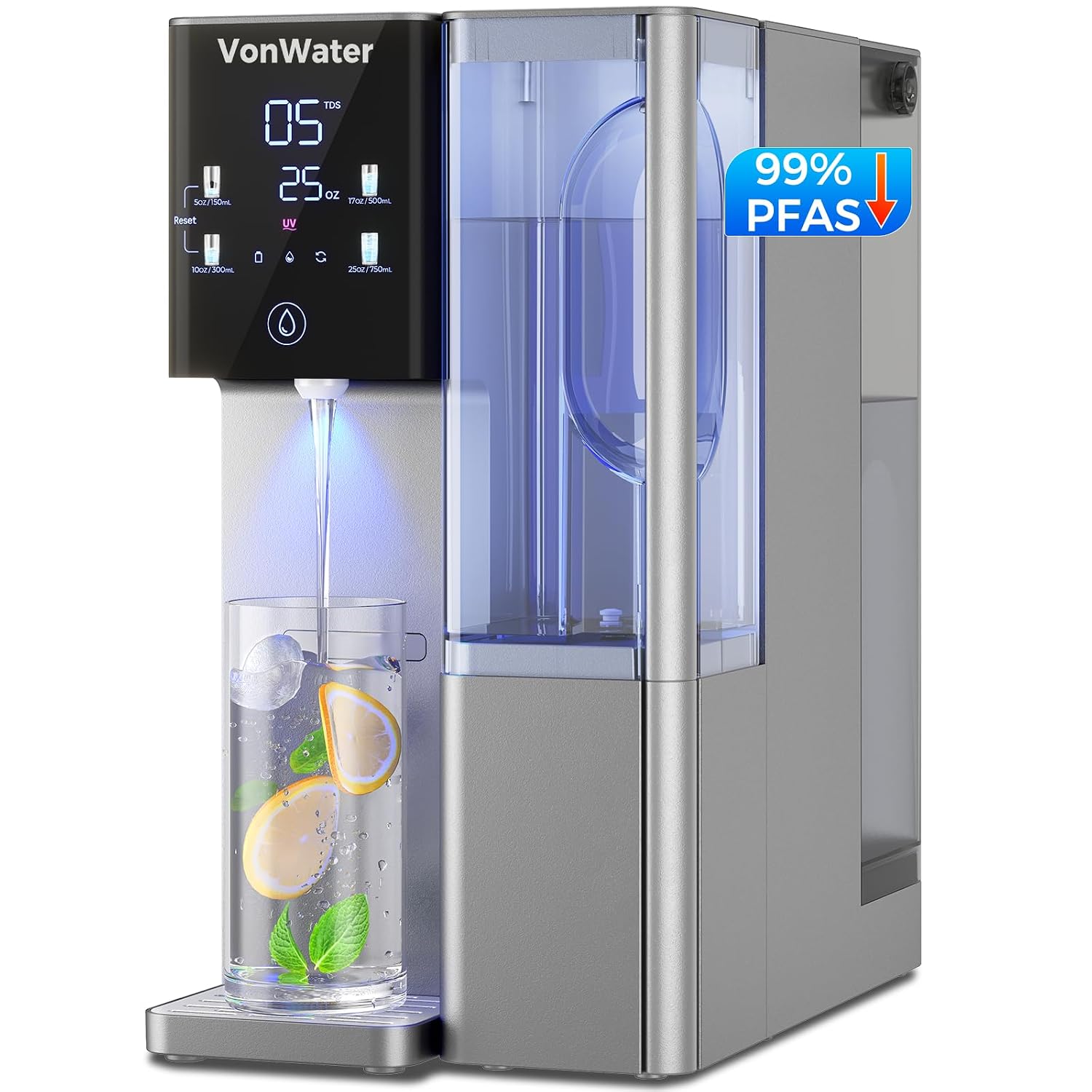
CT910G Countertop Reverse Osmosis Water Filter System, 7-Stage RO Water Filtration System, 528 Gallons Water Dispenser, 3:1 Pure to Drain, NSF 372,42,58, Reduce TDS PFAS, No Installation
Seven-stage countertop reverse osmosis system with a 528-gallon rated capacity and a listed 3:1 pure-to-drain ratio. Lists NSF/ANSI 372, 42, and 58, names TDS and PFAS reduction, and needs no installation.
Visit on Amazon
CuZn UC-200 Under Sink Water Filter, NSF/ANSI 42 & 372, 5-Year Filter Life
Under-sink water filter listing NSF/ANSI 42 and 372 with a five-year filter life, built for households that want the hardware hidden and a long replacement interval.
Visit on Amazon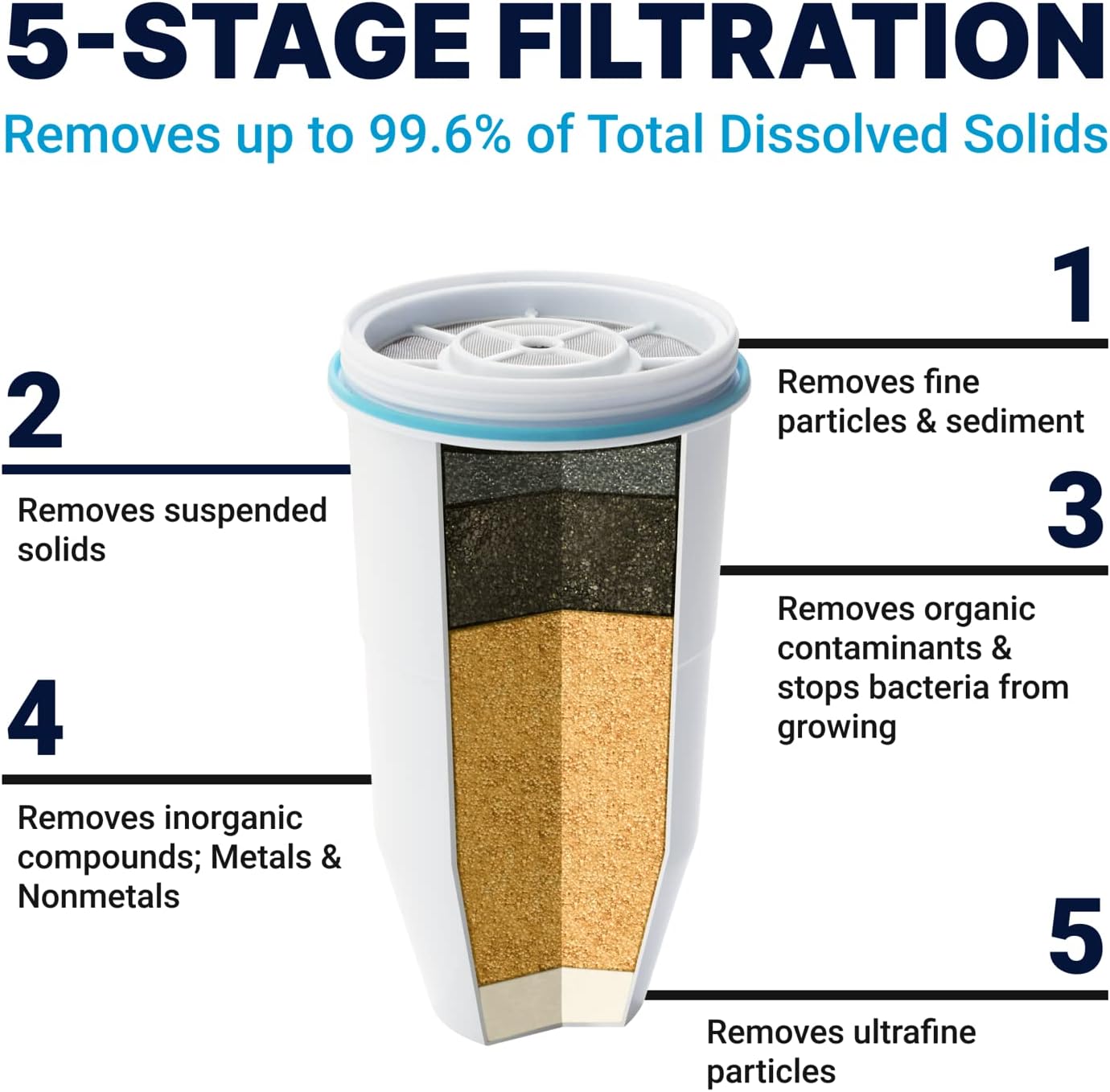
ZeroWater 10-Cup Pitcher Water Filter Removes PFOA/PFAS
Ten-cup pitcher that targets dissolved solids and names PFOA and PFAS reduction, with no installation and no countertop machine required.
Visit on Amazon
everydrop by Whirlpool Ice & Water Refrigerator Filter 1, Purple, EDR1RXD1
Drop-in ice and water refrigerator filter for compatible Whirlpool and Maytag models, replacing the cartridge your refrigerator already uses.
Visit on Amazon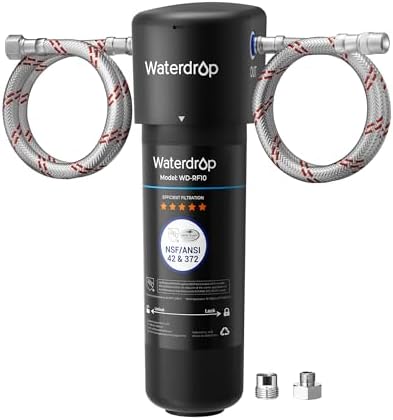
Waterdrop 10UA Under Sink Water Filter System, NSF/ANSI 42 Certified 1 Year
Under-sink water filter system carrying NSF/ANSI 42 certification with a one-year filter, for a dedicated filtered line below the counter.
Visit on Amazon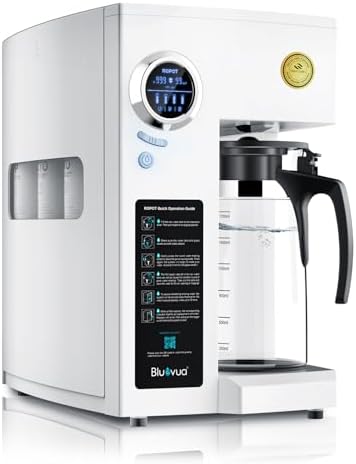
Bluevua RO100ROPOT Countertop Reverse Osmosis Water Filter System
Countertop reverse osmosis system that brings membrane filtration to the counter with no plumbing work, for buyers who want dissolved-solids reduction without an under-sink install.
Visit on AmazonPrices and availability may change. Check the retailer for current details.
How these products were compared
This guide compares filtration format, NSF certification listings, rated filter life and replacement cadence, installation requirements and footprint, and the contaminants each product's own documentation names. Product names, images, and retailer links are matched by product record so that every card points to the product shown.
Two things this guide will not do. It will not quote a price, because prices move and the link is the honest source. And it will not stretch a certification to cover more than it does. NSF/ANSI 42 is a taste and chlorine standard. If lead is the concern, look for 53 or for an RO membrane, and do not assume a 42 listing means either.
How to choose the right water filter
Start with what you want removed, not with the format. If the complaint is taste and odor, a certified carbon filter is enough, and a pitcher or an under-sink unit handles it. If the complaint is dissolved solids, a TDS number that bothers you, or a hard-water feel, you want a membrane, which means reverse osmosis. If the complaint is a specific health contaminant such as lead, read the certification number on the exact model and confirm that the standard behind it covers that contaminant.
Then work out space and maintenance. Under-sink systems disappear, which is their whole advantage, but they need cabinet room and a connection. Countertop RO units need neither, but they occupy counter space permanently and they need somewhere to send the drain water. A pitcher needs a shelf in the refrigerator and a refill every time somebody empties it. A refrigerator cartridge needs nothing beyond a replacement now and then, provided your refrigerator takes that model.
The third question is the one almost nobody asks before buying: what does the replacement filter cost per gallon, and how often will you actually change it? A cheap device with a costly proprietary cartridge is not a cheap device. A long-life cartridge you never replace on schedule is not a long-life cartridge either. Find the replacement part number and its price before you buy the machine, not after.
Settle the certification question first, because it decides which products are even eligible for your kitchen. The rest is fitting.
CT910G Countertop Reverse Osmosis Water Filter System
The top pick here is a seven-stage countertop reverse osmosis system that needs no installation at all. It lists NSF/ANSI 372, 42, and 58, which covers lead-free materials, taste and chlorine reduction, and the reverse osmosis standard itself, and its documentation names TDS and PFAS reduction. It carries a 528-gallon rated capacity and a listed 3:1 pure-to-drain ratio, meaning the unit is designed to send three gallons of treated water to the dispenser for every gallon that goes to drain, a comparatively efficient ratio for a residential RO system.
The trade-offs are the ones that come with every countertop RO unit. It lives on the counter, so it needs a permanent spot and a power source, and it produces a small stream of drain water that has to go somewhere. RO also strips dissolved minerals along with the contaminants, which is the point for some buyers and a downside for others. Finally, RO systems have more parts than a carbon filter, and more parts mean a longer list of consumables to track over the life of the unit.
For a renter, or for anyone unwilling to cut into a supply line, that is still a strong trade.
Alternatives to consider
The CuZn UC-200 Under Sink Water Filter is better suited to a household that wants the hardware out of sight and a long service interval, since it lists NSF/ANSI 42 and 372 and a five-year filter life. The ZeroWater 10-Cup Pitcher Water Filter is a stronger fit when you rent, move often, or want dissolved-solids reduction with no installation and no countertop machine.
The everydrop by Whirlpool Ice & Water Refrigerator Filter 1, the Waterdrop 10UA Under Sink Water Filter System, and the Bluevua RO100ROPOT Countertop Reverse Osmosis Water Filter System cover the rest of the ground: a drop-in cartridge for compatible refrigerators, a one-year NSF/ANSI 42 certified under-sink option, and a second countertop RO design for buyers who prefer that unit's layout.
Day-to-day use and maintenance
Every filter on this list is a consumable wearing a housing. The single most useful habit is to write the install date on the filter or in your phone the day you put it in, because replacement schedules are the difference between a working filter and a decorative one. When media exhausts, contaminants begin passing through, and nothing about the water will tell you it has happened.
For the countertop RO units, add a couple of steps. Keep an eye on the drain line and the dispenser, and check the rated capacity against your household's daily use so you know roughly how often the membrane and pre-filters come due. For under-sink systems, note the cartridge count before installation, since some units use a single filter and others use a stack. For pitchers, keep the reservoir clean and store it cold. For refrigerator cartridges, replace on the manufacturer's interval even if the water still tastes fine.
If you want a simple performance check, a basic TDS meter tells you whether a membrane or a dissolved-solids pitcher is still doing its job. It will not tell you whether a carbon filter is still removing chlorine or lead, so treat it as one signal among several rather than as a verdict.
Buying checklist
- Measure the counter, cabinet, and refrigerator space, plus the clearance needed to lift a reservoir or twist out a cartridge.
- Choose the certification standard based on what you actually need removed, not on the largest number printed on the box.
- Confirm that the exact model includes the certification you are relying on, and for refrigerator cartridges, confirm compatibility with your refrigerator's model number.
- Read the cleaning and maintenance instructions before the first use.
- Verify the current retailer price, availability, and return terms through the retailer link.
Final recommendation
Choose the CT910G Countertop Reverse Osmosis Water Filter System when you want broad dissolved-solids reduction, listed NSF/ANSI 42, 58, and 372 coverage, and no installation work, and you have counter space to give it. Choose the CuZn UC-200 Under Sink Water Filter when you would rather hide the filter in the cabinet and stretch replacements over years instead of months. If taste is the only problem, any certified carbon option here will solve it, and the pitcher is the cheapest way to find out whether you will actually keep up with a filter at all.